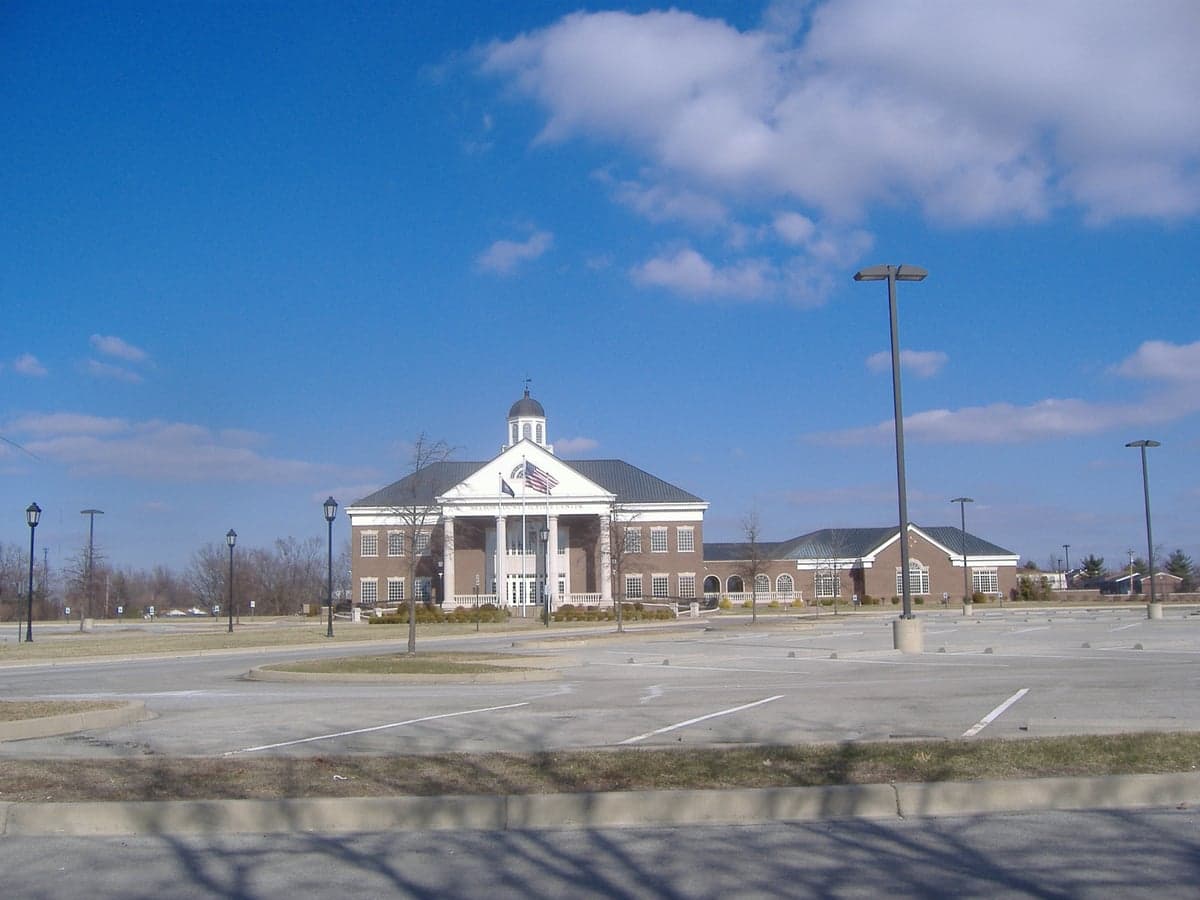
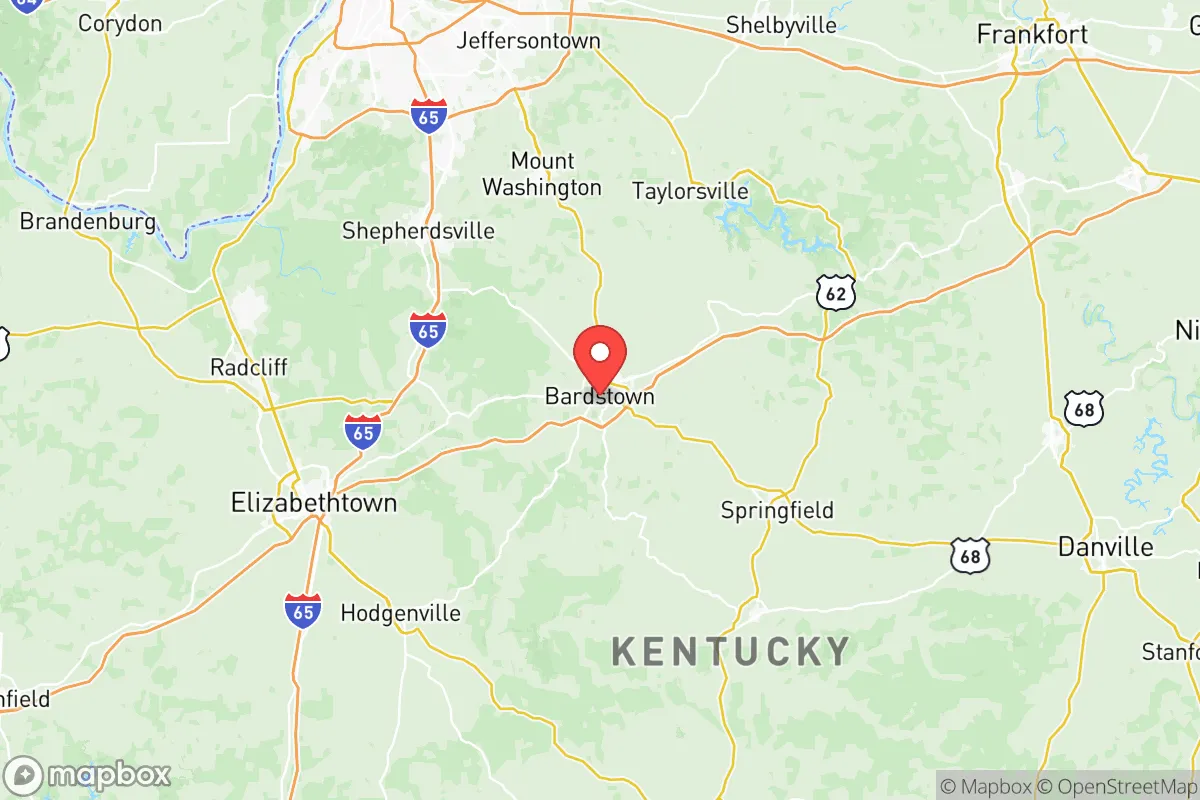
Photo: Wikipedia
Demographics of Nelson County
Affluence Level in Nelson County
A middle-class area roughly in line with national averages across income, home values, education, and employment.
People of Nelson County
Nelson County, Kentucky, is a predominantly white, rural community of 47,102 residents where a deep Catholic heritage, bourbon-distilling tradition, and small-town agrarian character define daily life. With a population that is 89.5% white and only 1.4% foreign-born, the county remains one of the least ethnically diverse in the Bluegrass region, though a small but established Black community (5.1%) and a growing Hispanic population (2.7%) are slowly reshaping its demographic profile. The county seat of Bardstown, known as the "Bourbon Capital of the World," anchors a county where 22.8% of adults hold a college degree, a figure below the national average that reflects the area's strong manufacturing, distilling, and agricultural employment base. For families and individuals seeking a place with deep historical roots, low crime, and a conservative social fabric, Nelson County offers a stable, slow-changing environment where tradition still carries weight.
Settlement & growth (pre-1960)
Long before European settlers arrived, the region that is now Nelson County was inhabited by the Shawnee and Cherokee peoples, who used the Salt River and its tributaries as hunting and travel corridors. The area was part of the vast Kentucky hunting grounds contested by multiple Native nations, with no permanent Native settlements within the county's modern boundaries. French fur traders and Catholic missionaries passed through the region in the early 1700s, but the first permanent European settlement did not begin until after the American Revolution.
The county was formed in 1784 from a portion of Jefferson County, named after Virginia governor Thomas Nelson Jr. The earliest white settlers were overwhelmingly of Scots-Irish and English descent, migrating from Virginia, Maryland, and Pennsylvania via the Wilderness Road in the 1780s and 1790s. These pioneer families were drawn by the promise of fertile limestone-soil farmland and the opportunity to grow tobacco and hemp. Bardstown, founded in 1780, became the county's first and most important settlement, serving as a regional trading hub and, briefly, the state capital in 1792. The town's location along the Salt River valley made it a natural gathering point for farmers and merchants.
A second, highly distinctive wave arrived in the early 1800s: German Catholic immigrants, primarily from the Rhineland and Bavaria, who were recruited by Bishop Benedict Joseph Flaget to settle the Kentucky frontier. These families founded the communities of Holy Cross (1806), New Haven (1815), and Fairfield (1820), establishing a dense network of Catholic parishes, schools, and monasteries that still define the county's religious landscape. The Abbey of Gethsemani, founded near Bardstown in 1848 by Trappist monks, became a spiritual center for the region and later the home of the influential writer Thomas Merton. By 1850, Nelson County had one of the highest concentrations of German Catholics in the American South, a demographic legacy that persists today in the county's many German surnames and its strong Catholic identity.
The mid-19th century brought a smaller but significant wave of Irish immigrants, who arrived during and after the Great Famine (1845–1852) to work on the Louisville and Nashville Railroad and in the county's growing distilleries. Many settled in Bardstown's "Irish Row" neighborhood and in the railroad town of Boston, a small community along the L&N line. The bourbon industry, which exploded after the Civil War, drew additional workers from the surrounding countryside, but the county's population remained overwhelmingly native-born white through the early 1900s.
The post-Civil War period saw the arrival of freed African Americans, who established small farming communities and neighborhoods in Bardstown and the rural areas around Cox's Creek and Bloomfield. By 1900, Black residents made up roughly 15% of the county's population, a share that has since declined due to out-migration during the Great Migration (1910–1970), when many Black families left for industrial jobs in Louisville, Detroit, and Chicago. The county's Black population today (5.1%) is a fraction of its historical peak, concentrated primarily in Bardstown's West End and in the unincorporated community of New Haven.
From 1900 to 1960, Nelson County's population grew slowly, from roughly 18,000 to 22,000, as the agricultural economy shifted from tobacco to dairy farming and the bourbon industry consolidated into a handful of major distilleries. The county saw little in-migration during the Dust Bowl or World War II, remaining a quiet, homogeneous rural area where German Catholic traditions and Southern Baptist influences coexisted uneasily but peacefully.
Modern era (post-1965)
The 1965 Hart-Cellar Act, which dramatically increased immigration from Asia and Latin America, had a minimal direct impact on Nelson County. The foreign-born population today stands at just 1.4%, far below the national average of 13.7%, and the county's Asian population (0.5%) and Indian population (0.0%) are negligible. The most significant demographic shift since 1965 has been the growth of the Hispanic population, which rose from near zero in 1990 to 2.7% today. This wave is composed primarily of Mexican and Central American immigrants who arrived in the 2000s and 2010s to work in the county's bourbon distilleries, horse farms, and meatpacking plants. Most Hispanic residents live in Bardstown, particularly in the southeastern part of the city near the Heaven Hill and Jim Beam bottling facilities, and in the rural community of New Haven, where a small Spanish-language Catholic mission serves the growing community.
Domestic migration has been more consequential. Since the 1990s, Nelson County has attracted a steady stream of white retirees and remote workers from the Louisville metropolitan area (30 miles north) and from the Rust Belt states of Ohio, Indiana, and Michigan. These newcomers are drawn by the county's lower cost of living, slower pace of life, and the bourbon tourism economy. Bardstown has seen significant suburban-style development along the US 31E and US 150 corridors, with new subdivisions and retail centers catering to these arrivals. The county's population grew by 12% between 2000 and 2020, from 42,000 to 47,000, with most growth concentrated in Bardstown and the bedroom communities of Bloomfield and Fairfield.
Racial and ethnic diversity has increased only modestly. The white share of the population declined from 94% in 2000 to 89.5% in 2024, while the Hispanic share rose from 1.2% to 2.7% and the Black share held steady at around 5%. The county remains one of the least diverse in Kentucky, with no significant Asian, Indian, or Arab communities. The small Black population is aging and concentrated in Bardstown's historic West End, while younger Black residents often leave for Louisville or Lexington after high school due to limited economic opportunities.
The future
Nelson County's population is projected to grow slowly, reaching roughly 50,000 by 2040, driven primarily by continued domestic migration from Louisville and the Rust Belt. The Hispanic population is expected to grow to 4–5% as families already in the county have children and as new immigrants arrive for distillery and agricultural work. The Black population share is likely to remain stable or decline slightly, as out-migration of younger Black residents continues. The county will remain overwhelmingly white, with a foreign-born share unlikely to exceed 3%.
The most significant cultural shift will be the continued suburbanization of Bardstown and its surrounding communities. New subdivisions are spreading into former farmland along the US 31E corridor toward New Haven and along KY 245 toward Bloomfield, bringing in families who commute to Louisville or work in the expanding bourbon tourism sector. This growth is straining the county's infrastructure—particularly its schools, water systems, and roads—but is unlikely to fundamentally alter the county's conservative, Catholic-influenced character. The bourbon industry, which employs roughly 1,500 people directly, will remain the economic and cultural anchor, drawing tourists and new residents alike.
For a family or individual moving to Nelson County now, the area offers a stable, low-diversity, tradition-minded community where Catholic and Protestant churches, local festivals, and a strong sense of place still matter. The county is not becoming more diverse in any meaningful way, and its cultural identity—rooted in German Catholic heritage, bourbon, and small-town life—is likely to persist for decades. Newcomers will find a welcoming but insular community where fitting in means respecting local customs and participating in civic life. The future of Nelson County is not one of dramatic change, but of gradual, managed growth within a deeply established cultural framework.

* Values derived from national, state, county, city and local statistics and may differ in a specific area. Last updated: 2026-07-27T10:00:16.000Z
Narrative content on this page is AI-generated and may contain mistakes. Verify any details that matter before acting on them.
ReloMaps may earn a commission from affiliate links at no extra cost to you.

