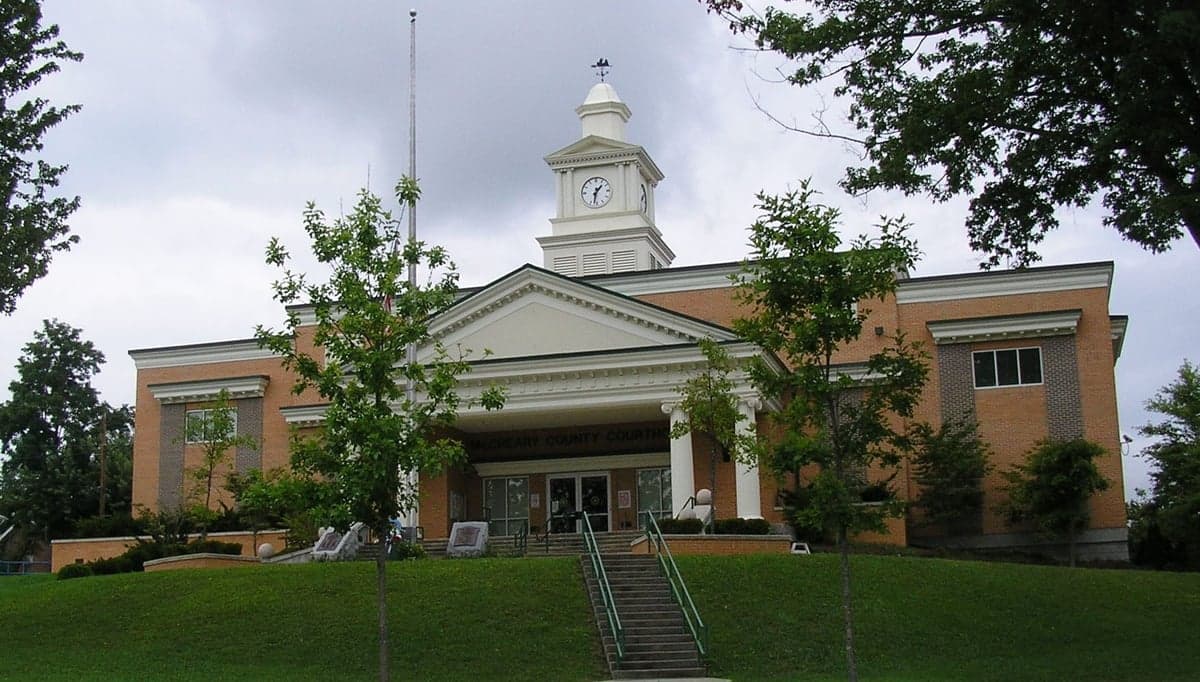
Photo: Wikipedia
Political ClimatePolitical Climate in McCreary County
Showing district-level results — no local-only data available.
Local Political AnalysisPolitical Analysis of McCreary County
McCreary County is one of the most reliably Republican counties in all of Kentucky, with a Cook Partisan Voting Index (PVI) of R+32—meaning it votes about 32 percentage points more Republican than the national average. That’s more than double the statewide Kentucky PVI of R+15, and it’s a lean that has only deepened over the past two decades. In the 2024 presidential election, Donald Trump carried McCreary County with roughly 85% of the vote, a margin that would be jaw-dropping in most of the country but feels almost routine here. The county hasn’t voted for a Democratic presidential candidate since Lyndon B. Johnson in 1964, and even then, it was a narrow win.
How it compares
To understand just how deep red McCreary County is, compare it to the rest of Kentucky. The state as a whole is solidly Republican (R+15), but McCreary is in a different stratosphere. The county’s R+32 PVI puts it in the same league as the most conservative rural counties in the nation. Within McCreary, there’s very little political variation between towns. Stearns, the largest community, votes about as Republican as the county average—typically 82-86% for GOP presidential candidates. Whitley City, the county seat, is slightly more moderate but still reliably red, often hitting around 80% for Republicans. Pine Knot and Marshes Siding are even more conservative, frequently pushing 88-90% GOP. There are no towns that lean blue; the closest thing to a swing precinct is in the Strunk area, where a handful of precincts occasionally dip to 75% Republican—still overwhelmingly red by any national standard. The trajectory is clear: as the national Democratic Party has moved left on cultural and economic issues, McCreary County has only hardened its Republican identity.
What this means for residents
For conservative residents, the political climate is deeply comfortable. Local elected offices—county judge-executive, sheriff, school board—are all held by Republicans, and policy debates tend to focus on tax cuts, Second Amendment rights, and limited government. There’s little pressure to moderate views, and conservative social values are the default in public life. For liberal residents, the reality is more isolating. Being openly progressive in McCreary County can mean feeling like a political outlier in everyday conversations, at community events, or even in local churches. There are no organized Democratic clubs or progressive advocacy groups in the county; the nearest active Democratic Party presence is in Somerset (Pulaski County) or London (Laurel County), about 30-40 minutes away. That said, most residents—regardless of party—share a strong sense of community and self-reliance, and political disagreements rarely fracture personal relationships the way they might in more polarized urban areas.
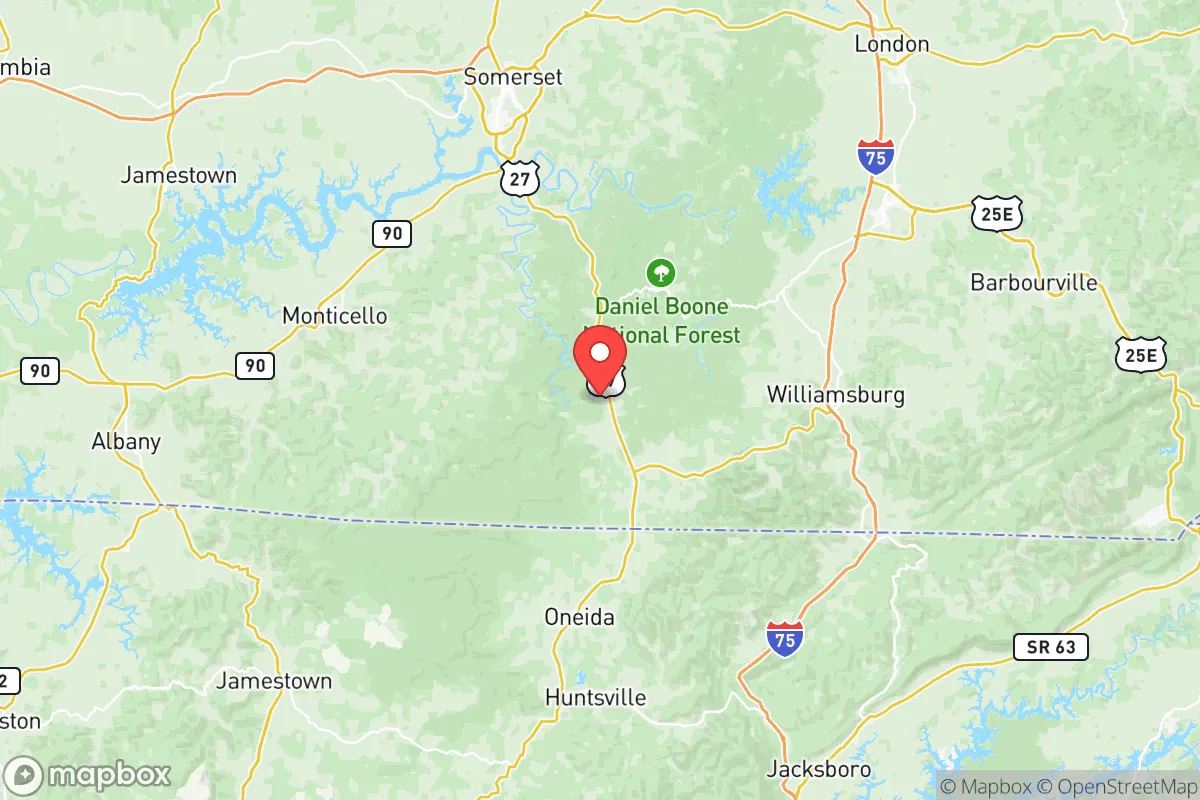
One cultural distinction worth noting: McCreary County sits in the heart of the Daniel Boone National Forest, and its economy has long been tied to timber and tourism rather than coal, unlike many neighboring Appalachian counties. This has shaped a political culture that is less focused on coal-industry protectionism and more on federal land management, hunting rights, and small-business regulation. The county’s deep Republican lean also means that local policy tends to favor low taxes and minimal regulation—there’s no local income tax, and property taxes are among the lowest in the state. For anyone moving here, the political reality is straightforward: you’ll find a community that values tradition, self-sufficiency, and a hands-off government, and you’ll need to be comfortable with that consensus, whether you share it or not.

State Political ClimatePolitical Climate in Kentucky
State Political AnalysisPolitical Environment in the State
Kentucky is a deeply red state with a Cook PVI of R+15, meaning it votes about 15 points more Republican than the national average in presidential elections. The dominant coalition is a mix of rural conservatives, evangelical Christians, and working-class voters who have shifted sharply rightward over the past two decades, while the state’s few urban centers—Louisville and Lexington—remain Democratic strongholds. Over the last 10-20 years, Kentucky has moved from a competitive purple state (it voted for Bill Clinton in 1992 and 1996) to a solidly Republican one, driven by cultural realignment and the decline of the state’s once-powerful Democratic machine in rural areas.
Urban vs. rural divide
The political map of Kentucky is a textbook study in urban-rural polarization. Louisville (Jefferson County) and Lexington (Fayette County) are the two blue anchors, consistently voting Democratic by double digits. Louisville, the state’s largest city, is a diverse, union-heavy metro that reliably delivers 60%+ for Democrats, while Lexington, home to the University of Kentucky, is a more moderate blue area driven by college-educated professionals. The rest of the state is overwhelmingly red. Bowling Green (Warren County) is a growing conservative hub, while Northern Kentucky (Boone, Kenton, Campbell counties) has shifted from swing territory to reliably Republican, fueled by suburban growth and Cincinnati exurbs. The rural counties of Eastern Kentucky—places like Pike, Floyd, and Letcher—were once Democratic strongholds (the “Bluegrass” Democrats) but have flipped hard red, often voting 80%+ Republican in recent cycles. The only notable exception is Frankfort (Franklin County), the state capital, which leans Democratic due to state government workers. This divide means that statewide elections are decided in the rural and exurban areas, not the cities.
Policy environment
Kentucky’s policy environment is solidly conservative, with a low-tax, limited-government posture. The state has a flat income tax that is being phased down from 4.5% to 4.0% by 2026, with a goal of elimination. Property taxes are among the lowest in the nation, and there is no estate tax. The regulatory climate is business-friendly, with right-to-work laws and a tort reform system that caps non-economic damages. On education, Kentucky has a robust school choice movement: the state passed a charter school law in 2017 (though few have opened) and created education opportunity accounts in 2022. Healthcare is a mixed bag—the state expanded Medicaid under the Affordable Care Act in 2014, but the legislature has since imposed work requirements (currently blocked by courts). Election laws have tightened: Kentucky requires a photo ID to vote, and early voting was expanded in 2021 but remains more limited than in many states. The state is also a Second Amendment sanctuary state, with permitless carry passed in 2019.
Recent policy direction
The last five years have seen a clear rightward acceleration. In 2023, the legislature passed a near-total abortion ban with no exceptions for rape or incest, only to save the life of the mother. Gun laws have been loosened: permitless carry (2019) was followed by a law allowing concealed carry on public college campuses (2022). On parental rights, Kentucky passed a “Parents’ Bill of Rights” in 2022 that requires schools to notify parents about curriculum changes and prohibits instruction on sexual orientation and gender identity in elementary grades. The state also banned transgender girls from female sports (2022) and restricted gender-affirming care for minors (2023). On privacy and surveillance, Kentucky has no broad data privacy law, but it did pass a law restricting the use of facial recognition by police in 2021. Property rights are strong, with no statewide zoning mandates and a “right to farm” law protecting agricultural operations. Tax policy is trending downward: the flat tax is being cut, and the state eliminated the corporate inventory tax in 2022. Voting access has been modestly restricted: the 2020 election saw expanded absentee voting due to COVID, but the legislature made those changes permanent only for early voting, not no-excuse absentee.
Civil unrest & political movements
Kentucky has seen its share of political flashpoints. The Breonna Taylor protests in Louisville in 2020 were among the largest in the nation, leading to months of demonstrations, property damage, and a state police takeover of the city’s investigation. The fallout included the passage of “Breonna’s Law” in Louisville, which banned no-knock warrants, but the state legislature has not followed suit. On the right, the “Let Them Play” movement in 2020-2021 saw large protests against COVID-19 school closures and mask mandates, particularly in rural counties and Northern Kentucky. Immigration politics are less visible here than in border states, but there is a small but vocal movement against sanctuary policies—none of which exist in Kentucky. Election integrity controversies flared after 2020, with some rural counties passing resolutions questioning the results, but no major changes to election administration occurred. The state has a history of secessionist rhetoric in Eastern Kentucky, where some counties have floated the idea of joining West Virginia, though this remains fringe. A new resident would notice the prevalence of political signage and flags—especially in rural areas—and the strong presence of evangelical churches in local politics.
Projection
Over the next 5-10 years, Kentucky is likely to become even more Republican, but with a twist. The urban centers of Louisville and Lexington will continue to grow and diversify, making them more Democratic, but the rural and exurban areas are growing faster in terms of political weight. In-migration is modest—Kentucky is not a top destination like Texas or Florida—but the people moving in tend to be retirees and remote workers from the Midwest and Northeast, many of whom are conservative-leaning. The biggest demographic shift is the aging of the population: the state’s median age is 39, and older voters are the most reliable Republican bloc. The flat tax phase-out will likely continue, and the abortion ban will remain in place unless federal law changes. School choice will expand, with more charter schools and voucher-like programs. The biggest wildcard is the opioid crisis and economic recovery in Eastern Kentucky, which could either deepen the region’s conservative populism or, if federal investments in infrastructure and clean energy take hold, create a more moderate electorate. For someone moving in now, expect a state that is reliably red, with a government that is actively conservative on social and economic issues, and a political culture that is polite but deeply divided along urban-rural lines.
For a new resident, the bottom line is straightforward: if you are conservative, you will find a state that aligns with your values on taxes, guns, education, and social issues. If you are liberal, you will find a state where your vote is largely irrelevant in statewide elections, but where you can live comfortably in Louisville or Lexington, which function as blue islands with their own progressive policies. The practical takeaway is that Kentucky is a low-cost, low-regulation state with a stable political environment—but one that is moving decisively rightward, with no signs of reversing course.
* Values derived from national, state, county, city and local statistics and may differ in a specific area. Last updated: 2026-09-14T20:40:30.000Z
Narrative content on this page is AI-generated and may contain mistakes. Verify any details that matter before acting on them.
ReloMaps may earn a commission from affiliate links at no extra cost to you.

