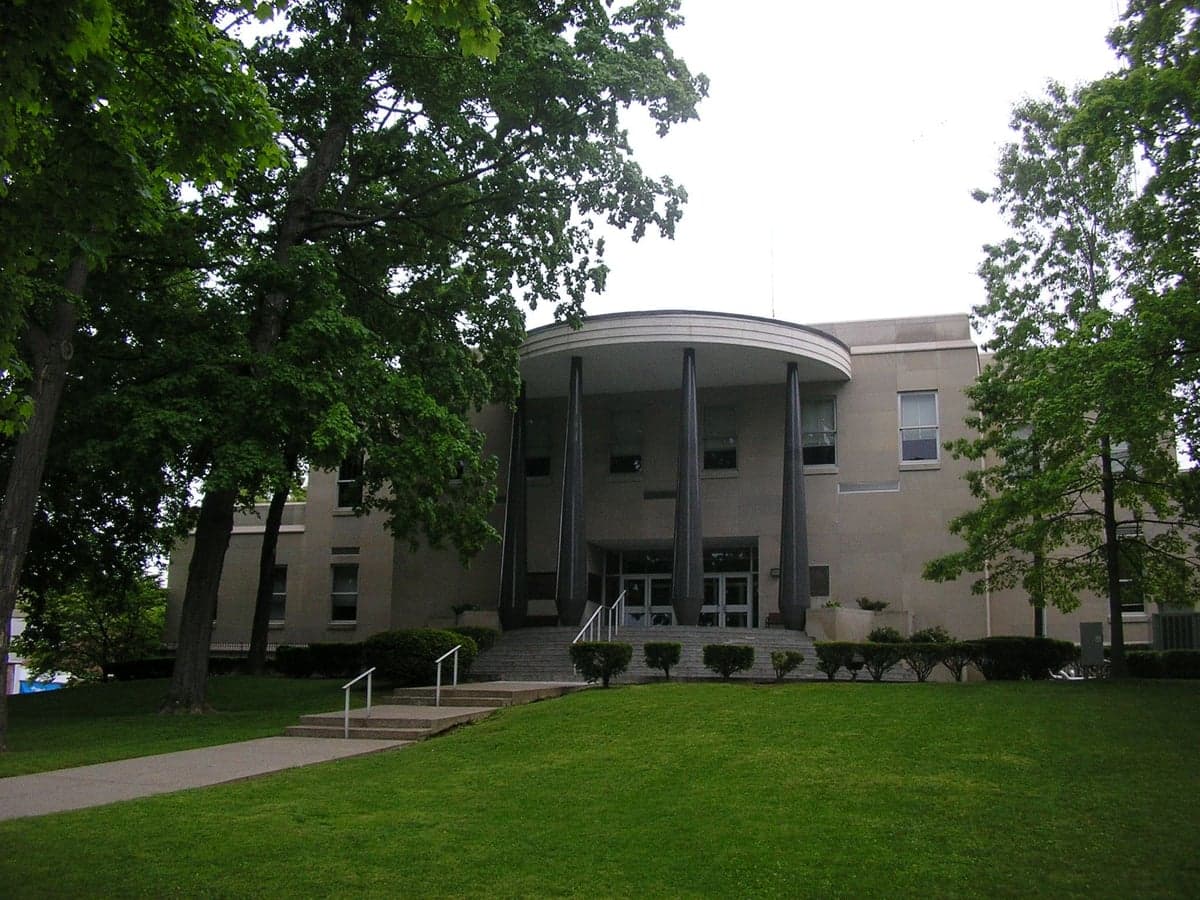
Photo: Wikipedia
Political ClimatePolitical Climate in Henderson County
Showing district-level results — no local-only data available.
Local Political AnalysisPolitical Analysis of Henderson County
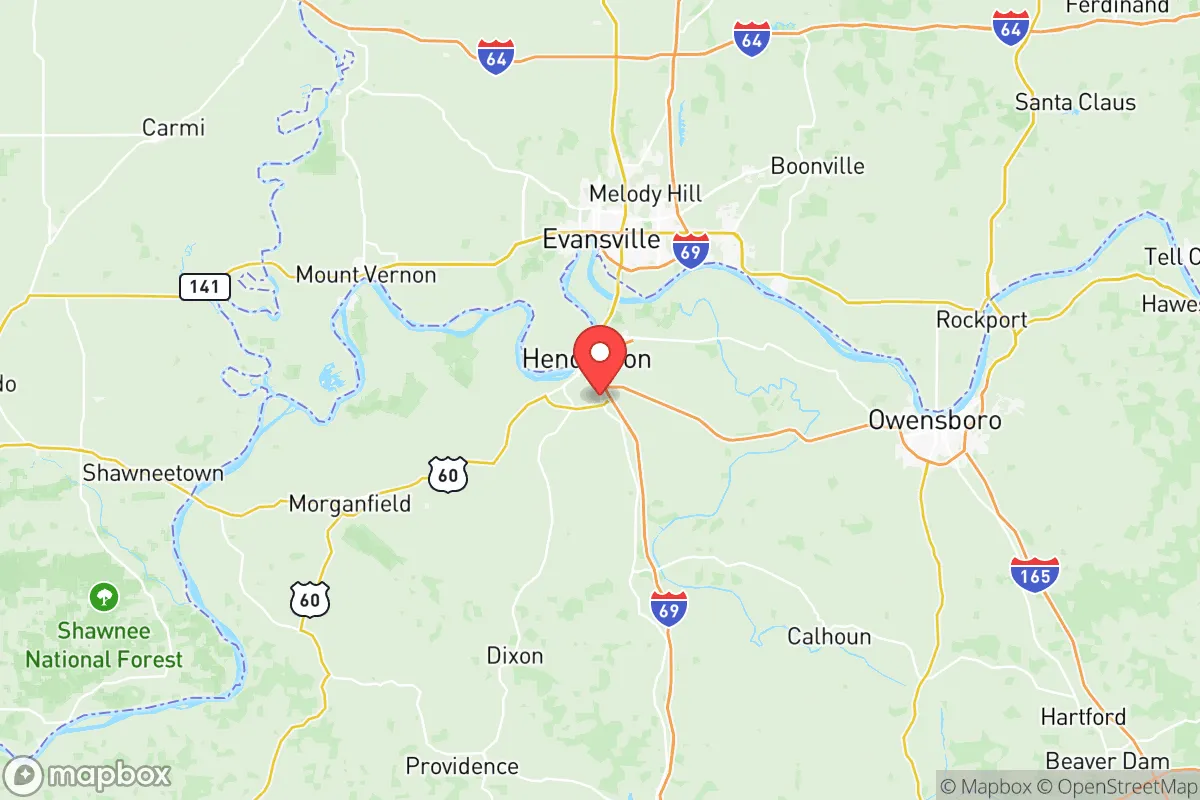
Henderson County, Kentucky, is a reliably Republican stronghold with a Cook Partisan Voting Index (PVI) of R+23, making it significantly more conservative than the state of Kentucky as a whole, which sits at R+15. This isn't a recent shift; the county has been trending red for decades, but the margin has widened noticeably since the 2010s. While the city of Henderson itself, the county seat and largest population center, occasionally shows a more moderate or even slightly blue lean in local races—particularly in precincts around the downtown core and near the riverfront—the surrounding rural areas and smaller towns like Robards, Corydon, and Hebbardsville vote overwhelmingly Republican, often by margins exceeding 70%. The county's trajectory appears to be holding steady, with no signs of a significant swing back toward the center in the near future.
How it compares
The eight-point gap between Henderson County (R+23) and the state of Kentucky (R+15) is substantial and reflects a deeper cultural and economic divide within the Commonwealth. For context, while Kentucky as a whole is solidly red, its PVI is pulled slightly leftward by the Democratic strongholds of Louisville (Jefferson County) and Lexington (Fayette County), as well as a handful of historically union-heavy coal counties in the east that still lean blue. Henderson County, by contrast, sits in the western part of the state, an area that has become increasingly conservative as the old Democratic machine of the "Bluegrass Region" faded. In practice, this means a Republican candidate for statewide office—like the Governor or Senate—can expect to win Henderson County by a comfortable double-digit margin, even if they lose the state overall. For example, in the 2023 gubernatorial race, Republican Daniel Cameron carried Henderson County with 62% of the vote, even as Democrat Andy Beshear won statewide. The county's politics are more aligned with the deep-red rural and exurban counties of Western Kentucky, like Union and Webster, than with the more moderate suburbs of Louisville or the independent streak of Northern Kentucky.
What this means for residents
For conservative residents, the political climate is comfortable and affirming. Local elected offices—from the County Judge-Executive to the school board and most city council seats in Henderson—are held by Republicans, and conservative policy priorities like lower taxes, Second Amendment rights, and limited government regulation are generally reflected in local governance. There is a strong network of Republican women's clubs, conservative churches, and civic organizations that shape community life. For liberal or moderate residents, the reality is more nuanced. While they are a clear minority, they are not marginalized; the city of Henderson, with its riverfront parks, growing arts scene, and a small but active Democratic Party chapter, provides a social and political counterweight. Many liberals find their niche in local advocacy groups focused on education, environmental issues (particularly Ohio River water quality), and social services. The key is that political disagreements rarely become personal; the area's small-town character means people interact across party lines at work, at church, and at community events like the W.C. Handy Blues & Barbecue Festival. The biggest practical impact for liberals is that their votes rarely sway countywide elections, but they can still influence city-level races and school board decisions, especially in the more competitive precincts of Henderson proper.
One cultural distinction worth noting is the county's relationship with the Ohio River and its industrial heritage. Henderson County has a strong union presence, particularly at the Alcoa (now Arconic) plant and in the river barge and logistics industries. This creates an interesting dynamic: many union members vote Republican in national and state elections, but they expect their local representatives to support labor-friendly policies. This pragmatic, "live and let live" attitude is a hallmark of the area's political culture. You won't find the kind of hyper-partisan activism common in suburban battlegrounds; instead, politics here is more about personal relationships and local issues like road funding, industrial recruitment, and flood control. For anyone moving to the area, the advice is simple: your political views are unlikely to cause friction, but you should be prepared for a community where conservative values are the default, and where the most heated debates are more likely to be about the high school football team than about national politics.

State Political ClimatePolitical Climate in Kentucky
State Political AnalysisPolitical Environment in the State
Kentucky is a deeply red state with a Cook PVI of R+15, meaning it votes about 15 points more Republican than the national average in presidential elections, but its political reality is far more layered than that single number suggests. The state has shifted sharply rightward over the past 20 years—in 2000, it was a competitive toss-up, but by 2024, Donald Trump carried it by over 30 points. That trajectory is driven by a collapse of Democratic support in rural areas and small towns, even as the state’s two major metro areas, Louisville and Lexington, remain reliably blue. For a relocator, the practical takeaway is that Kentucky is a state where conservative values dominate state policy, but local politics vary dramatically depending on whether you land in a city, a suburb, or a rural county.
Urban vs. rural divide
The political map of Kentucky is a textbook case of the urban-rural split. Jefferson County (Louisville) and Fayette County (Lexington) are the state’s Democratic strongholds, consistently voting blue by 15-25 points in statewide races. Louisville, the largest city, is a union-heavy, culturally diverse metro that anchors the state’s only reliably Democratic congressional district. Lexington, home to the University of Kentucky, leans left but is slightly more moderate, with a growing tech and healthcare sector. Outside these two islands, the state is overwhelmingly Republican. The suburbs around Louisville—like Oldham County and Shelby County—have trended redder over the past decade, with Oldham County now voting Republican by 40+ points. Meanwhile, rural counties in Eastern Kentucky (e.g., Pike, Floyd, Letcher) were once Democratic strongholds due to unionized coal mining, but they flipped hard to the GOP starting in the 2000s; Pike County, which voted for Al Gore in 2000, gave Trump 78% in 2024. The same pattern holds in Western Kentucky, where counties like Graves and Marshall are deeply red, though the Jackson Purchase region around Paducah retains a few competitive pockets. The only other notable blue dot is Frankfort, the state capital, which leans Democratic due to state government workers.
Policy environment
Kentucky’s policy environment is solidly conservative, shaped by a Republican supermajority in the legislature and a GOP governor (as of 2025). The state has a flat income tax of 4.5%, which is being phased down toward 4% by 2026, and no inheritance tax. Property taxes are among the lowest in the nation, with an average effective rate of 0.83%. Sales tax is 6% on most goods, but groceries and prescription drugs are exempt. The state is a right-to-work state, and it passed a near-total abortion ban in 2022 (trigger law) with no exceptions for rape or incest, only to save the mother’s life. Education policy is a flashpoint: Kentucky has a school choice program (the Education Opportunity Account Act) that allows tax-credit scholarships for private school tuition, but it’s been tied up in court. The state also passed a 2022 law banning transgender girls from female school sports and a 2023 law restricting gender-affirming care for minors. Election laws are moderately restrictive: Kentucky requires a government-issued photo ID to vote, has no-excuse absentee voting (expanded during COVID but made permanent), and has a 28-day early voting window. The state does not have a “stand your ground” law, but it is a “castle doctrine” state with a “duty to retreat” in public spaces—a distinction that matters for self-defense law.
Recent policy direction
Over the past five years, Kentucky has moved decisively to the right on a broad set of issues. In 2023, the legislature overrode Governor Andy Beshear’s veto to pass a bill banning gender-affirming care for minors, a law that is currently being challenged in federal court. On guns, the state passed permitless carry (constitutional carry) in 2019, allowing any adult who can legally own a firearm to carry it concealed without a permit. On education, the 2022 “Parents’ Bill of Rights” (HB 9) requires schools to notify parents of any changes to a student’s health or well-being, including mental health services, and prohibits instruction on sexual orientation or gender identity in elementary school. On taxes, the 2022 tax reform package (HB 8) accelerated the income tax rate cut and expanded the sales tax to some services, including streaming and ride-sharing. On voting, the 2021 law (SB 1) shortened the early voting window from 28 to 14 days and required a photo ID, though it also made Election Day a state holiday. On property rights, Kentucky is a “Dillon’s Rule” state, meaning local governments have limited authority unless explicitly granted by the state—this has been used to block local ordinances on minimum wage, plastic bags, and short-term rentals. On medical and bodily autonomy, the state has a medical cannabis program (signed into law in 2023) that will begin dispensing in 2025, but recreational use remains illegal. On privacy and surveillance, Kentucky has no statewide ban on facial recognition or license plate readers, though some local police departments use them.
Civil unrest & political movements
Kentucky has seen its share of political flashpoints, though large-scale civil unrest is rare. The 2020 protests in Louisville over the death of Breonna Taylor were the most significant, lasting for months and drawing national attention; they led to the passage of “Breonna’s Law,” which bans no-knock warrants in Louisville, but the state legislature has not extended the ban statewide. The state has a small but vocal secessionist movement in Eastern Kentucky, where some residents have floated the idea of joining West Virginia, though it has no political traction. Immigration politics are relatively quiet—Kentucky has no sanctuary cities, and the state passed a 2023 law (SB 1) requiring local law enforcement to cooperate with federal immigration authorities. Election integrity controversies flared in 2020 and 2022, with Republican legislators pushing for audits and tighter ID laws, but no major fraud was found. The state’s most visible political movement is the pro-life and religious conservative coalition, which has been highly effective at passing legislation through the Family Foundation of Kentucky. On the left, the Kentucky Democratic Party is weak and fractured, with most energy concentrated in Louisville and Lexington around racial justice and LGBTQ+ issues.
Projection
Over the next 5-10 years, Kentucky is likely to remain solidly red, but the margins may narrow slightly as Louisville and Lexington continue to grow and attract younger, more diverse populations. In-migration is modest—Kentucky gains about 10,000 net new residents per year, mostly from Ohio, Indiana, and Tennessee—and these movers tend to be conservative-leaning families looking for lower costs and a slower pace. The rural counties will continue to bleed population, which will reduce their political weight over time, but the state’s gerrymandered legislative maps ensure that rural Republicans will hold power well into the 2030s. The biggest wildcard is the state’s healthcare landscape: Kentucky expanded Medicaid under the Affordable Care Act, and about 30% of the population is on Medicaid, so any federal cuts could destabilize the state’s budget and shift political dynamics. On social issues, expect continued battles over abortion, transgender rights, and school choice, with the legislature likely to push further right. The income tax rate will likely drop to 3-4% by 2030, but the sales tax base will expand to cover more services. For a relocator, the bottom line is that Kentucky will be a reliably conservative state for the foreseeable future, but with two blue cities that offer a counterbalance for those who want urban amenities and a more progressive social environment.
For someone moving to Kentucky, the practical takeaway is straightforward: if you’re conservative, you’ll find a state government that aligns with your values on taxes, guns, education, and social issues, with low costs and a welcoming environment for families. If you’re liberal, you’ll find a comfortable home in Louisville or Lexington, where local politics are blue and cultural amenities are strong, but you’ll be living under a state government that is actively hostile to many of your policy preferences. The state’s political trajectory is stable and predictable—more red than a decade ago, and likely to stay that way—so choose your county carefully, because the difference between living in Jefferson County and Pike County is the difference between two different Americas.
* Values derived from national, state, county, city and local statistics and may differ in a specific area. Last updated: 2026-07-08T21:20:39.000Z
Narrative content on this page is AI-generated and may contain mistakes. Verify any details that matter before acting on them.
ReloMaps may earn a commission from affiliate links at no extra cost to you.

