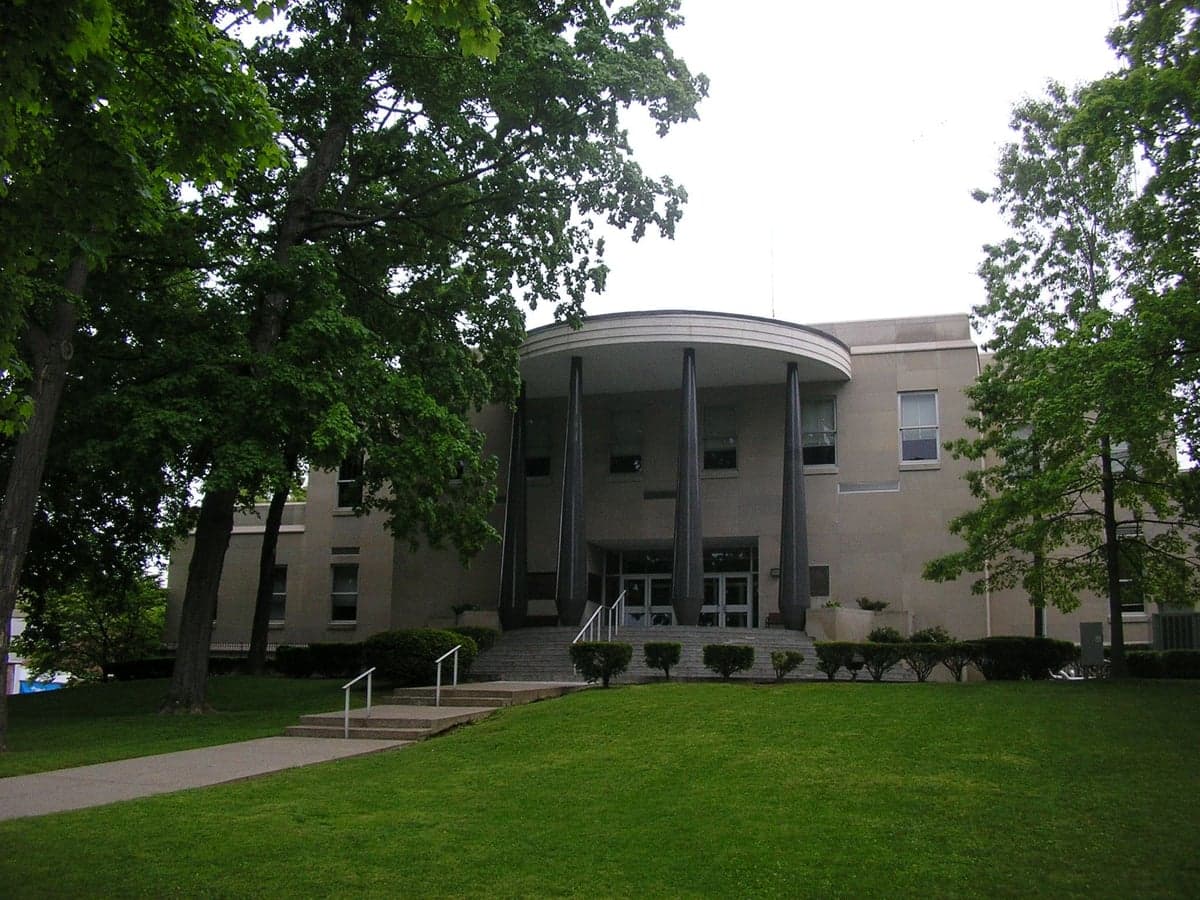
Photo: Wikipedia
Demographics of Henderson County
Affluence Level in Henderson County
A below-average socioeconomic profile. Incomes, home values, and educational attainment trail the U.S., with higher poverty and unemployment.
People of Henderson County
Henderson County, Kentucky, today is a predominantly white, rural community of 44,493 residents, characterized by a deeply rooted sense of place and a slow, steady pace of life. With a foreign-born population of just 0.6% and a college attainment rate of 19.0%, the county is notably less diverse and less educated than the national average, reflecting its historical role as a manufacturing and agricultural hub rather than a destination for new immigrants. The population is concentrated in the county seat of Henderson and the smaller communities of Robards, Corydon, and Hebbardsville, where family ties often stretch back multiple generations, and the cultural identity remains strongly tied to Ohio River commerce, tobacco farming, and a conservative, self-reliant ethos.
Settlement & growth (pre-1960)
Long before European settlers arrived, the area now known as Henderson County was part of the hunting grounds of the Shawnee and other Native nations, who used the Ohio River as a major travel and trade corridor. The region was sparsely populated by indigenous peoples, who were largely displaced following the American Revolution. The first permanent European settlement began in 1797, when the Virginia General Assembly established the town of Henderson, named for Colonel Richard Henderson, the land speculator who had purchased much of Kentucky from the Cherokee in the 1775 Transylvania Purchase. The earliest white settlers were primarily of Scots-Irish and English descent, migrating from Virginia, North Carolina, and Pennsylvania via the Wilderness Road and the Ohio River. They were drawn by the promise of fertile bottomland for tobacco and corn, and by the river's potential for trade.
Throughout the 19th century, the county's population grew steadily, driven by agriculture and river commerce. The arrival of the Louisville and Nashville Railroad in the 1850s connected Henderson to broader markets, spurring the growth of small towns like Robards and Corydon as shipping points for tobacco and grain. The county's economy was heavily reliant on enslaved African American labor before the Civil War; by 1860, enslaved people made up roughly 25% of the population. After Emancipation, many freedmen remained in the area, forming the foundation of the county's Black community, which today stands at 6.8%. They concentrated in Henderson's "Southside" neighborhood and in rural settlements like Hebbardsville, where they worked as sharecroppers and tenant farmers.
The late 19th and early 20th centuries brought a modest wave of German and Irish immigrants, who arrived to work on the railroad and in the growing tobacco and lumber industries. These immigrants largely settled in Henderson proper, where they established small businesses and Catholic parishes. However, the county never experienced the large-scale immigration seen in industrial cities like Louisville or Cincinnati. The Dust Bowl and Great Depression of the 1930s had a muted effect on Henderson County, as its agricultural base was more stable than the Plains states, but it did see a small influx of families from Arkansas and Oklahoma seeking work in the region's tobacco fields and river-related industries. The post-World War II era brought the expansion of manufacturing, with companies like Alcan (now Novelis) opening an aluminum plant in Henderson in the 1950s, attracting workers from surrounding rural areas and solidifying the county's blue-collar character.
Modern era (post-1965)
The 1965 Hart-Cellar Act, which dramatically reshaped U.S. immigration, had virtually no impact on Henderson County. The county's foreign-born population remains at 0.6%, far below the national average, and there are no significant immigrant enclaves. The demographic story of the past 60 years is instead one of domestic out-migration and suburban stagnation. Young adults have consistently left for college and jobs in larger cities like Evansville, Indiana (just across the river), Louisville, and Nashville, leaving an aging population behind. The county's population peaked at around 46,000 in the 1980s and has since declined slightly, with a modest rebound in recent years driven by retirees and remote workers seeking lower housing costs.
The county's racial composition has remained remarkably stable. The white population has held steady at around 84-86% since the 1990s, while the Black population has declined from a post-war high of roughly 10% to its current 6.8%, as younger Black residents have moved to urban centers for better opportunities. The Hispanic population, at 3.2%, is the fastest-growing demographic group, driven by labor demand in agriculture and food processing. These families have concentrated in Henderson and the unincorporated areas around Robards, where they work in tobacco and grain farming, as well as in the county's poultry and pork processing plants. The East/Southeast Asian population (0.2%) and Indian subcontinent population (0.0%) are negligible, reflecting the county's lack of the high-skilled job base or university presence that attracts these groups elsewhere.
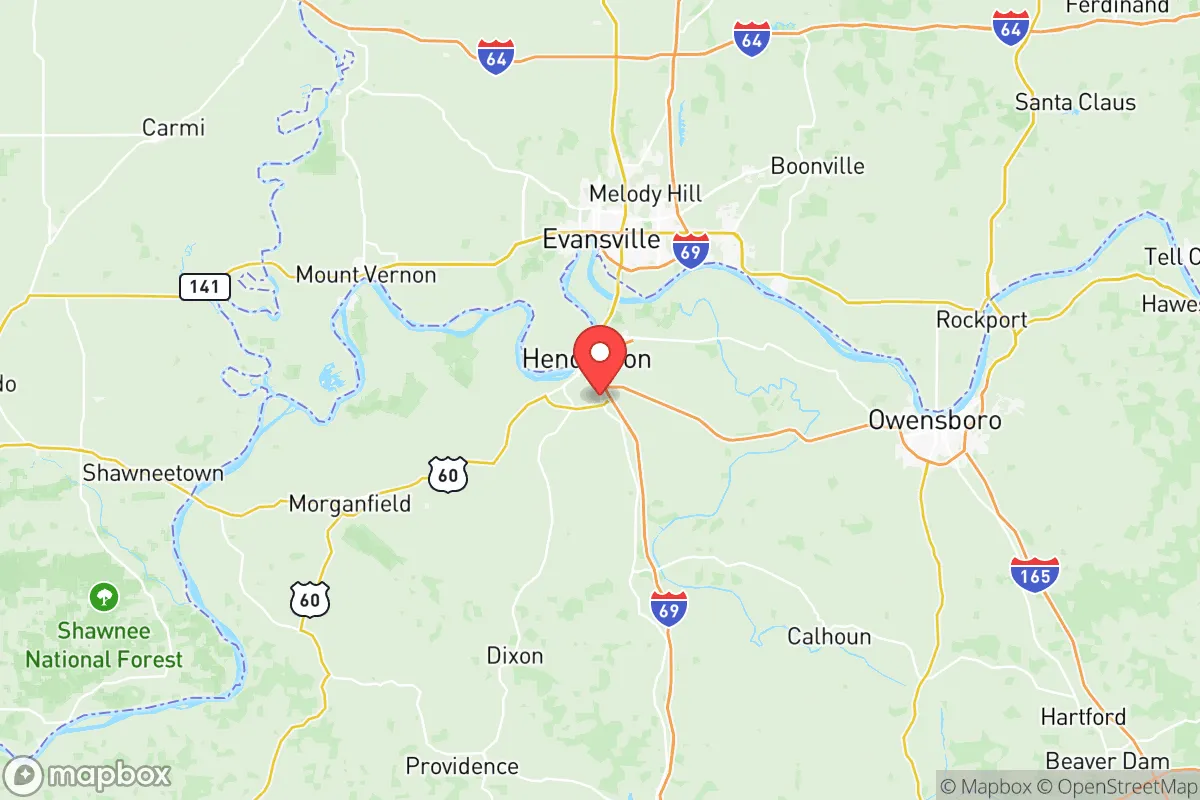
Suburbanization has been limited. Unlike many U.S. counties, Henderson County did not experience a major post-war suburban boom. The city of Henderson itself remains the dominant population center, with a few small subdivisions spreading outward along U.S. 60 and KY 136. The towns of Corydon (population ~700) and Robards (population ~500) have remained small, rural service centers, while Hebbardsville and Niagara are little more than crossroads with a handful of homes. The county's housing stock is older, and new construction has been modest, concentrated in a few subdivisions on Henderson's west side.
The future
Henderson County's population is projected to remain flat or decline slightly over the next 10-20 years, as the aging Baby Boomer cohort passes away and out-migration of young adults continues. The county is not becoming more diverse in any meaningful sense; the Hispanic share may rise to 5-6% over the next decade, but the county will remain overwhelmingly white and native-born. The Black population is likely to continue its slow decline, as younger generations leave for urban areas. There is no evidence of significant new immigrant settlement, and the county's low college attainment rate (19.0%) and limited high-skilled job base make it unlikely to attract the tech or professional workers who are diversifying other parts of Kentucky, such as Lexington or Louisville.
The most likely demographic scenario is a slow, gentle decline, with the population settling around 42,000-43,000 by 2040. The county's cultural identity will remain rooted in its agricultural and manufacturing heritage, with a strong conservative political tilt and a close-knit, family-oriented social fabric. New residents will continue to be primarily domestic migrants—retirees from the Midwest seeking lower taxes, and a trickle of remote workers attracted by cheap housing and the proximity to Evansville's amenities. The county's future is not one of transformation, but of preservation: a quiet, rural community that changes slowly and values its history.
For someone moving in now, Henderson County offers a stable, affordable, and safe environment where community ties are strong and the pace of life is unhurried. It is not a place of rapid growth or demographic change, but rather a place where the past is still present, and where new arrivals are expected to fit into an established, traditional way of life. The county's population story is one of continuity, not change—a fact that will appeal to those seeking roots, but may frustrate those looking for diversity or dynamism.

* Values derived from national, state, county, city and local statistics and may differ in a specific area. Last updated: 2026-07-08T21:20:39.000Z
Narrative content on this page is AI-generated and may contain mistakes. Verify any details that matter before acting on them.
ReloMaps may earn a commission from affiliate links at no extra cost to you.

