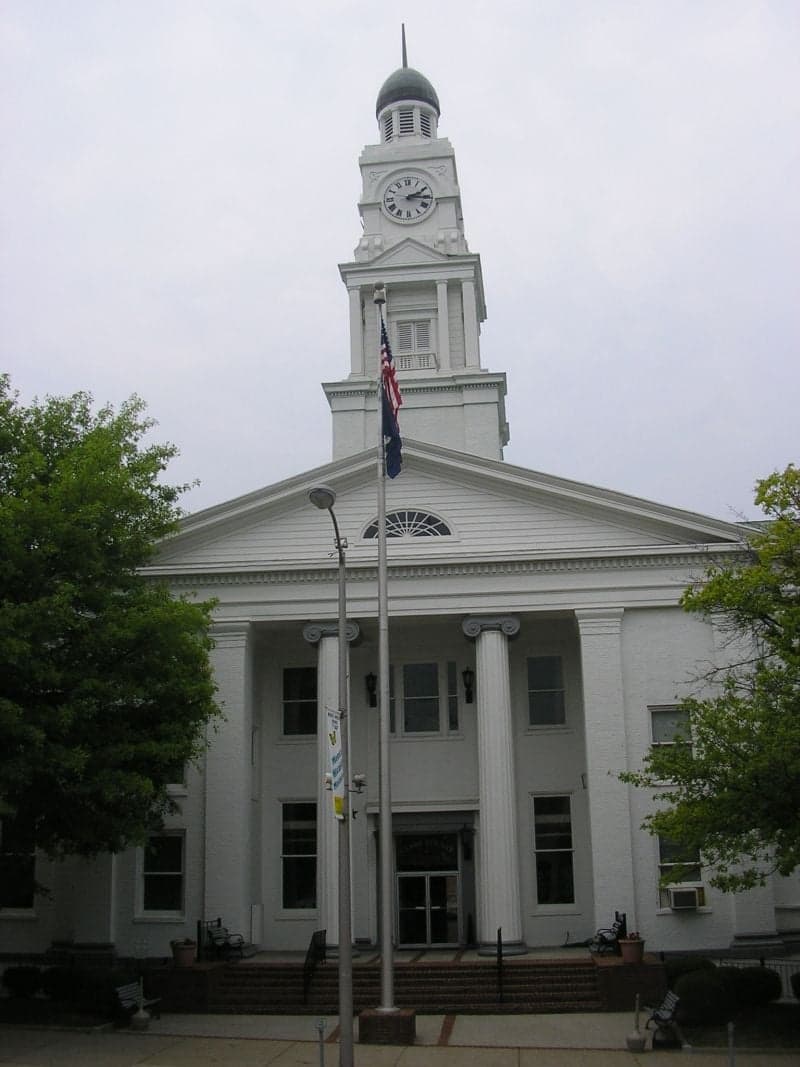
Photo: Wikipedia
Political ClimatePolitical Climate in Clark County
Showing district-level results — no local-only data available.
Local Political AnalysisPolitical Analysis of Clark County
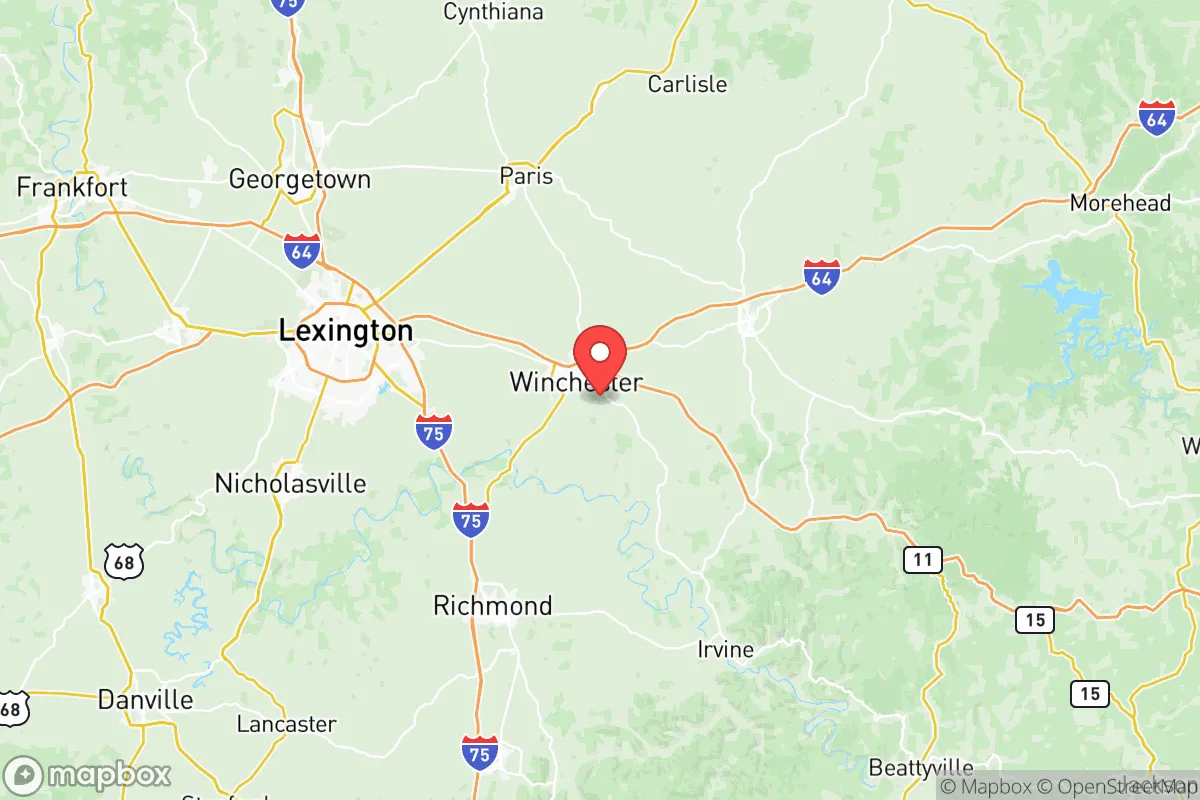
Clark County, Kentucky, is a reliably Republican area with a Cook PVI of R+7, but it's noticeably less conservative than the rest of the state, which sits at R+15. This means that while the county hasn't voted for a Democratic presidential candidate since 1996, it's not a deep-red stronghold either—it's more of a "lean red" place where local races can be genuinely competitive. The county's political center of gravity is Winchester, the county seat, which tends to be the most moderate part of the county, while the rural areas and smaller communities like Ford and Pilot View lean heavily Republican. Over the past decade, the county has shifted rightward, but at a slower pace than much of rural Kentucky, largely because of the growing influence of Winchester's more diverse economy and its proximity to Lexington.
How it compares
Compared to Kentucky as a whole, Clark County is a swingier version of the state's political landscape. The state's R+15 PVI reflects deep Republican dominance in places like eastern Kentucky's coal counties and western Kentucky's rural areas, where margins often exceed 40 points. Clark County's R+7 rating puts it closer to the national average, meaning it's more representative of the country's overall political mood than the state is. In the 2024 presidential election, for example, Clark County voted for Donald Trump by about 12 points, while the state as a whole gave him a 30-point margin. The county's urban-rural split is stark: Winchester's precincts near the downtown core and the Kentucky River often vote within 5 points of the national average, while outlying areas like Becknerville and Ruckerville routinely deliver 70-80% Republican margins. This internal variation makes Clark County a bellwether for how suburban and exurban areas are evolving in the Bluegrass region.
What this means for residents
For conservative residents, Clark County feels like a comfortable place where their values are reflected in local policy—the county commission is solidly Republican, and the school board has a conservative majority. But they also live in a county where they can't take victory for granted; local elections often hinge on turnout in Winchester's moderate precincts. For liberal residents, the county is a mixed bag. They're unlikely to see a Democratic majority anytime soon, but they can find community in Winchester, where progressive candidates occasionally win city council seats and where the local Democratic Party is active. The practical reality is that both sides have to engage in coalition-building. A conservative candidate who ignores Winchester's concerns about downtown development or public schools risks losing the county seat, while a liberal candidate who can't connect with rural voters on issues like agriculture or gun rights won't get past the primary.
Culturally, Clark County stands out from the rest of Kentucky in a few key ways. The county's identity is tied to the Winchester-Clark County Industrial Authority, which has successfully recruited manufacturing and logistics jobs, creating a more diverse economic base than the coal-dependent or agriculture-heavy counties elsewhere in the state. This economic diversity has fostered a slightly more pragmatic, less ideological political culture. You'll find fewer "culture war" debates at county commission meetings than in more rural counties, and more focus on infrastructure, industrial recruitment, and the local school system. The presence of Bluegrass Community and Technical College's Winchester campus also brings a steady stream of younger, more moderate residents. That said, the county is still deeply rooted in Kentucky's traditional values—church attendance is high, gun ownership is common, and the annual Winchester-Clark County Fair remains a cornerstone of community life. For anyone moving here, the key takeaway is that Clark County offers a political environment that's conservative but not extreme, where local issues often matter more than national party labels.

State Political ClimatePolitical Climate in Kentucky
State Political AnalysisPolitical Environment in the State
Kentucky is a deeply conservative state with a Cook PVI of R+15, meaning it votes about 15 points more Republican than the national average in presidential elections. The state has shifted sharply rightward over the past two decades: in 2000, it was a competitive swing state that went for George W. Bush by just 4 points, but by 2024, Donald Trump carried it by over 30 points. The dominant coalition is a mix of rural, small-town, and exurban voters who prioritize gun rights, religious liberty, and low taxes, while the state's few urban centers—Louisville, Lexington, and Northern Kentucky—provide the only real Democratic resistance. This isn't a purple state trending blue; it's a red state that's gotten redder, and that trajectory shows no signs of reversing.
Urban vs. rural divide
The political map of Kentucky is a textbook case of the urban-rural split. Jefferson County (Louisville) and Fayette County (Lexington) are the only reliably Democratic strongholds, with Louisville's east end and Lexington's suburbs trending more moderate while the urban cores vote solidly blue. In 2024, Jefferson County went for Kamala Harris by about 12 points, and Fayette County by about 8 points. But outside these two islands, the state is overwhelmingly Republican. The rural west—places like Paducah and Hopkinsville—vote Republican by 30-40 points, while the eastern coal country around Pikeville and Hazard is even more conservative, often exceeding 70% for GOP candidates. The fastest-growing suburban areas, like Bowling Green and Richmond, are reliably red and getting redder. The only real political nuance is in Northern Kentucky's Covington and Newport, which are slightly more competitive due to Cincinnati commuters, but even those counties now lean Republican by 10-15 points. For a new resident, this means your neighbors' politics will depend heavily on whether you're inside the Louisville or Lexington city limits—everywhere else, you'll be in deep red territory.
Policy environment
Kentucky's policy environment is shaped by a Republican supermajority that has controlled both chambers of the legislature since 2017, and a governor's office that flipped from Democrat Andy Beshear to Republican Daniel Cameron in 2023. The state has a flat income tax that was cut from 5% to 4% in 2023, with a scheduled phase-down to 3.5% by 2026. There is no state-level property tax on real estate, though local governments levy their own. The regulatory posture is business-friendly, with right-to-work laws and a tort reform cap on non-economic damages. Education policy has seen a major push for school choice: in 2022, the legislature passed a charter school law (though no charters have opened yet) and created education opportunity accounts that allow tax credits for private school scholarships. Healthcare is a mixed bag: Kentucky expanded Medicaid under the ACA, but the state has imposed work requirements for able-bodied adults, and the legislature has repeatedly blocked Beshear's attempts to expand abortion access. Election laws have tightened: voter ID is required, early voting is limited to three days before the election, and absentee voting requires an excuse. Gun laws are among the most permissive in the nation—constitutional carry passed in 2019, and there is no permit required to carry a concealed firearm.
Recent policy direction
The last five years have seen Kentucky move aggressively in a conservative direction across multiple fronts. On gun rights, the 2019 constitutional carry law was followed by a 2023 law allowing guns in churches and a 2024 law prohibiting local governments from enacting their own gun restrictions—preempting Louisville's attempted assault weapons ban. On parental rights, the 2023 "Don't Say Gay" law prohibits classroom instruction on sexual orientation and gender identity in K-5, and a 2024 law requires schools to notify parents if a child requests a name or pronoun change. On abortion, the state has a near-total ban with exceptions only for life of the mother, rape, and incest (with a 72-hour waiting period for the latter two). On property rights, the legislature passed a 2023 law limiting local zoning authority for short-term rentals like Airbnb. On taxation, the flat income tax cuts are paired with a 2024 law eliminating the state's inheritance tax entirely. On voting, the 2021 voter ID law was followed by a 2024 law requiring all absentee ballots to be notarized. On privacy and surveillance, Kentucky has no statewide data privacy law, but a 2024 law prohibits the use of facial recognition by law enforcement without a warrant. For a relocator, the practical takeaway is that Kentucky is moving toward a model of maximum individual liberty on guns, education, and property, while restricting liberty on abortion and voting access.
Civil unrest & political movements
Kentucky has seen its share of political flashpoints, though they tend to be localized rather than statewide. The 2020 Breonna Taylor protests in Louisville were the most intense, with months of demonstrations, property damage, and a state of emergency declared by the governor. That event galvanized both the Black Lives Matter movement and a counter-movement of pro-police activism, and it directly led to the 2021 passage of "Breonna's Law" banning no-knock warrants statewide. On the right, the state has a strong Second Amendment sanctuary movement—over 60 counties have passed resolutions declaring themselves gun sanctuaries. Immigration politics are less visible than in border states, but there is a small but vocal anti-immigrant faction that has pushed for E-Verify mandates (not yet passed). There is no serious secession or nullification rhetoric in Kentucky, unlike in Texas or California. Election integrity controversies have been muted compared to other states, though the 2020 election saw Trump's legal team challenge results in Jefferson County without success. For a new resident, the most visible political movement you'll encounter is the pro-life activism around pregnancy centers and the pro-gun activism at local gun shows and county fairs—these are mainstream, not fringe, in most of the state.
Projection
Over the next 5-10 years, Kentucky will likely become even more conservative, driven by two demographic trends. First, the state's rural and exurban areas are growing faster than its urban cores—places like Georgetown (home to a Toyota plant) and Elizabethtown (a Fort Knox bedroom community) are adding population while Louisville and Lexington grow slowly. Second, in-migration from blue states like California and Illinois is accelerating, but these newcomers are disproportionately conservative retirees and remote workers seeking lower taxes and gun-friendly laws, not liberal transplants. The Republican supermajority is likely to persist, and the next governor (Cameron) is expected to push for further income tax cuts, a school voucher program, and a ban on gender-affirming care for minors. The only wild card is the state's aging population—Kentucky has one of the oldest median ages in the country, and if younger voters (who lean slightly more Democratic) move in, it could moderate the trend. But for now, the trajectory is clear: Kentucky will be a solidly red state for at least the next decade, with policy continuing to move rightward on guns, education, and taxes.
For a new resident, the bottom line is that Kentucky offers a predictable, stable conservative environment where your rights to own guns, choose your child's school, and keep more of your paycheck are protected by law. If you're liberal, you'll find your political home in Louisville or Lexington, but you'll be a minority voice in the state legislature and in most counties. If you're conservative, you'll feel the state is moving in your direction, with the caveat that the pace of change can feel slow due to the state's budget constraints and the need to balance tax cuts with funding for roads and schools. Either way, Kentucky's politics are not a surprise—they're a reflection of a state that knows what it wants and is steadily getting it.
* Values derived from national, state, county, city and local statistics and may differ in a specific area. Last updated: 2026-07-17T10:45:43.000Z
Narrative content on this page is AI-generated and may contain mistakes. Verify any details that matter before acting on them.
ReloMaps may earn a commission from affiliate links at no extra cost to you.

