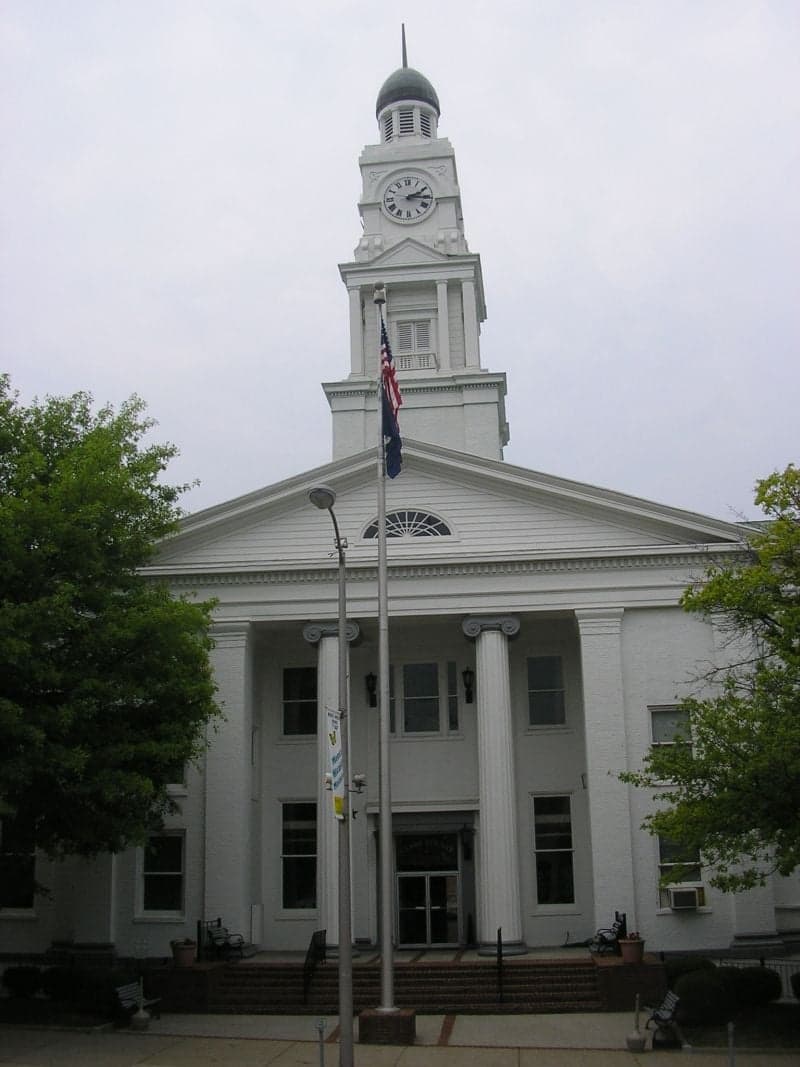
Photo: Wikipedia
Demographics of Clark County
Affluence Level in Clark County
A middle-class area roughly in line with national averages across income, home values, education, and employment.
People of Clark County
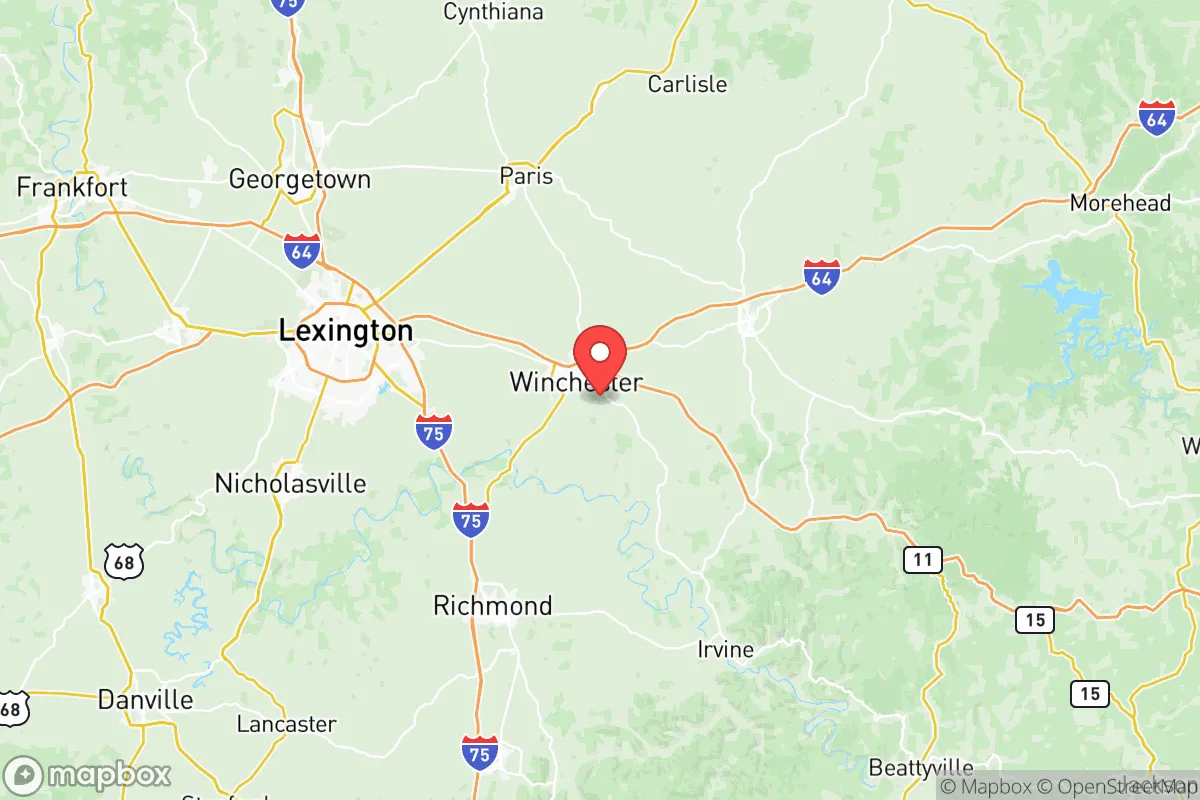
Clark County, Kentucky, is a predominantly white, rural community of 37,004 residents where the population is notably less diverse than the national average, with a foreign-born share of just 0.5% and a college attainment rate of 22.2%. The county’s character is rooted in its agricultural and small-town heritage, centered on the county seat of Winchester and the smaller communities of Ford, Trapp, and Goffs Corner. Residents identify strongly with a self-reliant, conservative ethos, shaped by generations of families who have worked the land and commuted to nearby manufacturing and logistics jobs in Lexington and Richmond. The population is aging slowly, with a median age slightly above the state average, and the county remains one of the most ethnically homogeneous in the Bluegrass region.
Settlement & growth (pre-1960)
Before European settlement, the area now known as Clark County was part of the hunting grounds of the Shawnee and Cherokee nations, who used the Kentucky River valley for seasonal camps and buffalo trails. No permanent Native villages existed within the county’s modern borders, but the region was contested territory between tribes and early Anglo-American explorers. The first permanent European settlers arrived in the 1770s, primarily Scots-Irish and English pioneers moving west through the Cumberland Gap. These families, drawn by the promise of fertile bottomland and land grants for Revolutionary War service, established homesteads along the Kentucky River and its tributaries, including the present-day communities of Winchester (founded 1793) and Ford (settled circa 1800).
By the 1790s, Clark County was officially formed from parts of Bourbon and Fayette counties, named after Revolutionary War hero George Rogers Clark. The early economy was entirely agrarian, with tobacco, hemp, and corn as cash crops, and enslaved African Americans made up roughly 25% of the population by 1830. The county’s black population remained concentrated in and around Winchester, working on large plantations along the Kentucky River bottoms. After the Civil War, many freedmen remained in the area, forming small communities like Trapp and Goffs Corner, though outmigration to northern industrial cities began in the 1910s and accelerated through the Great Migration.
The late 19th and early 20th centuries brought modest industrial growth. The arrival of the Louisville and Nashville Railroad in the 1870s connected Winchester to regional markets, spurring a tobacco-processing and distilling industry. German and Irish immigrants arrived in small numbers during this period, settling in Winchester’s working-class neighborhoods near the rail yards and the distillery district. However, unlike many Kentucky counties, Clark County did not experience a large wave of Southern or Eastern European immigration; the foreign-born population never exceeded 2% before 1920. The Dust Bowl and Great Depression years saw a trickle of families from Arkansas and Oklahoma, but the county’s population remained remarkably stable, hovering around 18,000 from 1900 to 1940.
World War II and the postwar boom brought the first significant demographic shift. The expansion of the Blue Grass Army Depot in nearby Richmond and the opening of manufacturing plants in Lexington drew workers from rural Clark County into the broader regional economy. Suburbanization began in the 1950s, with new housing developments spreading south and east of Winchester along U.S. Route 60 and Kentucky Route 15. The communities of Meadowthorpe and Pine Grove emerged as bedroom neighborhoods for commuters, while the county’s rural population began a slow decline that would continue for decades.
Modern era (post-1965)
The 1965 Hart-Cellar Act had almost no direct impact on Clark County. The foreign-born population remained below 1% through the 1990s, and the county did not attract the refugee resettlement or immigrant labor flows that reshaped urban Kentucky. Instead, the county’s modern demographic story is one of domestic outmigration and slow diversification through natural increase. The white population share, which was 96% in 1970, has gradually declined to 88.3% as of the 2020 census, driven almost entirely by the growth of the Hispanic and black populations.
Hispanic residents, now 4.0% of the county, began arriving in the 1990s, primarily as migrant agricultural workers in the tobacco and horse-farming industries. Many settled in Winchester’s west side and in the unincorporated area of Becknerville, where a small but stable Latino community has formed around the Catholic church and local landscaping businesses. The black population, 4.3% of the county, has remained relatively flat since 1970, with most African American residents concentrated in Winchester’s historic east-end neighborhoods and in the rural community of Trapp. East and Southeast Asian residents (0.6%) and Indian subcontinent residents (0.2%) are present in very small numbers, mostly professionals employed at the University of Kentucky or regional hospitals, and they tend to live in newer subdivisions near the Fayette County line.
Domestic migration patterns have been the dominant force. Since 2000, Clark County has experienced steady growth from former residents of Lexington and Fayette County, who move east for cheaper housing and larger lots. This “exurban flight” has concentrated in the corridor along U.S. 60 between Winchester and the Fayette County line, particularly in the Van Meter and Ruckerville areas. These newcomers are predominantly white, middle-class families, and they have shifted the county’s political and cultural center slightly toward suburban conservatism, while the older rural population remains more traditional and agrarian in outlook.
The future
Clark County is projected to grow slowly, reaching roughly 40,000 residents by 2035, with the most rapid growth occurring in the exurban fringe near Lexington. The county is becoming slightly more diverse, but the pace is glacial: the Hispanic share may reach 6-7% by 2040, while the black and Asian shares will likely remain below 5% each. The foreign-born population is expected to remain under 2%, as the county lacks the industrial base or urban amenities that attract international migrants.
The cultural identity of Clark County is evolving from a purely rural, agricultural community to a hybrid exurban-rural landscape. New subdivisions in Meadowthorpe and along the U.S. 60 corridor are drawing younger families who commute to Lexington, while the older farming communities of Ford and Goffs Corner are losing population as farms consolidate. The county’s political character is likely to remain conservative, but the exurban influx may moderate some of the more traditionalist views, particularly on economic development and land use. For a newcomer, Clark County offers a stable, low-crime environment with strong community ties, but those seeking significant ethnic or cultural diversity will find it limited.
For someone moving in now, Clark County is becoming a quieter, more affordable alternative to Lexington’s suburbs, where the population is stable, the schools are solid, and the pace of life remains unhurried. The county’s future is one of gradual, managed growth, with the character of a place that values its agricultural roots while accommodating the slow spread of exurban development. It is not a place of rapid change or dramatic demographic transformation, but rather a community where the people who live there largely share a common background and a preference for continuity over change.

* Values derived from national, state, county, city and local statistics and may differ in a specific area. Last updated: 2026-07-17T10:45:43.000Z
Narrative content on this page is AI-generated and may contain mistakes. Verify any details that matter before acting on them.
ReloMaps may earn a commission from affiliate links at no extra cost to you.

