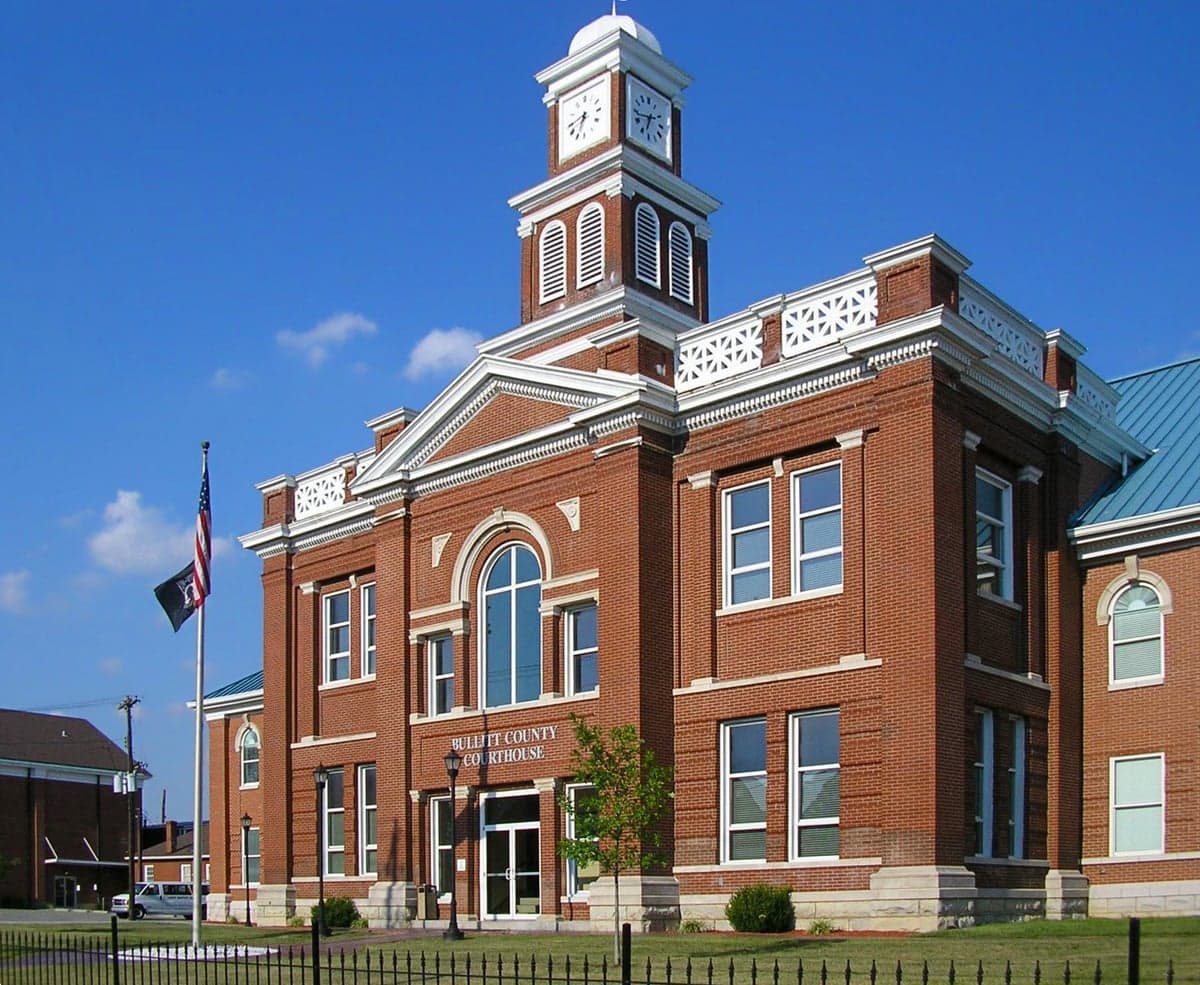
Photo: Wikipedia
Political ClimatePolitical Climate in Bullitt County
Showing district-level results — no local-only data available.
Local Political AnalysisPolitical Analysis of Bullitt County
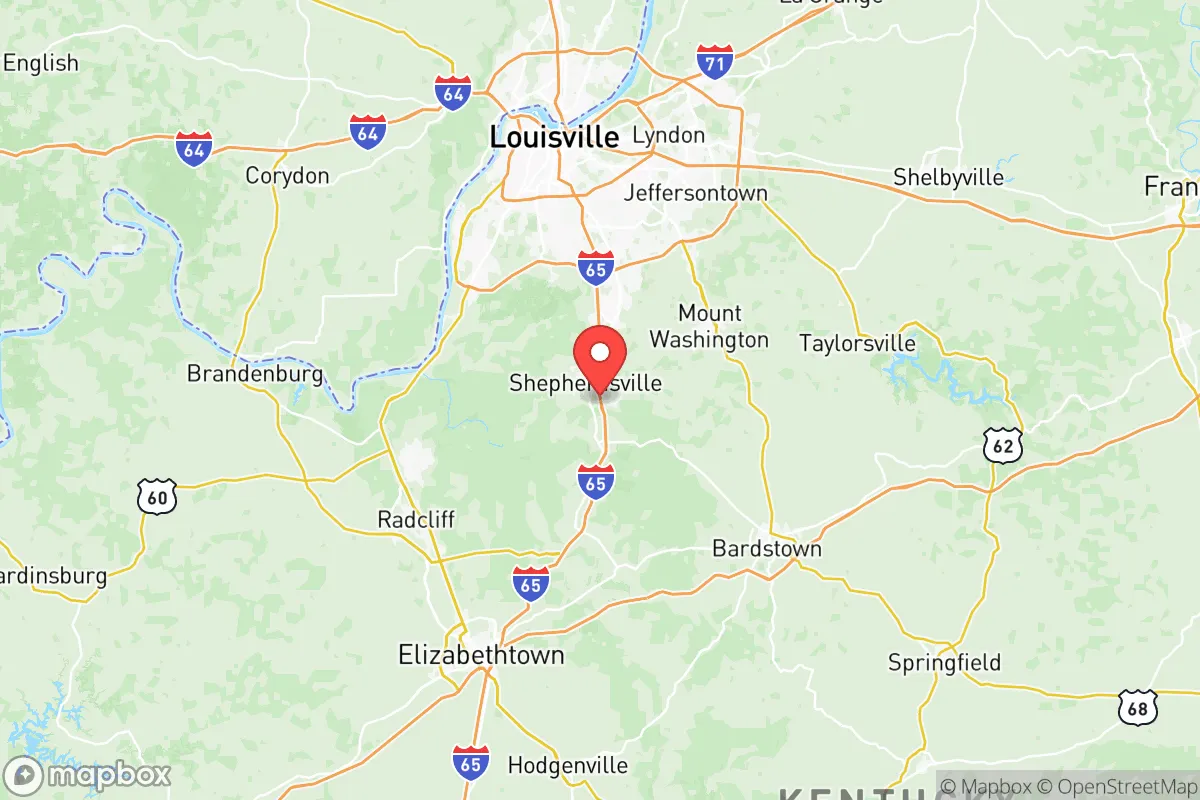
Bullitt County, Kentucky, is a reliably Republican stronghold with a Cook PVI of R+20, making it significantly more conservative than the state of Kentucky as a whole, which sits at R+15. This isn't a new development; the county has been trending red for decades, but the margin has widened noticeably since the 2010s. In the 2024 presidential election, Donald Trump carried Bullitt County with over 72% of the vote, outperforming his statewide margin by a solid 10 points. The county's politics are deeply shaped by its mix of rural farmland, suburban bedroom communities for Louisville commuters, and a strong local culture centered on gun rights, low taxes, and family values.
How it compares
While Kentucky as a whole is a solid red state, Bullitt County is a deeper shade of red. The R+20 PVI means the county votes about 5 points more Republican than the state average in a typical election. This gap is most visible in state-level races: a Republican candidate for governor or state legislature can expect to win Bullitt County by a wider margin than they'd see in, say, neighboring Jefferson County (Louisville) or even the more competitive suburbs of Lexington. The political geography within Bullitt County isn't entirely uniform, though. Shepherdsville, the county seat and largest city, leans heavily Republican, with precincts routinely delivering 75-80% of the vote to GOP candidates. Mount Washington is similarly conservative, though its growing population of young families has introduced a small but measurable number of swing voters. The more rural areas, like Lebanon Junction and the unincorporated communities around Clermont and Pitts Point, are the most reliably red, often hitting 80%+ for Republican candidates. The only precincts that occasionally show a Democratic lean are in the far northern edge of the county, near the Jefferson County line, where a handful of more suburban, less rural voters live. Even there, the Democratic vote rarely cracks 40%.
What this means for residents
For conservative residents, Bullitt County is a comfortable place to live politically. Local government, from the county judge-executive to the school board, is dominated by Republicans. Tax policy is generally low, with the county's property tax rate among the lowest in the state. Gun rights are broadly supported, and there's little appetite for zoning or land-use restrictions. For liberal residents, the reality is more isolating. There is no organized Democratic Party presence to speak of, and progressive candidates rarely bother to campaign in the county. Socially, it can be difficult to find like-minded neighbors, especially in the more rural precincts. That said, the proximity to Louisville (about 20 minutes north) means that liberal residents can easily access a more diverse political and cultural environment for work, entertainment, or community. The county's politics are stable and unlikely to shift dramatically in the near future, barring a major demographic change or a national realignment that reshapes the suburban-rural divide.
Culturally, Bullitt County is distinct from the rest of Kentucky in a few ways. It's less influenced by the horse industry or the urban energy of Lexington, and more tied to the working-class, blue-collar identity of the Ohio River valley. The county is home to the Jim Beam distillery in Clermont, which anchors a strong bourbon tourism economy, but the local politics remain firmly populist and anti-establishment. There's a palpable skepticism of both Frankfort and Washington, D.C., which shows up in everything from local school board meetings to the county's resistance to state-mandated mask mandates during the pandemic. For anyone moving to the area, understanding that Bullitt County is not just red, but a deeper, more culturally conservative shade of red than the state as a whole, is essential to getting a feel for daily life here.

State Political ClimatePolitical Climate in Kentucky
State Political AnalysisPolitical Environment in the State
Kentucky is a solidly Republican state with a Cook PVI of R+15, meaning it typically votes about 15 points more Republican than the national average. Over the past 20 years, the state has shifted decisively rightward: in 2000, it was a competitive swing state (George W. Bush won it by just 4 points), but by 2024, Donald Trump carried it by over 30 points. The dominant coalition is a mix of rural and small-town conservatives, evangelical Christians, and working-class voters who have abandoned the Democratic Party in droves, especially in the eastern coal fields and western farm counties. The Democratic strongholds are shrinking to Louisville (Jefferson County), Lexington (Fayette County), and a handful of college towns like Bowling Green and Richmond.
Urban vs. rural divide
The political map of Kentucky is a textbook case of the urban-rural split. Louisville and Lexington are the only reliably blue metros: Jefferson County voted for Joe Biden by 13 points in 2020, while Fayette County went for Biden by 11 points. These two counties alone account for roughly 20% of the state's population, but they are surrounded by deep-red suburbs and exurbs. For example, Oldham County (just northeast of Louisville) voted for Trump by 44 points, and Scott County (north of Lexington) went for Trump by 28 points. The rest of the state is overwhelmingly Republican, with many eastern Kentucky counties like Pike, Floyd, and Letcher — once Democratic strongholds in the coal era — now voting Republican by 50-60 point margins. The western part of the state, including the Purchase area around Paducah and the Pennyrile region around Hopkinsville, is also solidly red, though with a few pockets of Democratic holdouts in majority-Black communities like Owensboro and Henderson. The rural-urban divide is stark: a voter in downtown Louisville lives in a completely different political world than one in rural Morgan County, where Trump won 84% of the vote.
Policy environment
Kentucky's policy environment is conservative across the board. The state has a flat income tax that is being phased down from 5% to 4% by 2026, with a goal of eventual elimination. There is no state-level property tax on real estate (only local), and the sales tax is 6% with no local add-ons. The regulatory posture is business-friendly: Kentucky is a right-to-work state (since 2017) and has a Republican supermajority in the legislature that has consistently passed tort reform and occupational licensing deregulation. Education policy is a flashpoint: the state has a robust school choice movement, with a 2022 law creating education opportunity accounts (vouchers) that were struck down by the state Supreme Court in 2024, but a constitutional amendment to allow them is on the ballot for 2026. Healthcare is dominated by the expansion of Medicaid under the Affordable Care Act (which former Governor Matt Bevin tried to undo but failed), but the state has not expanded eligibility further. Election laws are restrictive: Kentucky requires a photo ID to vote, has no same-day registration, and has a 14-day early voting window (expanded from 3 days in 2020). The state also has a voter roll maintenance program that purges inactive voters annually.
Recent policy direction
Kentucky's recent legislative sessions have been a full-spectrum conservative push. On gun and self-defense law, the state passed constitutional carry (permitless carry) in 2019, and in 2024 it passed a law allowing teachers to carry firearms on school grounds with training. On parental and education rights, the 2022 "Parents' Bill of Rights" (HB 563) requires schools to notify parents of any changes to a student's health or well-being, and bans instruction on sexual orientation and gender identity in grades K-5. On speech and privacy, the state has no broad surveillance law, but it does have a 2023 law banning TikTok on government devices. On medical and bodily autonomy, Kentucky has a near-total abortion ban (triggered in 2022) with no exceptions for rape or incest, only to save the mother's life. The state also passed a 2023 law banning gender-affirming care for minors, which is currently being litigated. On property rights, Kentucky is a "Dillon's Rule" state, meaning local governments have only the powers explicitly granted by the state, which limits local zoning and rent control. On taxation, the 2022 tax reform package (HB 8) set the state on a path to eliminate the income tax entirely, contingent on revenue triggers. On voting and ballot access, the 2021 law (SB 1) tightened absentee ballot rules and shortened the window for curing mismatched signatures.
Civil unrest & political movements
Kentucky has seen its share of political flashpoints. The 2020 protests in Louisville over the death of Breonna Taylor were among the largest in the state's history, with weeks of demonstrations, property damage, and a heavy police presence. That event galvanized both the Black Lives Matter movement and a counter-movement around "law and order," which helped Republicans sweep statewide races in 2020 and 2022. The state also has a visible but small secessionist movement in eastern Kentucky, where some residents have floated the idea of joining West Virginia, though it has no political traction. Immigration politics are relatively quiet, as Kentucky has a small foreign-born population (about 4%), but there have been local controversies over meatpacking plants in Bowling Green and Mayfield hiring immigrant workers. The state has no sanctuary cities, and Louisville's "Welcoming City" ordinance (which limits cooperation with ICE) has been a target of Republican legislation. Election integrity is a live issue: the 2020 election saw Trump's claims of fraud embraced by many rural voters, leading to a 2022 law that added stricter voter ID requirements and limited drop boxes. The most visible political movement in recent years has been the rise of the "Christian nationalist" wing within the state GOP, which has pushed for school prayer legislation and a 2024 resolution declaring Kentucky a "sanctuary state for the unborn."
Projection
Over the next 5-10 years, Kentucky is likely to become even more Republican, but with a twist. The in-migration pattern is modest — the state gains about 10,000-15,000 new residents per year, mostly from Ohio, Indiana, and Illinois — and these newcomers tend to be conservative-leaning retirees and remote workers drawn to low taxes and rural property. The Democratic base in Louisville and Lexington is aging and not being replaced by young liberals at the same rate as in other states, because Kentucky's economy (dominated by manufacturing, logistics, and healthcare) doesn't attract the tech and creative class that drives leftward shifts elsewhere. The biggest wild card is the state's declining population in eastern Kentucky, which is losing residents faster than any region in the country; this will further reduce the already-small Democratic vote in those areas. The Republican supermajority is likely to persist, and the policy direction will continue toward income tax elimination, school choice expansion, and further restrictions on abortion and transgender rights. A new resident moving in now should expect to find a state where conservative values are deeply embedded in law and culture, where the political debate is about how far right to go, not whether to go right at all.
For a new resident, the bottom line is straightforward: if you are a conservative, you will find Kentucky's political climate comfortable and aligned with your values, with low taxes, strong gun rights, and a government that actively promotes traditional social norms. If you are a liberal, you will be in a clear minority outside of Louisville and Lexington, and you should expect to encounter policies that may feel restrictive on issues like abortion, LGBTQ+ rights, and voting access. The state is not politically volatile — there are no recall elections, no frequent ballot initiatives, and no major third-party movements — so what you see is largely what you get. The practical takeaway is to choose your county carefully: Jefferson County (Louisville) and Fayette County (Lexington) offer a more moderate environment, while Oldham County, Boone County, and Warren County (Bowling Green) are deeply conservative. The state's political trajectory is stable and predictable, which is either a comfort or a frustration depending on your perspective.
* Values derived from national, state, county, city and local statistics and may differ in a specific area. Last updated: 2026-07-09T12:51:46.000Z
Narrative content on this page is AI-generated and may contain mistakes. Verify any details that matter before acting on them.
ReloMaps may earn a commission from affiliate links at no extra cost to you.

