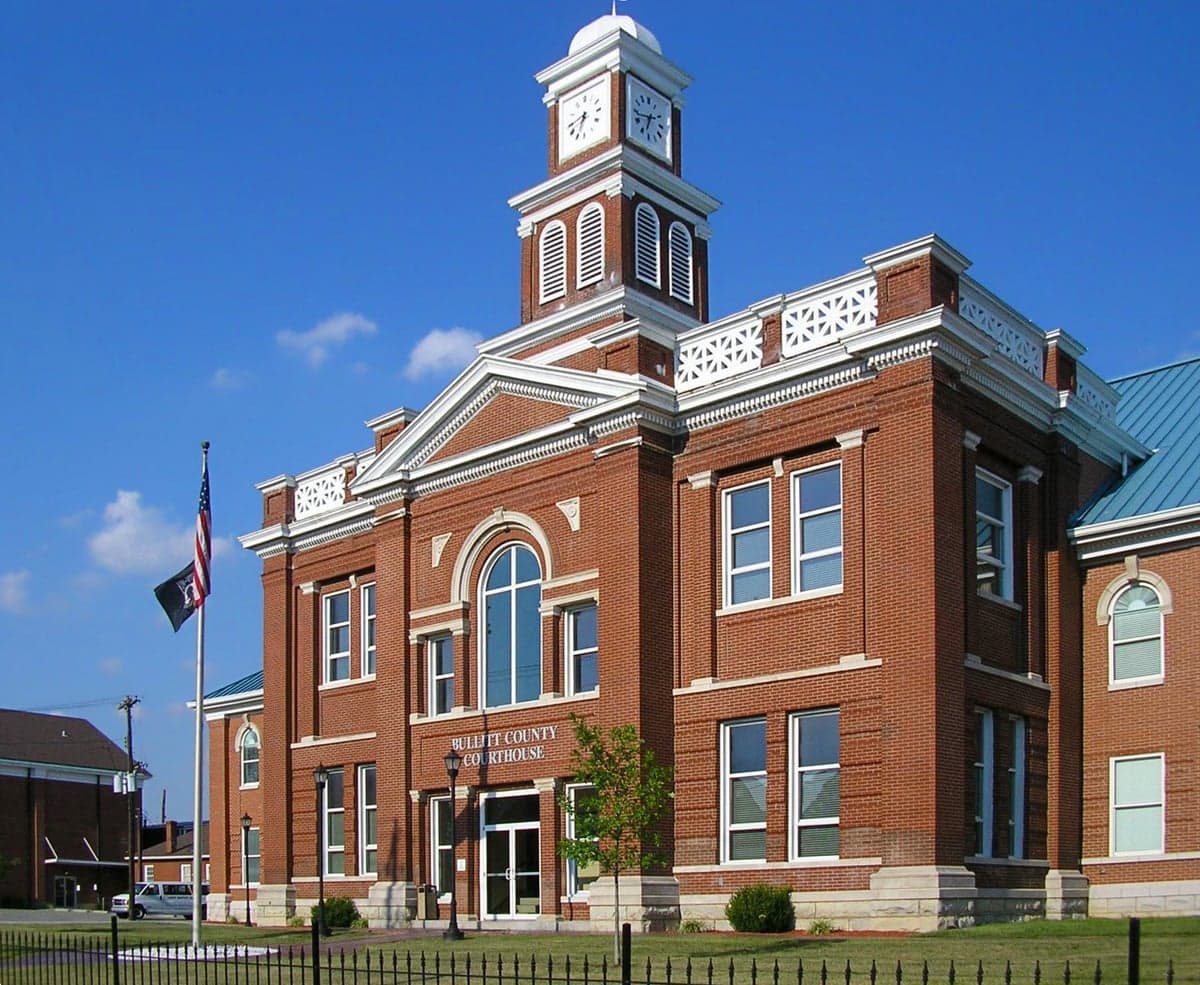
Photo: Wikipedia
Demographics of Bullitt County
Affluence Level in Bullitt County
A middle-class area roughly in line with national averages across income, home values, education, and employment.
People of Bullitt County
Bullitt County, Kentucky, is a predominantly white, family-oriented suburban and exurban community of 83,209 residents, characterized by its low foreign-born population of just 1.4% and a strong sense of local identity rooted in its rural past. The county’s population is 91.7% white, with a Hispanic share of 2.9% and a Black share of 1.1%, reflecting a demographic profile that has remained relatively stable even as the Louisville metropolitan area has grown outward. Residents often describe the county as a place where traditional values, outdoor recreation along the Salt River, and a slower pace of life coexist with the practical need to commute to jobs in Louisville and Elizabethtown.
Settlement & growth (pre-1960)
Before European settlement, the area now known as Bullitt County was part of the hunting grounds of the Shawnee and Cherokee nations, who used the Salt River valley for seasonal camps and buffalo traces. The first permanent European-American settlers arrived in the 1770s and 1780s, primarily of Scots-Irish and English descent, drawn by the promise of fertile land and the protection of early forts like Fort Nonsense near present-day Shepherdsville. These pioneers were largely subsistence farmers and hunters, and the county was officially formed in 1796 from parts of Jefferson and Nelson counties.
Throughout the 19th century, the population grew slowly but steadily. The discovery of salt licks and the establishment of the Bullitt Lick saltworks near Pitts Point attracted a small wave of laborers and entrepreneurs, though the industry declined by the 1840s. The Louisville and Nashville Railroad, completed through the county in the 1850s, spurred the growth of towns like Shepherdsville (the county seat), Mount Washington, and Lebanon Junction. These communities became market centers for the surrounding agricultural economy, which relied on tobacco, corn, and livestock. German immigrants, a notable minority, arrived in small numbers in the mid-1800s, settling primarily in Mount Washington and Hebron Estates, where they established farms and small businesses. The county’s population remained overwhelmingly rural and white through the early 20th century, with a small Black population concentrated in Shepherdsville and Pitts Point, many of whom were descendants of enslaved people who worked on tobacco plantations.
The post-World War II era brought the first significant suburban push. The construction of the Kentucky Turnpike (now I-65) in the 1950s made Bullitt County accessible to commuters working in Louisville’s manufacturing and logistics sectors. This period saw the beginning of a shift from a purely agricultural economy to a bedroom-community model, with new subdivisions appearing around Shepherdsville and Hillview. By 1960, the county’s population had reached roughly 15,000, still small but growing faster than the state average.
Modern era (post-1965)
The 1965 Hart-Cellar Act had a minimal direct impact on Bullitt County, as the region did not attract the large-scale immigration seen in coastal or major urban areas. The foreign-born population remains very low at 1.4%, and the county’s racial and ethnic composition has changed only modestly since the 1960s. The most significant demographic shift has been domestic: the continued suburbanization of the Louisville metropolitan area. From the 1970s through the 2000s, families seeking affordable housing, lower taxes, and larger lots moved from Jefferson County into Bullitt County, particularly into Mount Washington, Hillview, and the newer subdivisions around Brooks and Fox Chase. This influx was predominantly white, reinforcing the county’s existing demographic character.
Hispanic population growth, while small in absolute terms (2.9%), has been the most notable change since 2000. This growth is largely driven by Mexican and Central American immigrants working in construction, landscaping, and agriculture, with small clusters forming in Shepherdsville and Lebanon Junction. The East/Southeast Asian population (0.4%) and Indian subcontinent population (0.2%) remain tiny, with most individuals employed in professional roles in Louisville or at the nearby Fort Knox military base. The Black population (1.1%) has also grown slightly, primarily through domestic migration from Louisville, with families settling in Shepherdsville and Mount Washington. The county’s college-educated rate of 18.9% is below the national average, reflecting a workforce heavily oriented toward trades, manufacturing, and logistics rather than white-collar professions.
The future
Bullitt County is projected to continue its slow, steady growth, driven by the expansion of the Louisville metropolitan area and the development of the I-65 corridor. The population is expected to become slightly more diverse, with the Hispanic share likely rising to 4-5% by 2040, and the Black and Asian shares inching upward as younger families move from Jefferson County. However, the county will almost certainly remain predominantly white and culturally conservative, with a strong emphasis on local schools, churches, and outdoor recreation. New subdivisions are concentrating in Mount Washington and the area around Brooks, while Shepherdsville continues to serve as the commercial and governmental hub. The county’s cultural identity is evolving from a purely rural farming community to a suburban-exurban hybrid, but the pace of change is slow, and the sense of local tradition remains strong.
For someone moving in now, Bullitt County offers a stable, affordable, and safe environment with a clear sense of community, but it is not a place of rapid demographic or cultural change. The county is becoming a more connected part of the Louisville region, but its residents value the slower pace and lower density that distinguish it from the city. Newcomers will find a population that is welcoming but rooted, and a local economy that rewards practical skills and hard work over academic credentials.

* Values derived from national, state, county, city and local statistics and may differ in a specific area. Last updated: 2026-07-09T12:51:46.000Z
Narrative content on this page is AI-generated and may contain mistakes. Verify any details that matter before acting on them.
ReloMaps may earn a commission from affiliate links at no extra cost to you.

