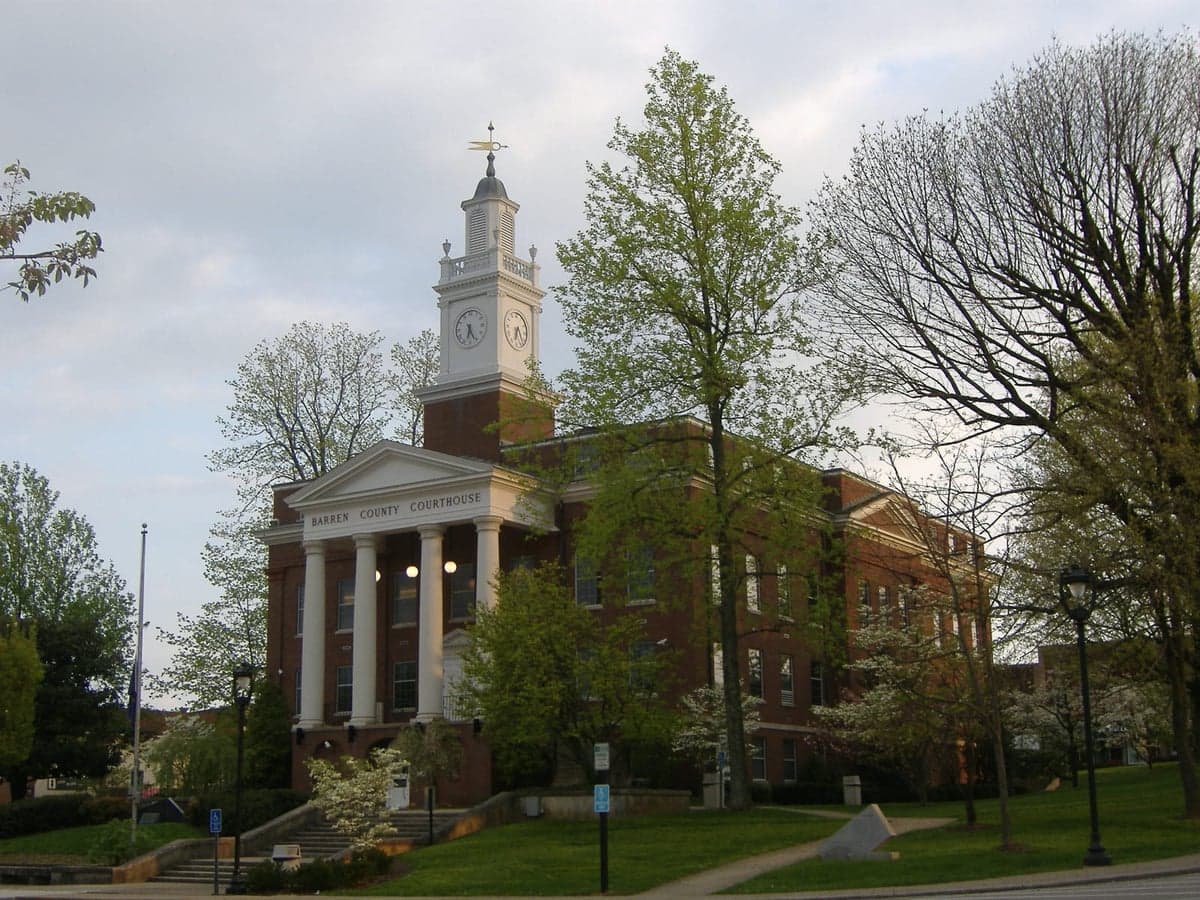
Photo: Wikipedia
Political ClimatePolitical Climate in Barren County
Showing district-level results — no local-only data available.
Local Political AnalysisPolitical Analysis of Barren County
Barren County, Kentucky, is a reliably Republican stronghold with a Cook Partisan Voting Index (PVI) of R+20, making it significantly more conservative than the state of Kentucky as a whole, which sits at R+15. The county has trended redder over the past decade, driven by rural realignment and cultural shifts, though its politics are not monolithic. Glasgow, the county seat and largest city, leans Republican but contains pockets of Democratic-leaning precincts, particularly around the downtown area and near Western Kentucky University's Glasgow campus. Smaller towns like Cave City and Park City are deeply red, while the rural precincts along the Cumberland River corridor show the highest Republican margins, often exceeding 75% in presidential elections.
How it compares
Barren County's R+20 rating places it roughly five points to the right of Kentucky's statewide average, a gap that has widened since 2016. In the 2024 presidential election, Donald Trump carried Barren County with 72% of the vote, compared to 65% statewide. This divergence is sharper in local races: the county's state House districts (24th and 25th) are held by Republicans who often run unopposed, while statewide Democratic candidates like Andy Beshear have managed to win in Kentucky by appealing to moderates in suburban Louisville and Lexington—a strategy that barely registers in Barren County. The county's conservative tilt is reinforced by its demographics: it is 92% white, with a median age of 41, and a strong evangelical Protestant presence. However, Glasgow's small but growing Hispanic population (now about 8%) has introduced a slight moderating influence in a few precincts near the industrial parks, where Democratic margins have ticked up by 2-3 points since 2020.
What this means for residents
For conservative residents, Barren County's political climate means their values are reflected in local governance: the fiscal court is solidly Republican, gun rights are broadly supported, and social issues like abortion and school curriculum are debated from a conservative framework. Tax policy is business-friendly, with no local occupational tax in most of the county, and the Glasgow-Barren County Industrial Development Authority actively recruits manufacturing and logistics firms. For liberal residents, the reality is more isolating. There is no organized Democratic Party presence in the county; the local party chair position has been vacant since 2022. Progressive viewpoints are rarely aired in public forums, and social issues like LGBTQ+ rights are largely absent from local discourse. That said, Glasgow's downtown has seen a modest influx of younger professionals and artists, creating a small but visible counterculture that hosts a Pride event each June and a weekly farmers' market where political conversations are more varied.
Culturally, Barren County distinguishes itself from the rest of Kentucky by its fierce independence and a "live and let live" ethos that sometimes surprises outsiders. While the county votes overwhelmingly Republican, residents tend to resent heavy-handed government from any level—whether it's Frankfort mandating school policies or Washington imposing environmental regulations on the area's limestone quarries and agricultural operations. This libertarian streak means that, in practice, the political climate is less about partisan warfare and more about a shared skepticism of authority. The county's biggest policy distinction from the state is its aggressive pursuit of economic development over preservation: Barren County has embraced industrial recruitment and housing expansion, even as neighboring counties like Monroe and Metcalfe have resisted similar growth. This pragmatic conservatism—pro-business, low-tax, but wary of social engineering—is likely to persist, with the county's R+20 lean holding steady through 2028, barring a major demographic shift or economic disruption.

State Political ClimatePolitical Climate in Kentucky
State Political AnalysisPolitical Environment in the State
Kentucky is a deeply red state with a Cook PVI of R+15, meaning it votes about 15 points more Republican than the national average in presidential elections. The dominant coalition is a mix of rural, socially conservative voters and a growing number of suburban and exurban conservatives, particularly in the outer rings of Louisville and Lexington. Over the last 10-20 years, the state has shifted sharply rightward: in 2008, Barack Obama lost Kentucky by 16 points; by 2024, Donald Trump carried it by over 30 points, driven by the collapse of Democratic strength in rural areas and the realignment of working-class white voters. This trajectory shows no sign of reversing, though the urban cores of Louisville and Lexington remain Democratic strongholds.
Urban vs. rural divide
The political map of Kentucky is a textbook case of urban-rural polarization. Louisville (Jefferson County) and Lexington (Fayette County) are the only reliably blue metros, each delivering 55-60% of their vote to Democrats in recent cycles. These cities are home to the state’s major universities, healthcare systems, and a growing professional class. Outside these two islands, the state is overwhelmingly red. Bowling Green, Owensboro, and Paducah are solidly Republican, with margins often exceeding 20 points. The Northern Kentucky suburbs of Cincinnati—places like Fort Thomas and Independence—lean Republican but are more moderate than the rest of the state, often splitting tickets in state-level races. The Appalachian counties in the east, once Democratic strongholds under the "Yellow Dog" tradition, have flipped hard: Pike County voted for Obama in 2008 and then for Trump by 50 points in 2024. The Bluegrass region around Lexington is a mix of horse-farm country and exurban subdivisions, trending redder as new residents arrive from out of state.
Policy environment
Kentucky’s policy environment is conservative across the board. The state has a flat income tax that is being phased down from 5% to 4% by 2026, with a goal of elimination. Property taxes are low, and there is no tax on Social Security benefits. The regulatory posture is business-friendly, with a right-to-work law and no state-level minimum wage above the federal $7.25. Education policy is a flashpoint: the state has a robust school choice movement, with a 2022 law creating education opportunity accounts for low-income students, though a 2024 constitutional amendment to allow public funding for private schools failed. Healthcare is dominated by the expansion of Medicaid under the Affordable Care Act, which Governor Matt Bevin (R) initially opposed but his successor Andy Beshear (D) has defended. Election laws are moderately restrictive: voter ID is required, early voting is limited to three weeks, and no-excuse absentee voting was made permanent after the pandemic. The state does not have a "stand your ground" law, but it does have a permitless carry law for firearms, passed in 2019.
Recent policy direction
The last five years have seen a clear conservative shift on multiple fronts. Gun and self-defense law: In 2019, Kentucky passed permitless carry (constitutional carry), allowing any adult 21 or older to carry a concealed firearm without a permit. The state also has a "castle doctrine" but not a broad "stand your ground" statute. Parental and education rights: The 2022 "Parents’ Bill of Rights" (HB 563) requires schools to notify parents of any changes to a student’s services or mental health, and prohibits instruction on sexual orientation or gender identity in grades K-5. Speech and privacy: There is no state-level data privacy law, but a 2023 law restricts the collection of biometric data by private entities. Medical and bodily autonomy: Kentucky has a near-total abortion ban, triggered in 2022 with no exceptions for rape or incest, only to save the life of the mother. A 2024 court ruling upheld the ban. Gender-affirming care for minors is banned under a 2023 law. Property rights: The state has strong eminent domain protections, and a 2021 law limited local governments’ ability to regulate short-term rentals. Taxation: The 2022 tax reform package (HB 8) set a path to eliminate the individual income tax, contingent on revenue triggers. Voting and ballot access: A 2021 law (SB 1) added a voter ID requirement, shortened the absentee ballot application window, and banned ballot harvesting. Early voting was expanded to three weeks, including Saturdays.
Civil unrest & political movements
Kentucky has seen its share of political flashpoints. The Breonna Taylor protests in Louisville in 2020 were among the largest in the nation, with weeks of demonstrations, property damage, and the fatal shooting of a protester by law enforcement. That event galvanized a progressive movement in Louisville but also hardened conservative sentiment in the rest of the state. The 2022 election integrity controversy saw a brief push for a forensic audit of the 2020 election in several counties, but it fizzled without major changes. There is a small but vocal secessionist movement in eastern Kentucky, tied to the broader "State of Jefferson" idea, but it has no legislative traction. Immigration politics are muted—Kentucky has a small foreign-born population (about 4%)—but a 2024 law (SB 1) requires local law enforcement to cooperate with federal immigration authorities, and there are no sanctuary cities. The Kentucky Right to Life organization is one of the most powerful lobbying groups in the state, and the Kentucky Education Association (teachers union) is the main counterweight on the left. The 2023 governor’s race between Andy Beshear (D) and Daniel Cameron (R) was a proxy war over abortion and education, with Beshear winning narrowly by framing Cameron as too extreme on the abortion ban.
Projection
Over the next 5-10 years, Kentucky will likely become more Republican, but with a growing suburban moderation on social issues. In-migration is modest—the state grows about 0.5% annually—and comes mostly from other Midwestern and Southern states, bringing conservative voters. The urban cores of Louisville and Lexington will remain blue, but their suburbs are trending redder as new subdivisions fill with families fleeing higher-cost states. The income tax phaseout will likely continue, making the state more attractive to retirees and remote workers. The abortion ban is unlikely to be loosened unless the legislature flips, which is improbable. The school choice movement will keep pushing, and a future constitutional amendment for private school funding may pass. The biggest wildcard is the healthcare landscape: if Medicaid expansion is ever repealed, rural hospitals could collapse, triggering a political backlash. A new resident moving in now should expect a state that is solidly conservative on fiscal and cultural issues, with a low-tax, low-regulation environment, but with a visible and vocal liberal minority in the two big cities. The political temperature is warm but not boiling—most Kentuckians are more concerned with basketball and bourbon than with partisan warfare.
Bottom line for a new resident: If you’re conservative, you’ll find a state that aligns with your values on taxes, guns, and education, with a legislature that moves quickly on your priorities. If you’re liberal, you’ll find a strong community in Louisville or Lexington, but you’ll be swimming against the tide in state policy—especially on abortion and LGBTQ+ rights. The practical takeaway is that Kentucky is a place where your local politics will match your neighborhood: blue in the cities, red everywhere else, and the state government will reliably lean right for the foreseeable future.
* Values derived from national, state, county, city and local statistics and may differ in a specific area. Last updated: 2026-06-17T10:17:31.000Z
Narrative content on this page is AI-generated and may contain mistakes. Verify any details that matter before acting on them.
ReloMaps may earn a commission from affiliate links at no extra cost to you.

