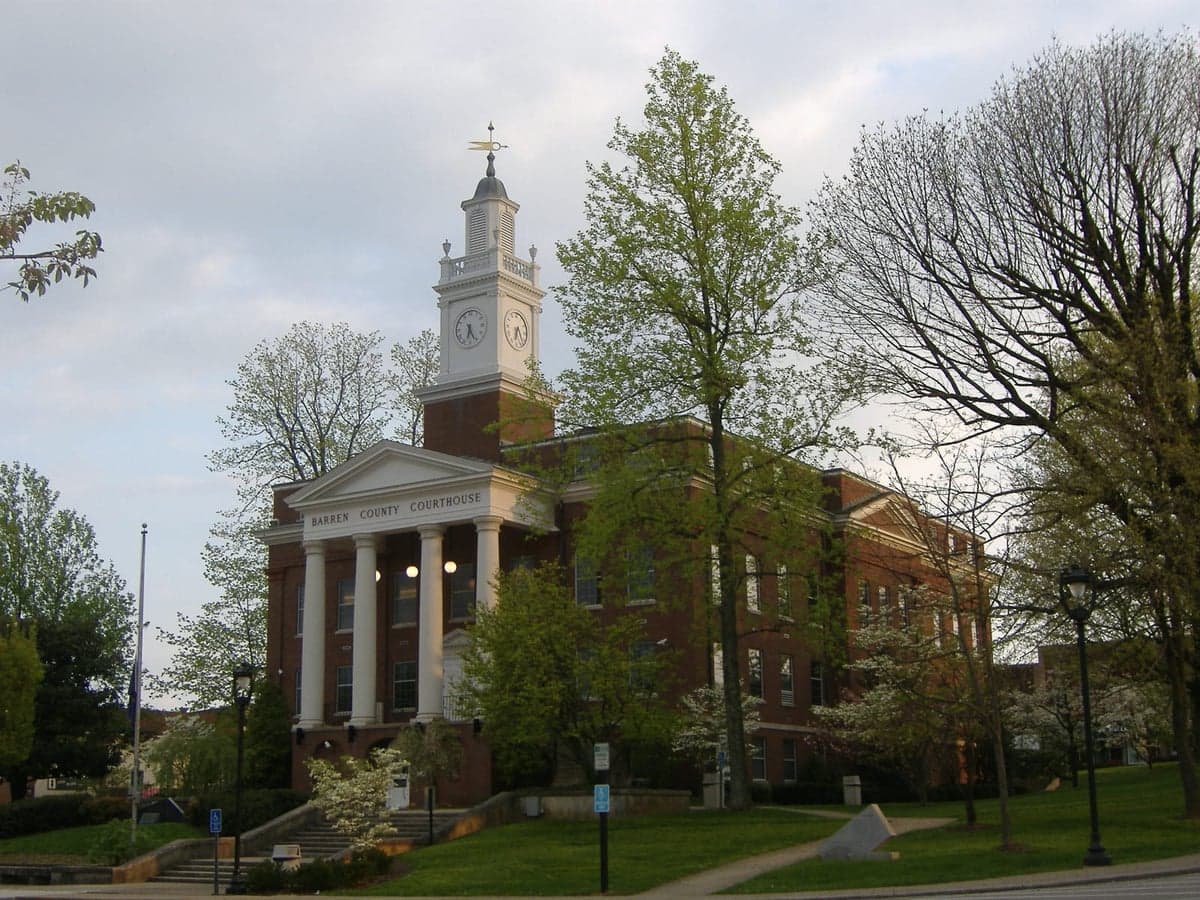
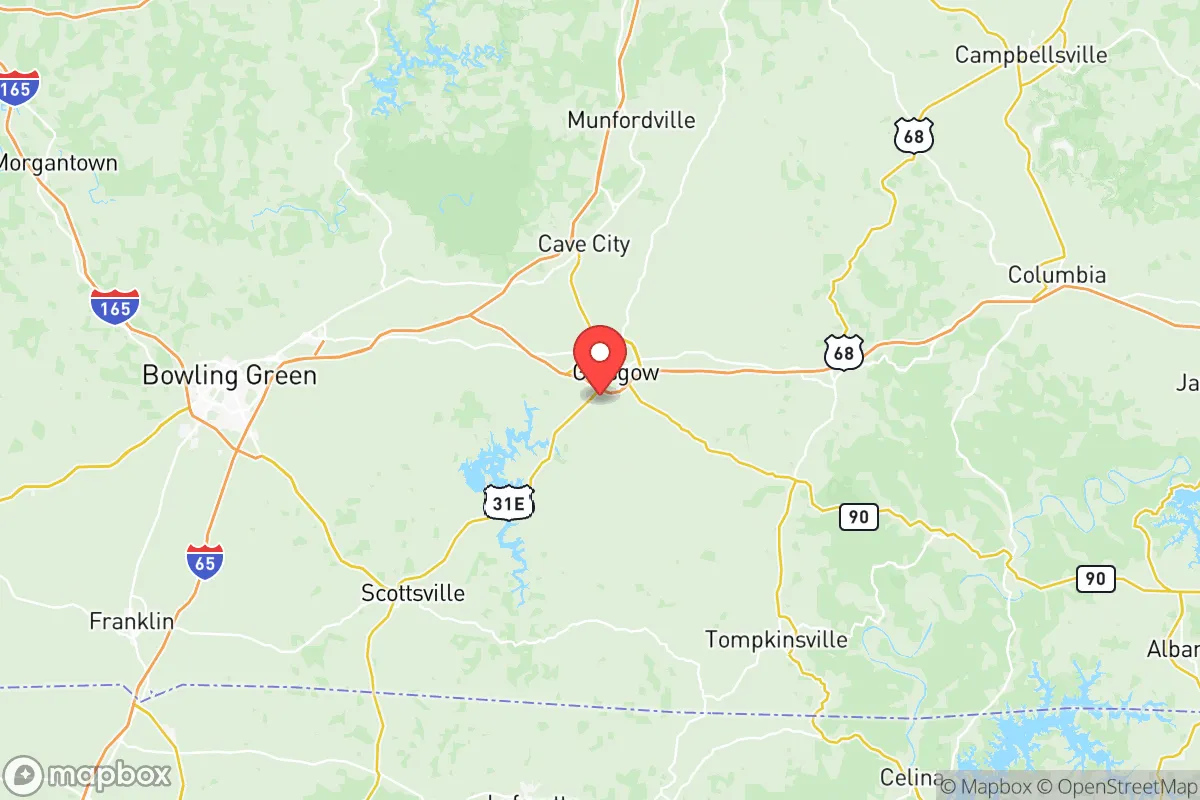
Photo: Wikipedia
Demographics of Barren County
Affluence Level in Barren County
A below-average socioeconomic profile. Incomes, home values, and educational attainment trail the U.S., with higher poverty and unemployment.
People of Barren County
Today, Barren County, Kentucky, is home to roughly 44,670 residents, a population that remains predominantly white (88.1%) and native-born (only 1.4% foreign-born), with a small but growing Hispanic community (4.3%) and a Black population of 3.6%. The county’s identity is rooted in its rural, agricultural heritage and its role as a regional service hub centered on Glasgow, the county seat and largest city. With a college-educated rate of just 17.8%, the workforce leans heavily toward manufacturing, healthcare, and retail, giving the area a down-to-earth, family-oriented character that appeals to those seeking a slower pace and lower cost of living.
Settlement & growth (pre-1960)
Before European settlement, the region that is now Barren County was part of the traditional hunting grounds of the Cherokee and Shawnee nations, who used the area’s abundant game and salt licks but maintained no permanent villages. The first white settlers arrived in the 1770s and 1780s, primarily Scots-Irish and English pioneers pushing through the Cumberland Gap along the Wilderness Road. These early families were drawn by the promise of cheap, fertile land under Virginia’s land grant system, and they established small farms and crossroads communities. The county was formally created in 1798 from parts of Warren and Green counties, with Glasgow—named after the Scottish city—designated as the seat of government in 1799.
Through the 19th century, settlement remained overwhelmingly Anglo-American, with a steady trickle of German and Irish immigrants arriving in the 1840s and 1850s to work on the Louisville and Nashville Railroad, which reached Glasgow in 1859. These newcomers tended to settle in Glasgow itself or in the railroad-adjacent hamlets of Park City and Cave City, where they found work as laborers, merchants, and craftsmen. The post-Civil War era saw a small but significant influx of freed African Americans, who concentrated in Glasgow’s south side and in rural communities like Hiseville and Eighty Eight, where they worked as sharecroppers and tenant farmers. By 1900, the county’s population had reached roughly 23,000, with the vast majority still engaged in agriculture—primarily tobacco, corn, and livestock.
The early 20th century brought little demographic change. The Great Depression and the mechanization of farming pushed many rural families off the land, but the opening of the Mammoth Cave National Park in 1941 and the construction of the Cumberland Parkway in the 1960s began to shift the economy toward tourism and services. The county’s population hovered around 28,000 through the 1950s, with Glasgow serving as the commercial and medical hub for a wide swath of south-central Kentucky. The descendants of the original Scots-Irish settlers remain the dominant cultural group today, particularly in the rural precincts around Glasgow, Edmonton, and Horse Cave.
Modern era (post-1965)
The 1965 Hart-Cellar Act had little direct impact on Barren County, as the area never attracted the large-scale immigration seen in urban centers. The foreign-born population remains minuscule at 1.4%, and the county’s racial composition has shifted only modestly since 1970. The most notable change has been the growth of the Hispanic community, which rose from near zero in 1990 to 4.3% today. This wave began in the late 1990s and accelerated after 2005, driven by men from Mexico and Central America who found work in the county’s expanding poultry processing plants and in construction. These families have concentrated in Glasgow, particularly along the U.S. 31E corridor and in the Hiseville area, where a small but visible cluster of Hispanic-owned businesses—taquerias, grocery stores, and churches—has emerged.
Domestic migration has been a more significant force. Since the 1980s, Barren County has attracted a steady stream of retirees and working-age families from the Rust Belt—especially Ohio, Indiana, and Michigan—drawn by lower housing costs, a slower pace of life, and the proximity to the Barren River Lake recreation area. These newcomers tend to settle in the lakefront communities of Lucas and Park City, as well as in the newer subdivisions on Glasgow’s north side. The county’s Black population, at 3.6%, has remained stable but aging, with younger African Americans often leaving for larger cities like Louisville or Nashville. The East/Southeast Asian community (0.7%) is tiny and largely consists of a few families employed at the local hospital or at the Glasgow industrial park, with no distinct ethnic enclave.
Suburbanization has been modest but real. Glasgow has expanded outward with strip malls, big-box stores, and single-family subdivisions, while the surrounding towns—Cave City, Horse Cave, and Edmonton—have seen slower growth and retain their small-town character. The county’s college-educated rate of 17.8% is well below the national average, reflecting a workforce that remains heavily oriented toward blue-collar and service-sector jobs. The largest employers include the T.J. Samson Community Hospital, the Dana Incorporated automotive parts plant, and several poultry processing facilities, which together anchor the local economy.
The future
Barren County is likely to become slightly more diverse over the next 10-20 years, but the pace of change will be slow. The Hispanic population is projected to grow to perhaps 6-8% as existing families have children and a trickle of new arrivals continues, but the county lacks the job base or social networks to attract large-scale immigration. The white population will continue to age and shrink slightly, as younger adults leave for college and urban job markets, while retirees from the Midwest will continue to fill lakefront and suburban homes. The Black and Asian populations are expected to remain stable at current levels, with no major influx on the horizon.
The most significant demographic trend is the gradual urbanization of Glasgow, which is absorbing a growing share of the county’s population as rural hamlets like Eighty Eight and Hiseville continue to depopulate. The county’s cultural identity—rooted in Southern Protestant traditions, hunting and fishing, and a strong sense of local independence—will remain dominant, but it will be tempered by the influence of Midwestern transplants and the small Hispanic community. The low cost of living and the absence of major social tensions make Barren County a stable, predictable place for families seeking a traditional rural or small-town lifestyle.
For someone moving in now, Barren County offers a community that is overwhelmingly white, native-born, and conservative-leaning, with a modest but growing Hispanic presence and a very small Black and Asian population. The area is not becoming a melting pot, but it is slowly absorbing new groups without the friction seen in faster-growing regions. The future points toward a slightly more diverse, slightly more suburban county that retains its agricultural roots and its reputation as a quiet, affordable place to raise a family.

* Values derived from national, state, county, city and local statistics and may differ in a specific area. Last updated: 2026-06-17T10:17:31.000Z
Narrative content on this page is AI-generated and may contain mistakes. Verify any details that matter before acting on them.
ReloMaps may earn a commission from affiliate links at no extra cost to you.

