

Photo: Wikipedia
Demographics of Keene, TX
Affluence Level in Keene, TX
A below-average socioeconomic profile. Incomes, home values, and educational attainment trail the U.S., with higher poverty and unemployment.
People of Keene, TX
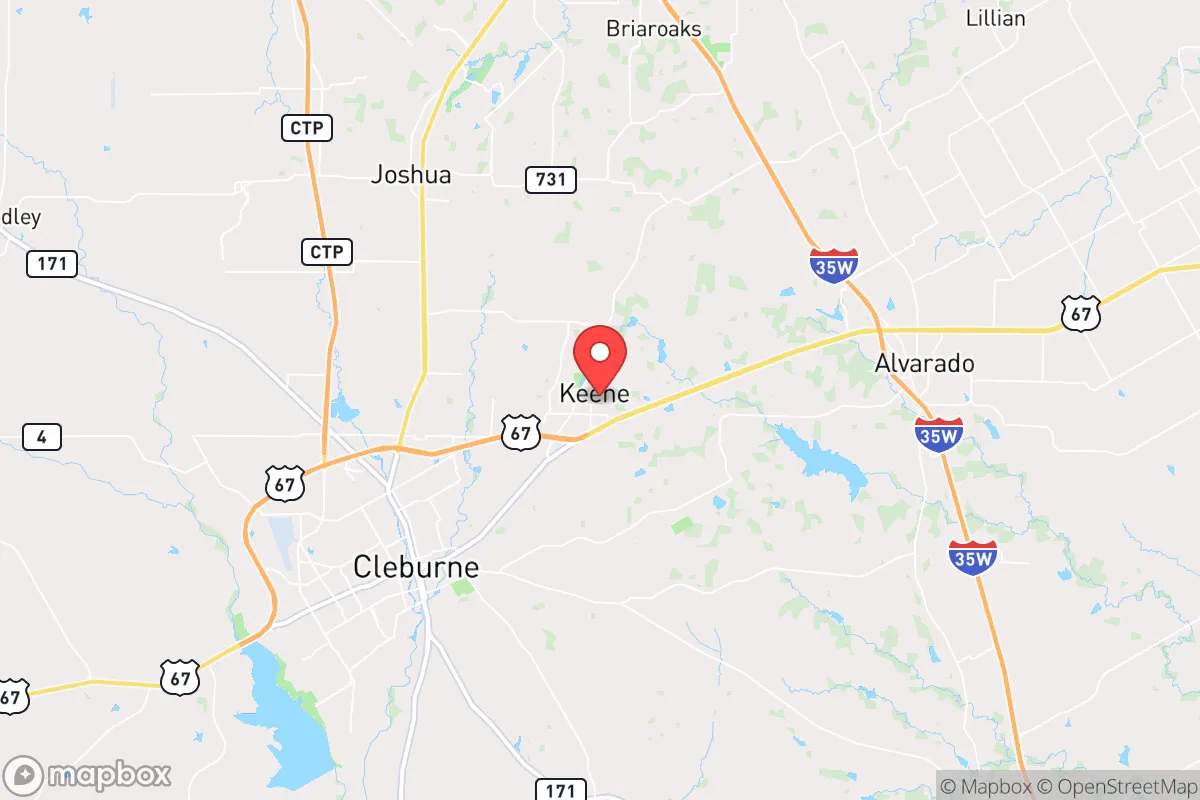
The people of Keene, Texas, today number 6,574 and form a community shaped by its Seventh-day Adventist roots, a growing Hispanic population, and a notable East and Southeast Asian presence. The city is denser than surrounding rural Johnson County, with a distinctive identity as a college town anchored by Southwestern Adventist University. This mix of religious heritage and increasing diversity gives Keene a character that is both traditional and quietly evolving, making it a unique relocation option for families seeking a small, values-oriented community with a multicultural undercurrent.
How the city was settled and grew
Keene was founded in the 1890s specifically as a Seventh-day Adventist colony, a planned religious community that drew its first wave of settlers from Adventist families across the Midwest and Northeast. These early residents were predominantly white, middle-class, and deeply committed to the church’s health and education principles. They built the core of the city around what is now College Hill, the historic neighborhood surrounding Southwestern Adventist University (founded 1893), where many of the original Victorian and Craftsman homes still stand. The Adventist church’s emphasis on health and vegetarianism also attracted a small number of German and Scandinavian immigrants who shared similar dietary and religious values, settling in the University Heights area just north of campus. By the mid-20th century, Keene remained a small, insular, and overwhelmingly white Adventist enclave, with the population hovering around 2,000 and growth limited by the church’s control over land sales.
Modern era (post-1965)
The 1965 Immigration and Nationality Act opened the door for a significant demographic shift. Southwestern Adventist University began actively recruiting international students, particularly from East and Southeast Asia, where the Adventist church had strong missionary networks. This brought the first wave of Filipino, Korean, and Vietnamese families to Keene, many of whom stayed after graduation and settled in the University Park subdivision, a post-1970s development of ranch-style homes near the campus. Today, East and Southeast Asian residents make up 5.1% of the population, a share that is roughly double the national average for a city this size. The Hispanic population began growing in the 1980s and 1990s, driven by domestic in-migration from South Texas and Mexico for work in warehousing, logistics, and the nearby Cleburne manufacturing base. These families concentrated in the Keene Estates neighborhood, a more affordable area of newer construction south of Highway 67, and in the Village Creek mobile home park. The Hispanic share now stands at 30.2%, making it the largest minority group. The white non-Hispanic population, while still a majority at 58.2%, has declined from near-total dominance in 1970 as the Adventist community has aged and younger members have moved to larger cities. The Black population remains small at 2.1%, and the Indian subcontinent population is negligible at 0.1%.
The future
Keene’s population is becoming more diverse, but the pace of change is moderate. The Hispanic share is projected to continue rising, driven by natural increase and continued in-migration for affordable housing and logistics jobs along the I-35W corridor. The East and Southeast Asian population is likely to remain stable or grow slightly, sustained by Southwestern Adventist University’s international recruitment. The white Adventist population will continue to shrink as a share, but the city’s religious identity is not fading—newer Hispanic and Asian residents often join Adventist churches, blending cultural traditions with the church’s health-focused lifestyle. New housing developments, such as the Keene Crossing subdivision planned for the city’s western edge, are attracting a mix of young families and commuters who work in Fort Worth (30 minutes north). These newcomers are less likely to be Adventist, which will slowly dilute the city’s historical religious homogeneity. Over the next 10-20 years, Keene will likely become a more typical exurb—diverse, commuter-oriented, and less insular—while retaining its Adventist college-town core.
For someone moving in now, Keene offers a small-town atmosphere with a surprising level of ethnic diversity, anchored by a stable religious institution. The city is becoming more connected to the Dallas-Fort Worth metroplex, which brings economic opportunity but also gradual cultural change. It is a good fit for families who value a quiet, safe environment with a distinct community identity, and who are comfortable with a population that is increasingly Hispanic and Asian but still predominantly white and Adventist in its institutions.

* Values derived from national, state, county, city and local statistics and may differ in a specific area. Last updated: 2026-10-17T17:11:59.000Z
Narrative content on this page is AI-generated and may contain mistakes. Verify any details that matter before acting on them.
ReloMaps may earn a commission from affiliate links at no extra cost to you.

