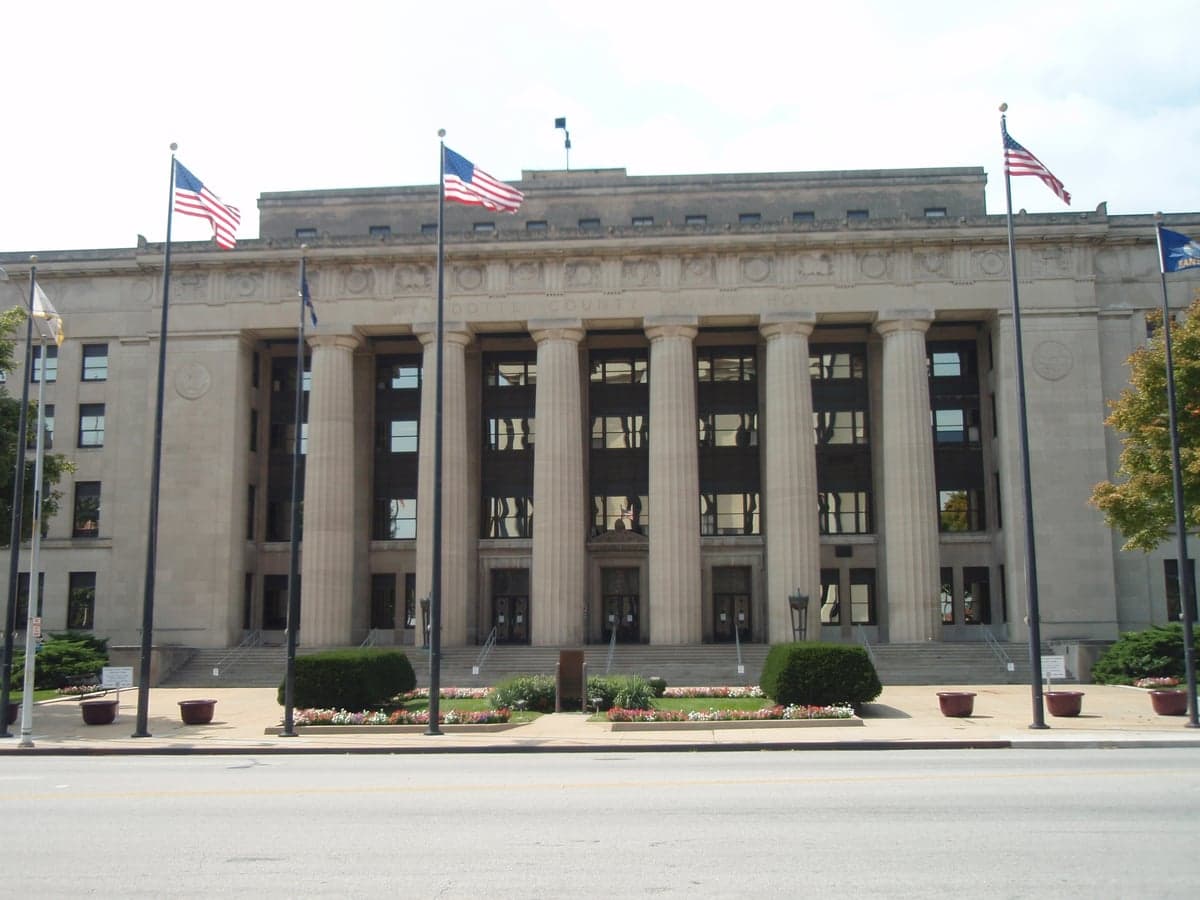
Photo: Wikipedia
Political ClimatePolitical Climate in Wyandotte County
Showing district-level results — no local-only data available.
Local Political AnalysisPolitical Analysis of Wyandotte County
Wyandotte County, Kansas, is the state's deepest blue stronghold, a Democratic island in a sea of red. Despite the county’s Cook Partisan Voting Index (PVI) of R+10, which reflects the statewide leaning of Kansas, the reality on the ground is far more nuanced. In 2024, Democratic candidates consistently won the county by 20-30 points, driven by the urban core of Kansas City, KS, while the rural and suburban fringes—like the towns of Bonner Springs and Edwardsville—have voted increasingly Republican. The trend is subtle but real: the county is becoming more polarized, with the city-center deepening its blue hue as the outer ring shifts rightward, while the state as a whole remains solidly R+9.
How it compares to the rest of Kansas
Comparing Wyandotte County to the rest of Kansas is like comparing two different states under one capitol. While Kansas’s R+9 PVI reflects a reliably Republican electorate driven by places like Johnson County and rural farm communities, Wyandotte’s Democratic lean is rooted in a densely populated, racially diverse, and union-heavy workforce. In Kansas City, KS, precincts along State Avenue and near the Turner neighborhood consistently deliver 70-80% Democratic margins. Drive 15 minutes west to Bonner Springs, and you’ll find precincts that flip to 55-60% Republican, especially around the Wyandotte County Park area. Edwardsville follows a similar pattern, while the tiny township of Piper, near the county's northern edge, is a genuine swing area—often splitting 50-50 in local races. This internal variation means the county’s overall Democratic majority masks a growing suburban conservative undercurrent that mirrors the national trend.
What this means for residents
For a conservative living in Wyandotte County, the political reality is one of feeling outnumbered but not powerless. County commission and school board races in the Bonner Springs area are often hotly contested, and the Kansas GOP has made deliberate efforts to invest in these suburban precincts since 2020. A conservative homeowner in Edwardsville might find their local city council leans center-right, but their state representative is likely a Democrat. For liberals in Kansas City, KS, the county government is a reliable ally—policies around affordable housing, public transit funding through the Kansas City Area Transportation Authority, and immigrant services are generally progressive. However, state laws from Topeka—like tax caps and restrictions on local zoning—can handcuff the county’s ambitions. Both sides agree on one thing: property taxes are high (the county mill levy sits around 100 mills), and political energy is often consumed by local fights over spending and development at the Legends Outlets or the new commercial zones near Village West.
Culturally, Wyandotte County feels distinctly different from the rest of Kansas. It is one of the few counties in the state with a thriving multi-ethnic fabric—large Latino and African American communities give Kansas City, KS a vibe closer to its Missouri neighbor than to rural Kansas. The local policy distinction that most defines life here is the county's status as a "home rule" champion: it has consistently pushed back on state preemption, from plastic bag bans to local minimum wage attempts. For a new resident, the political climate means your vote genuinely matters in a way it might not in a deep-red county—statewide Democrats depend entirely on turning out Wyandotte’s base, so local issues get outsized attention during election cycles. Whether you lean left or right, you live in a place where politics feels immediate, not academic.

State Political ClimatePolitical Climate in Kansas
State Political AnalysisPolitical Environment in the State
Kansas is a solidly Republican state with a Cook PVI of R+9, but that label masks a more nuanced reality: the state has been trending rightward in presidential races while simultaneously experiencing fierce internal battles between its dominant conservative wing and a more moderate, business-friendly faction. Over the past 10-20 years, the GOP’s grip has tightened at the statewide level—Donald Trump won the state by 15 points in 2020 and 20 points in 2024—but the state legislature and governor’s office have seesawed between hardline and pragmatic conservatism, creating a political climate that feels both reliably red and unpredictably factional. For a relocator, this means you’ll find a state that is broadly conservative in culture and policy, but with real variation depending on where you land and what issues matter most to you.
Urban vs. rural divide
The political map of Kansas is a textbook study in urban-rural polarization. The two major population centers—Johnson County (suburban Kansas City) and Sedgwick County (Wichita)—are the state’s swing regions, while the rest of the state is deeply red. Johnson County, home to Overland Park, Olathe, and Lenexa, has been the epicenter of Kansas’s political drama: it was a stronghold of the moderate Republican “Mainstream” coalition that fought the 2012-2017 Brownback tax experiment, and it has trended slightly toward Democrats in recent cycles, though it still leans Republican. Wichita’s Sedgwick County is more reliably conservative but has a sizable Democratic base in the city proper. Meanwhile, rural counties like Thomas County (Colby) and Finney County (Garden City) routinely vote 80%+ Republican, driven by agricultural interests and social conservatism. The state’s only reliably blue stronghold is Douglas County (Lawrence), home to the University of Kansas, which has voted Democratic by double digits in every recent election. The political divide isn’t just about geography—it’s about worldview: the rural-urban split in Kansas is among the sharpest in the nation, with Johnson County’s suburban moderates often at odds with the rural conservative base over education funding, tax policy, and social issues.
Policy environment
Kansas’s policy environment is defined by its low-tax, low-regulation posture, but with notable exceptions. The state has a flat income tax rate of 5.7% (down from a top rate of 6.45% in 2020) and no inheritance tax, and it’s a right-to-work state. Property taxes are relatively high compared to neighboring states, but the state’s overall tax burden is below the national average. On education, Kansas has a long history of school funding litigation—the state supreme court has repeatedly ruled that the legislature’s funding formula is inadequate, leading to a series of funding increases that have satisfied the court but angered fiscal conservatives. Healthcare policy is a mixed bag: Kansas did not expand Medicaid under the Affordable Care Act, leaving roughly 150,000 low-income adults in a coverage gap, but the state has a robust network of rural hospitals and a strong telehealth infrastructure. Election laws are moderately restrictive: Kansas requires a photo ID to vote, has a voter registration deadline 21 days before an election, and does not offer no-excuse absentee voting (you need a reason). The state’s regulatory posture is generally business-friendly, with limited environmental regulations and a strong agricultural focus.
Recent policy direction
The last five years have seen Kansas lurch rightward on several fronts, but with some surprising brakes. In 2022, the legislature passed a near-total abortion ban, but it was decisively rejected by voters in a statewide referendum—the first such vote after Dobbs—with 59% of Kansans voting to protect abortion rights. This was a watershed moment: it showed that even in a red state, voters are wary of extreme social restrictions. On guns, Kansas is a constitutional carry state (no permit needed to carry concealed), and in 2023 the legislature passed a law prohibiting local governments from enforcing federal gun regulations—a “Second Amendment Sanctuary” measure. On education, the state has seen a surge in school choice legislation: in 2024, the legislature created a universal education savings account program that allows any student to use state funds for private school tuition, a major win for conservatives. Parental rights bills have been passed, including a 2023 law requiring schools to notify parents of any changes to a student’s “well-being” (widely seen as targeting transgender students). On property rights, Kansas has strong eminent domain protections and a low property tax cap, but local governments retain significant zoning authority. On voting, the state has tightened ballot access: in 2021, it passed a law requiring signature verification for mail ballots and limiting drop box locations, though it stopped short of the most restrictive measures seen in other states. The overall direction is clearly conservative, but the abortion referendum and the state supreme court’s education funding rulings show that the state’s libertarian and moderate streaks still have real power.
Civil unrest & political movements
Kansas has not seen the kind of large-scale civil unrest common in coastal states, but it has its own political flashpoints. The most visible in recent years has been the anti-abortion and abortion-rights movements: the 2022 referendum drew massive turnout and intense activism on both sides, with pro-choice groups organizing heavily in Johnson County and pro-life groups dominating rural areas. Immigration politics are less heated than in border states, but there is a significant immigrant population in western Kansas (especially in Finney County and Seward County), where meatpacking plants employ large numbers of Latino workers. This has led to occasional tensions over sanctuary policies—several Kansas cities, including Lawrence and Kansas City, Kansas, have declared themselves “welcoming cities,” but the state legislature has repeatedly tried to ban such policies. Election integrity controversies have been relatively muted compared to states like Arizona or Georgia, but there was a brief controversy in 2020 when then-Secretary of State Scott Schwab (a Republican) defended the state’s mail-in voting system against attacks from within his own party. The most organized political movements are the Kansas Republican Party’s internal factions: the “Mainstream” moderates (strong in Johnson County) and the “Kansas GOP” conservatives (strong in rural areas) have been locked in a decade-long civil war over tax policy, education funding, and social issues. For a new resident, this means you’ll see a lot of primary election drama and legislative gridlock, but not much street-level unrest.
Projection
Over the next 5-10 years, Kansas is likely to continue its slow rightward drift at the presidential level, but with significant internal volatility. The key demographic trend is the growth of Johnson County, which is becoming more diverse and more educated—this could push the state toward a more suburban, moderate Republicanism, similar to what’s happened in Colorado or Virginia. However, the rural population is shrinking, which could amplify the power of the conservative base in the legislature. The state’s in-migration is modest but positive, with most new arrivals coming from other Midwestern states and Texas, and they tend to be slightly more conservative than the existing population. The biggest wildcard is the state’s fiscal health: the 2012-2017 Brownback tax cuts led to massive budget shortfalls, and the state is still recovering. If the current flat tax and school choice expansions create new fiscal pressures, it could trigger a backlash from moderate voters. For a relocator, the realistic expectation is that Kansas will remain a solidly red state, but with a more pragmatic, suburban flavor than states like Oklahoma or Missouri. The abortion referendum showed that voters will push back against extreme social policies, so don’t expect a total ban or a dramatic leftward shift.
For a new resident, the bottom line is this: Kansas offers a conservative policy environment with low taxes, strong gun rights, and a business-friendly climate, but it’s not a monolith. If you’re a conservative, you’ll find a state that largely aligns with your values, but you’ll also encounter a lively internal debate between moderates and hardliners. If you’re a liberal, you’ll find a few blue islands—Lawrence, parts of Kansas City, and pockets of Johnson County—where you can live comfortably, but you’ll be in a clear minority at the state level. The practical takeaway is to choose your location carefully: Johnson County offers suburban amenities and a more moderate political culture, while rural Kansas offers a deeply conservative, community-oriented lifestyle. Either way, you’ll be moving to a state where politics is serious business, but where the fights are more about budgets and school funding than about street protests or cultural warfare.
* Values derived from national, state, county, city and local statistics and may differ in a specific area. Last updated: 2026-07-03T00:26:45.000Z
Narrative content on this page is AI-generated and may contain mistakes. Verify any details that matter before acting on them.
ReloMaps may earn a commission from affiliate links at no extra cost to you.

