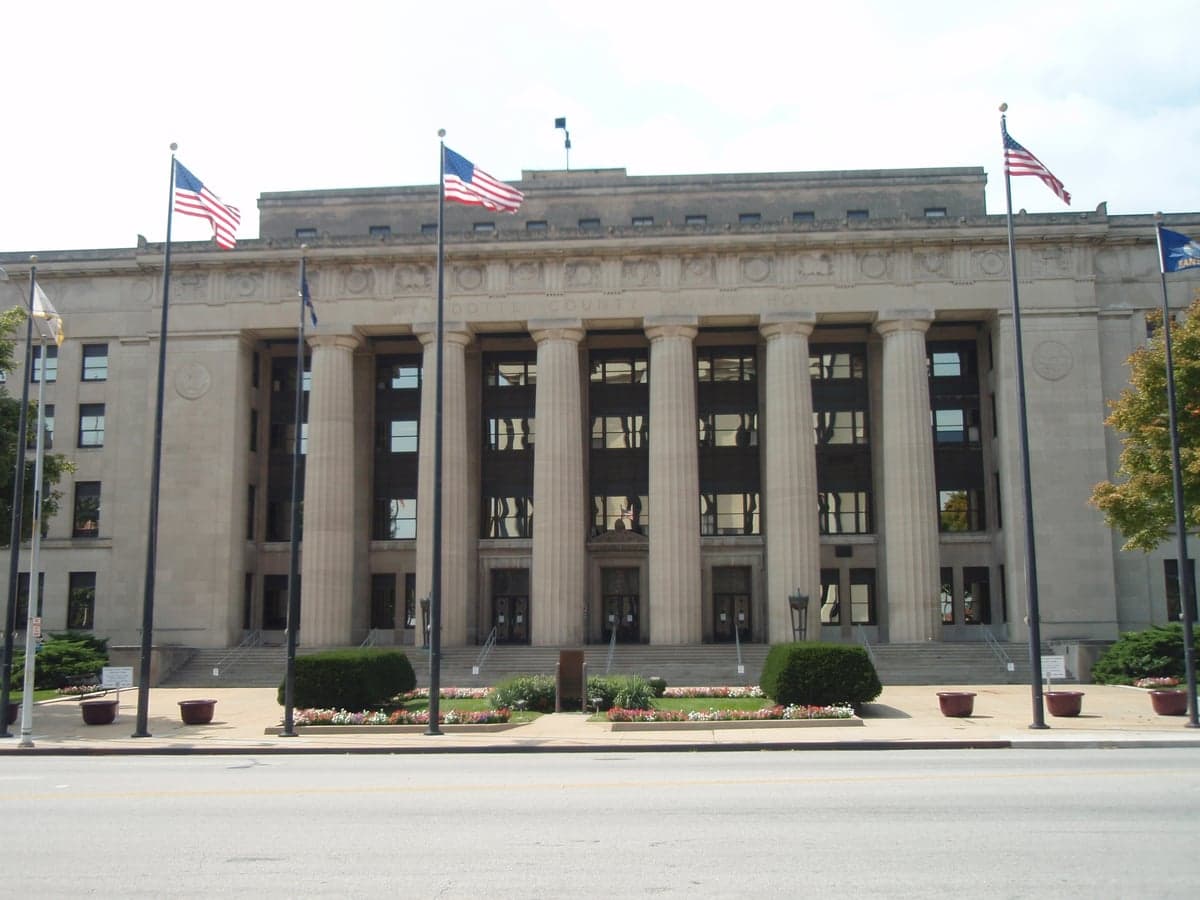
Photo: Wikipedia
Demographics of Wyandotte County
Affluence Level in Wyandotte County
A middle-class area roughly in line with national averages across income, home values, education, and employment.
People of Wyandotte County
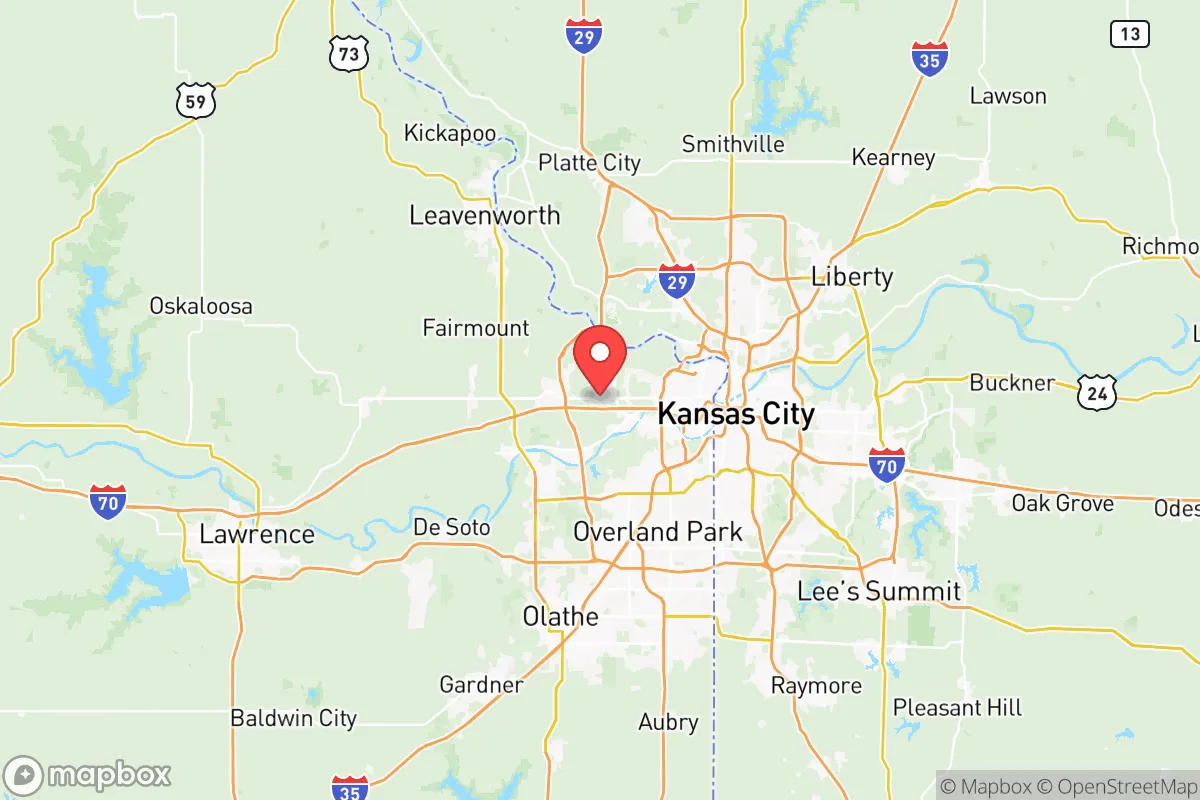
Today, Wyandotte County, Kansas, is one of the most ethnically diverse and densely populated counties in the state, home to roughly 167,000 residents in a compact 156 square miles. Its character is defined by a striking blend of a majority-minority population—37.2% White, 33.3% Hispanic, 18.8% Black, and 4.5% East/Southeast Asian—alongside a 12.7% foreign-born share and a relatively young median age. The county's identity is a working-class, urbanized core anchored by Kansas City, Kansas, with industrial roots in meatpacking, railroads, and manufacturing that have continuously reshaped who lives here.
Settlement & growth (pre-1960)
The land that would become Wyandotte County was originally inhabited by the Kansa and Osage peoples, who used the confluence of the Kansas and Missouri Rivers as a hunting and trading crossroads. French fur traders and missionaries passed through in the 1700s, but permanent European-American settlement began in earnest after the 1820s, when the U.S. government forcibly removed the Wyandot Nation (Huron) from Ohio and granted them a reservation at the river junction. By 1855, the Wyandot had sold most of their land, and the city of Kansas City, Kansas was platted, attracting American settlers from the East and Midwest who saw the potential for a river-port and railroad hub.
From the 1860s through the 1920s, the dominant wave of immigration was European. Irish immigrants arrived to build the railroads and dig the levees, settling in working-class neighborhoods like Armourdale and the West Bottoms. German and German-Russian families followed, drawn by meatpacking and flour milling jobs, and their descendants still anchor communities in Strawberry Hill and Rosedale. At the same time, newly freed African Americans moved to the county during Reconstruction, finding factory and railroad work, forming the core of the Black community in neighborhoods like Douglass Avenue and Eighth Street. The Great Migration (1910–1970) brought tens of thousands more Black families from the Deep South, cementing the county's role as a regional industrial stronghold.
A smaller but notable wave of Polish and Italian immigrants also arrived in the early 1900s, clustering near the packing plants of the Kansas River valley. By 1930, the county was roughly 80% White (most of European descent), 15% Black, and 5% other, with a rapidly expanding industrial base that included the Fairfax plant (later GM’s Fairfax Assembly) and the Kaw River railyards. The Dust Bowl and the Great Depression slowed migration, but the county's population held steady through World War II and the post-war boom, peaking around 165,000 in 1960.
Modern era (post-1965)
The 1965 Hart-Cellar Act reshaped Wyandotte County’s demographics more dramatically than any other single policy. Before 1965, the foreign-born share was negligible; today it is 12.7%, and the county is one of the fastest-diversifying in the Midwest. The first major new wave was Mexican immigration, which began in the 1970s and accelerated through the 1990s, driven by meatpacking and construction jobs. Hispanic residents now make up 33.3% of the population, with the largest concentration in Argentine and the Central Avenue corridor of Kansas City, Kansas. A dense network of tiendas, panaderías, and Spanish-language churches anchors a vibrant community that has grown from a few thousand in 1970 to over 55,000 today.
Since 1990, the county has also seen significant growth from East and Southeast Asian communities, particularly Vietnamese and Laotian families who arrived as refugees after the Vietnam War, and later through chain migration. They have clustered in the Merriam Lane and Bishop Ward High School areas, and their share of the population now stands at 4.5%. Smaller but growing Indian-subcontinent communities (0.7%) are more dispersed, often drawn by employment at the University of Kansas Medical Center or the region's logistics and IT firms. The Black population, which had peaked at around 28% in 1980, has declined slightly to 18.8% as some families moved to suburban Johnson County, while newer African immigrants (Somalis, Liberians) have partially offset that loss, particularly in the Kansas City, Kansas central neighborhoods.
Domestic migration has also shifted the county's character. From the 1970s through the 1990s, White flight to western suburbs like Shawnee and Lenexa reduced the non-Hispanic White share from 65% to under 40% by 2020. However, in the last decade, a modest counter-movement of younger White professionals—drawn by low housing costs and urban proximity—has begun to buy homes in neighborhoods like Piper and Village West. The county’s college-educated share remains low at 20.5%, reflecting its blue-collar base, though that number is slowly rising as new service-sector and healthcare jobs emerge.
The future
Wyandotte County is heading toward a non-White majority of roughly 70–75% by 2040, driven primarily by Hispanic natural increase and continued immigration. The White population is projected to decline further in absolute numbers, though not as steeply as in the 1980s and 1990s. The foreign-born share will likely climb past 15% as refugee resettlement (especially from Central America and East Africa) continues, and as the county becomes a secondary destination for immigrants priced out of coastal cities.
New communities are concentrating in the Village West and Legends area, a mixed-use development around a casino and shopping complex that has become a hub for retail and hospitality workers of all backgrounds. Meanwhile, the older industrial neighborhoods—Armourdale, Argentine, and the West Side—are seeing modest reinvestment, though they remain majority-minority and lower-income. The county’s cultural identity is shifting from a historically Black-and-European industrial patchwork to a multi-ethnic, Hispanic-plurality landscape where Spanish is heard as commonly as English in many public spaces.
For someone moving in now, Wyandotte County offers a compact, affordable urban environment with genuine diversity and a strong sense of community rooted in shared working-class history. The population is growing slowly but becoming younger and more mixed, making it a place where families can find affordable housing and a neighborly feel—especially if they are comfortable living in one of the most demographically dynamic counties in the Great Plains.

* Values derived from national, state, county, city and local statistics and may differ in a specific area. Last updated: 2026-07-03T00:26:45.000Z
Narrative content on this page is AI-generated and may contain mistakes. Verify any details that matter before acting on them.
ReloMaps may earn a commission from affiliate links at no extra cost to you.

