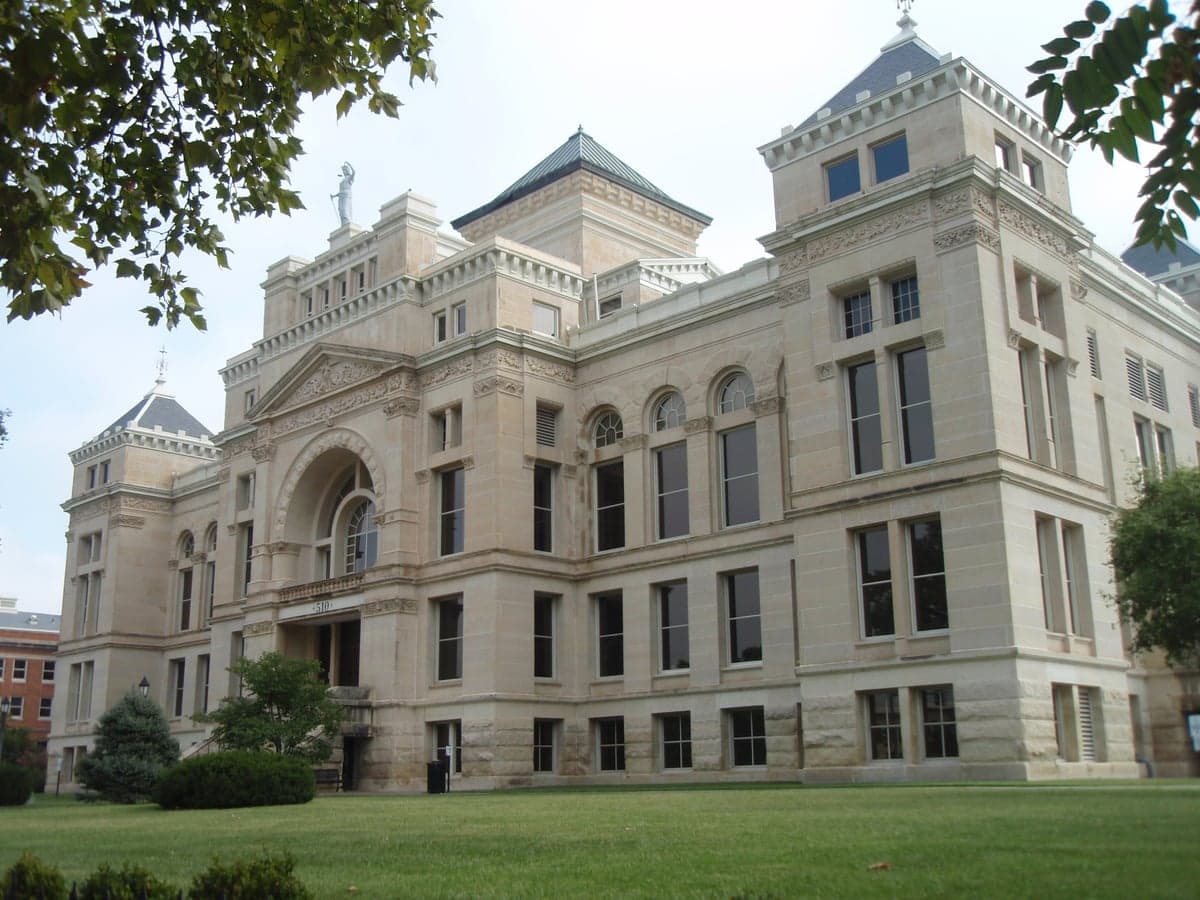
Photo: Wikipedia
Political ClimatePolitical Climate in Sedgwick County
Showing district-level results — no local-only data available.
Local Political AnalysisPolitical Analysis of Sedgwick County
Sedgwick County has long been a solid Republican stronghold, but like much of Kansas, it's seen a slow drift leftward in recent cycles that's worth keeping an eye on. The county's Cook Partisan Voting Index (PVI) sits at R+12, meaning it typically votes about 12 points more Republican than the national average. That's a bit redder than the state of Kansas as a whole, which has a PVI of R+9, but the gap has narrowed over the past decade. The real story here isn't the countywide numbers—it's the growing divide between the urban core and the rest of the county.
How it compares
When you compare Sedgwick County to the rest of Kansas, the difference is mostly about Wichita. The city itself has been trending more purple, with precincts around Old Town, College Hill, and the Delano district consistently voting Democratic in recent elections. Meanwhile, the suburban and rural parts of the county—places like Andover, Maize, Goddard, and Derby—remain deeply red, often voting 70% or more Republican. That's where the R+12 rating comes from: the suburbs and exurbs pull the county right, while Wichita's core pulls it left. The state as a whole, by contrast, has a more uniform conservative base outside of Johnson County and Lawrence, so Sedgwick's internal split is actually more pronounced than Kansas's overall lean. It's a microcosm of the national urban-rural divide, and it's getting sharper every cycle.
What this means for residents
For folks living here, the political climate means you'll see a real mix of policies depending on where you are. The county commission and city council have stayed reliably conservative on most issues—property taxes are kept relatively low, zoning is business-friendly, and there's been little appetite for the kind of progressive social experiments you see in places like Lawrence or Kansas City. But the shift in Wichita's core is starting to show up in local elections. In 2023, the city council saw a couple of close races where more progressive candidates nearly won seats, which would have been unthinkable a decade ago. That's concerning if you value limited government and personal freedoms—once those folks get a foothold, they tend to push for more regulations, higher spending, and policies that infringe on your rights, like mask mandates or business closures. The county's rural towns are pushing back hard, but the demographic trends aren't in their favor.
Culturally, Sedgwick County still feels like old-school Kansas: church on Sunday, barbecue on Saturday, and a general distrust of government overreach. You won't find the kind of aggressive lockdowns or vaccine mandates that plagued other parts of the country during COVID—the county commission here pushed back hard on state-level overreach. But the progressive tide is lapping at the edges, especially in Wichita's schools and city planning departments. If you're looking for a place where your rights are respected and the government stays out of your life, the suburbs and small towns like Colwich, Bentley, and Cheney are where you want to be. The city itself? Keep an eye on it—it's still solid, but the foundation's cracking.

State Political ClimatePolitical Climate in Kansas
State Political AnalysisPolitical Environment in the State
Kansas is a solidly Republican state with a Cook PVI of R+9, but don't let that number fool you into thinking it's a monolith. Over the past 20 years, the state has shifted from a reliably conservative stronghold to a place where the dominant coalition is split between traditional, small-government conservatives and a more populist, culturally-focused wing, while the Kansas City suburbs have drifted leftward. The real story is a tug-of-war between the state legislature's conservative supermajority and the occasional moderate governor, creating a political climate that feels both deeply red and surprisingly volatile depending on where you stand.
Urban vs. rural divide
The political map of Kansas is a textbook case of the urban-rural split. The eastern third of the state, anchored by Kansas City (Wyandotte and Johnson Counties), is the Democratic stronghold. Johnson County, once reliably red, has been trending blue for a decade, driven by an influx of professionals and younger families from the Missouri side. In 2020, Joe Biden won Johnson County by about 8 points, a flip that would have been unthinkable 20 years ago. Lawrence (Douglas County), home to the University of Kansas, is the state's most liberal enclave, consistently voting 2-to-1 Democratic. Meanwhile, Topeka (Shawnee County) and Wichita (Sedgwick County) are battlegrounds—Topeka leans slightly Democratic but is competitive, while Wichita, the state's largest city, is a purple island in a sea of red, with its suburbs like Andover and Derby voting heavily Republican. The rest of the state—the vast rural plains, the Flint Hills, and the western counties like Garden City and Dodge City—is deeply red. These areas are the engine of the GOP supermajority, with many counties routinely voting 75-80% Republican. The divide isn't just about party; it's about worldview: rural Kansans see the state government as a protector of agricultural and gun rights, while urbanites increasingly view it as an obstacle to progressive social policy.
Policy environment
Kansas's policy environment is a mixed bag for conservatives. The tax structure is the most famous battleground. The "Kansas Experiment" under Governor Sam Brownback (2012-2018) slashed income taxes, which the legislature later reversed after revenue shortfalls. Today, the state has a flat income tax rate of 5.7% (down from a top rate of 6.45% before the experiment), and the sales tax is 6.5%, with local add-ons. Property taxes are moderate but have been creeping up, especially in fast-growing Johnson County. The regulatory posture is generally business-friendly, with a right-to-work law and limited zoning in most rural areas. On education, the state has a long-running school funding lawsuit, with the Kansas Supreme Court repeatedly ordering the legislature to increase spending. This has created a persistent tension between the conservative legislature, which wants to fund schools through block grants, and the court, which demands equity. Healthcare policy is a flashpoint: Kansas has not expanded Medicaid under the Affordable Care Act, a decision that leaves about 150,000 low-income adults in a coverage gap. Election laws are conservative: the state requires a photo ID to vote, has strict voter registration deadlines, and in 2021 passed a law banning ballot drop boxes except in county election offices. For a conservative, the policy environment is largely favorable on taxes and regulation, but the constant court battles over education and the Medicaid standoff create a sense of unfinished business.
Trajectory & freedom
On the freedom front, Kansas has been a mixed bag, but the trend over the last five years is toward more personal liberty in key areas. Gun rights are robust: Kansas is a constitutional carry state (permitless carry for adults 21 and older, passed in 2015), and in 2021 the legislature passed a law prohibiting state and local enforcement of federal gun laws that don't have a Kansas equivalent—a direct challenge to federal overreach. Parental rights saw a major win in 2023 with the passage of the "Parents' Bill of Rights," which requires schools to notify parents of any changes to a student's mental, emotional, or physical health, and gives parents the right to review instructional materials. This was a direct response to concerns about critical race theory and gender ideology in schools. On medical autonomy, Kansas voters in 2022 overwhelmingly rejected a constitutional amendment that would have removed the right to abortion, preserving the state Supreme Court's 2019 ruling that the state constitution protects abortion access. This was a shock to the conservative legislature, which has since passed incremental restrictions like a 24-hour waiting period and a ban on telemedicine abortions. Property rights are generally strong, with limited eminent domain abuse, though wind farm siting has caused friction in rural areas. The trajectory is clear: the legislature is pushing to expand liberty on guns, parental rights, and religious freedom, while the courts and voters have checked them on abortion. A new resident should expect a state that is becoming more protective of conservative freedoms, but with a persistent judicial and urban counterweight.
Civil unrest & political movements
Kansas is not a hotbed of civil unrest, but there have been notable flashpoints. The most visible was the 2022 abortion amendment campaign, which saw massive grassroots organizing on both sides, with pro-choice groups outspending and out-mobilizing pro-life ones in the suburbs. This was a wake-up call for conservatives that the Kansas City suburbs are not reliably red on social issues. On the right, the Kansas Republican Party has seen a takeover by the more populist, Trump-aligned wing, with the moderate faction largely purged from leadership. This has led to internal fights over primary challenges and platform purity. Immigration politics are quieter than in border states, but Garden City and Dodge City have large immigrant populations (many working in meatpacking), and the legislature has passed laws requiring E-Verify for public employers and banning sanctuary cities. There is no serious secession or nullification rhetoric, though the 2021 gun preemption law is a form of nullification. Election integrity controversies flared after 2020, with the legislature passing the aforementioned voting restrictions, but there have been no widespread fraud allegations. A new resident would notice the political activism is most visible in the suburbs—yard signs, school board meetings, and local PACs—rather than street protests. The overall vibe is one of organized, institutional political combat rather than chaotic unrest.
Projection
Over the next 5-10 years, Kansas is likely to become more politically polarized, not less. The key demographic shift is the continued growth of Johnson County, which is attracting younger, more educated, and more diverse residents from the coasts and from Missouri. This will make the state more competitive at the statewide level—expect future gubernatorial and Senate races to be closer than the R+9 PVI suggests. However, the rural areas are not shrinking as fast as in some Plains states, thanks to agriculture and meatpacking, so the legislature will remain under conservative control for the foreseeable future. The wildcard is the Kansas Supreme Court, which will continue to be a battleground over school funding and abortion. A conservative governor could eventually reshape the court through retirements, but that's a long game. For a conservative moving in now, expect a state where you can live in a red suburb like Andover or Basehor and send your kids to schools that respect parental rights, but where you'll also see the Kansas City metro increasingly vote like a blue state. The freedom trajectory is positive on guns and parental rights, but the tax and education fights will continue. The bottom line: Kansas is a good bet for a conservative who wants a low-cost, family-friendly state with strong gun laws and a legislature that fights for traditional values, but you'll need to be engaged locally to keep the suburban drift from turning the whole state purple.
For a new resident, the practical takeaway is this: Kansas offers a solid conservative foundation with a legislature that is actively expanding personal freedoms on guns, parental rights, and religious liberty. The cost of living is low, the people are friendly, and the politics are serious but not chaotic. However, you cannot be complacent—the Kansas City suburbs are a political battleground, and the state Supreme Court is a persistent check on conservative policy. If you're moving to Wichita, Topeka, or a small town, you'll find a community that largely shares your values. If you're moving to Overland Park or Lenexa, you'll be in a purple zone where your vote and your voice matter more than ever. Kansas is still a red state, but it's a red state that requires you to stay involved.
* Values derived from national, state, county, city and local statistics and may differ in a specific area. Last updated: 2026-05-16T06:11:50.000Z
Narrative content on this page is AI-generated and may contain mistakes. Verify any details that matter before acting on them.
ReloMaps may earn a commission from affiliate links at no extra cost to you.

