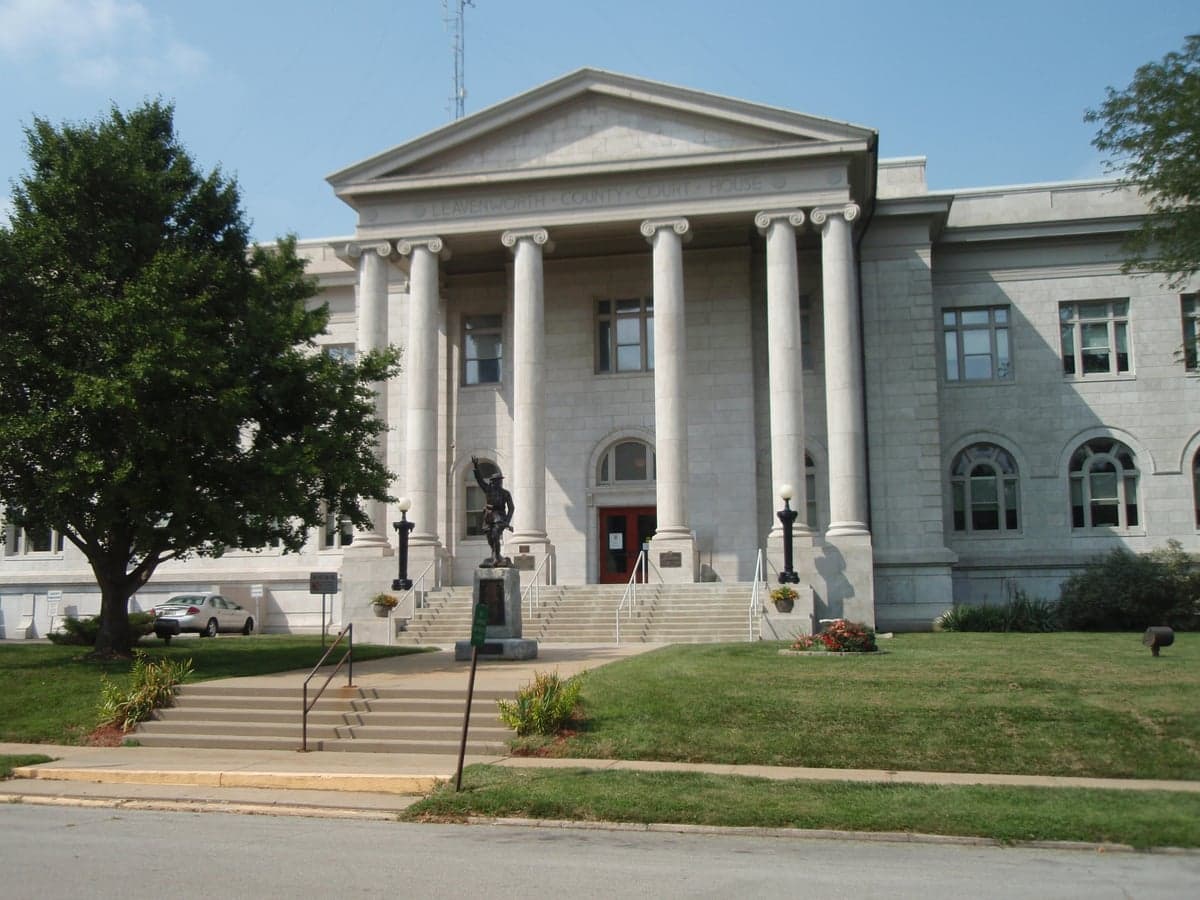
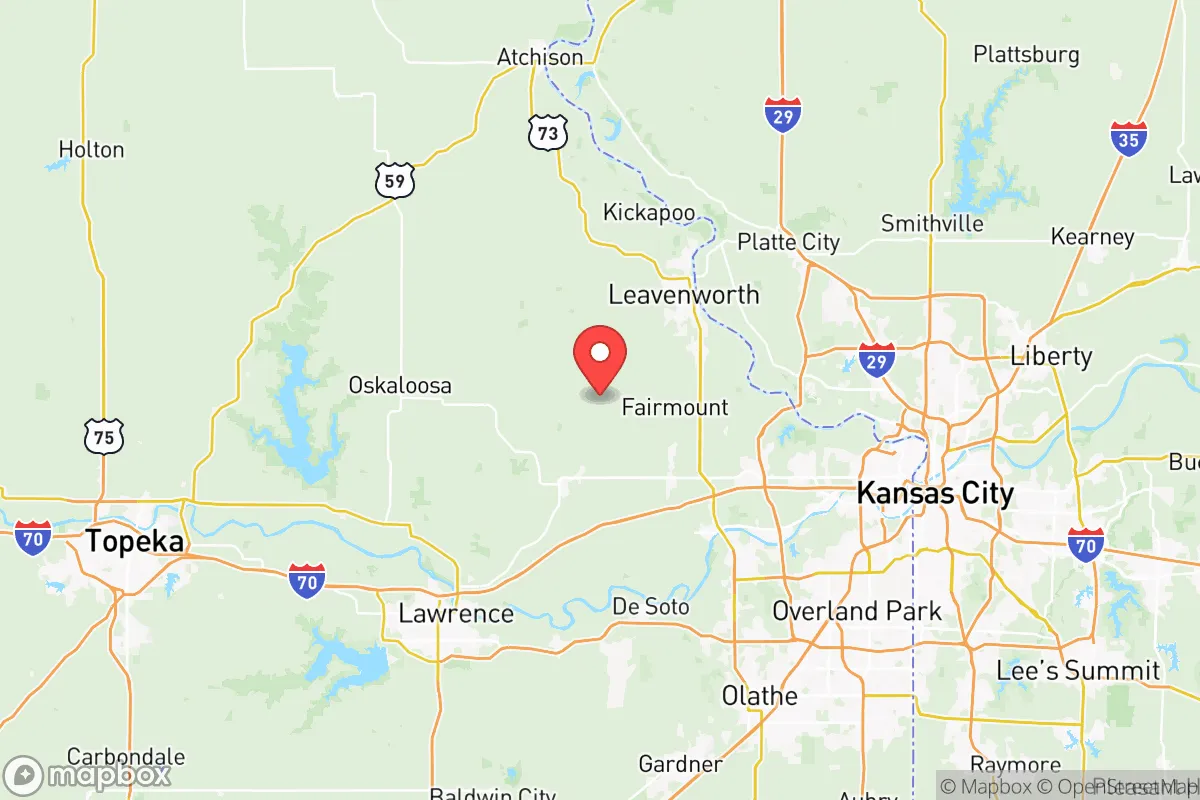
Photo: Wikipedia
Demographics of Leavenworth County
Affluence Level in Leavenworth County
A middle-class area roughly in line with national averages across income, home values, education, and employment.
People of Leavenworth County
Leavenworth County, Kansas, is home to 82,493 residents who live in a historically military- and agriculture-rooted community that remains predominantly white (77.7%) with a small but growing Hispanic population (7.3%) and a Black population of 7.2%. The county’s character is shaped by its role as the birthplace of Kansas Territory, its long-standing military presence at Fort Leavenworth, and a suburban-to-rural mix that leans conservative. With only 1.7% foreign-born residents and a college attainment rate of 36.6%, the population is relatively homogeneous and native-born compared to national averages, yet it is slowly diversifying through domestic migration from the Kansas City metro area.
Settlement & growth (pre-1960)
Before American settlement, the land that became Leavenworth County was home to the Kanza (Kaw) and Osage nations, who used the Missouri River bottomlands for hunting and seasonal camps. French fur traders and trappers passed through the area in the 1700s, but no permanent European settlements took root until the United States acquired the territory through the Louisiana Purchase in 1803. The U.S. Army established Fort Leavenworth in 1827, making it the oldest permanent white settlement in Kansas and a critical outpost for protecting the Santa Fe and Oregon Trails.
The county’s first major population wave came with the Kansas-Nebraska Act of 1854, which opened the territory to settlement and ignited the “Bleeding Kansas” conflict. Pro-slavery settlers from Missouri crossed into Leavenworth County, founding the city of Leavenworth in 1854 as a stronghold for the pro-slavery “Law and Order Party.” Simultaneously, free-state settlers from New England and the Upper Midwest arrived, establishing communities like Lansing and Tonganoxie. The town of Easton was platted in 1854 by free-state advocates, while Basehor emerged later as a farming hamlet. By 1860, the county’s population had surged to over 12,000, fueled by the military economy and river trade.
After the Civil War, the county attracted German and Irish immigrants who worked as farmers and laborers. German Catholics settled in the rural areas around Linwood and Jarbalo, establishing churches and schools that remain landmarks today. Irish immigrants concentrated in Leavenworth city, working in the stockyards and on the railroad. The post-Reconstruction era also brought a small number of freed African Americans, who formed a community in Leavenworth’s “Riverview” neighborhood and later in East Leavenworth. The 1880s saw the arrival of Czech and Slovak immigrants, who farmed near McLouth and Pleasant Grove. By 1900, the county’s population reached 20,000, with agriculture—especially corn, wheat, and livestock—as the economic backbone.
The early 20th century brought little new immigration, as the county’s economy stagnated relative to booming Kansas City. Fort Leavenworth remained the largest employer, housing the U.S. Disciplinary Barracks and the Command and General Staff College. The Great Depression and Dust Bowl drove some rural residents to leave, but the county’s population held steady at around 30,000 through the 1940s. World War II brought a temporary influx of soldiers and defense workers, but the county remained overwhelmingly white and native-born through the 1950s.
Modern era (post-1965)
The 1965 Hart-Cellar Act had minimal direct impact on Leavenworth County, as the area attracted very few post-1965 immigrants. The foreign-born population today stands at just 1.7%, far below the national average of 13.7%. Instead, the county’s modern demographic shifts have been driven by domestic migration. Beginning in the 1970s, suburbanization from Kansas City, Kansas, and Kansas City, Missouri, pushed middle-class families—predominantly white—into southern Leavenworth County. The town of Basehor grew rapidly as a bedroom community, with its population rising from 1,000 in 1980 to over 6,000 by 2020. Lansing similarly expanded, driven by the construction of the Lansing Correctional Facility and new housing developments.
The Hispanic population, now 7.3%, began growing in the 1990s as Mexican and Central American immigrants moved into agricultural and construction jobs. They concentrated in Leavenworth city and Tonganoxie, where a small but visible Hispanic business district has emerged. The Black population, at 7.2%, is largely descended from the historic African American community in Leavenworth city, with some newer arrivals from the Kansas City metro. East and Southeast Asian residents (1.2%) are mostly military-affiliated families stationed at Fort Leavenworth, with small clusters in Leavenworth city and Fort Leavenworth itself. The Indian subcontinent population (0.1%) is negligible, consisting of a handful of professionals at the military base or regional hospitals.
Suburbanization accelerated after 2000, with Basehor and Lansing absorbing most new housing starts. The county’s population grew from 68,691 in 2000 to 82,493 in 2024, a 20% increase driven almost entirely by white domestic migrants from the Kansas City metro. These newcomers tend to be younger families seeking lower taxes, larger lots, and conservative school districts. The county’s college attainment rate of 36.6% reflects the professional workforce at Fort Leavenworth and the growing number of commuters to Kansas City.
The future
Leavenworth County’s population is projected to continue growing slowly, reaching roughly 90,000 by 2035, with the southern tier—Basehor, Lansing, and Tonganoxie—absorbing most new residents. The county is not homogenizing into a single cultural identity but rather tribalizing into distinct zones: the historic, more diverse Leavenworth city; the military-oriented Fort Leavenworth community; and the rapidly growing, predominantly white suburban towns in the south. The Hispanic population is likely to grow modestly, reaching 10-12% by 2040, driven by natural increase and continued labor demand in construction and agriculture. The Black and Asian populations will probably remain stable, tied to the military base and historic enclaves.
In-migration from the Kansas City metro will continue to reinforce the county’s conservative cultural identity, as newcomers are drawn by the area’s lower crime rates, strong schools, and rural character. However, the county is unlikely to see significant international immigration, given its lack of ethnic enclaves and limited economic pull beyond the military. The next 10-20 years will likely see Leavenworth County become more suburban and slightly more diverse, but still overwhelmingly white and native-born, with a cultural identity rooted in its military heritage and agricultural past.
For someone moving in now, Leavenworth County offers a stable, slow-growing community where the population is largely homogeneous but not static. The southern suburbs are where growth and new amenities are concentrated, while Leavenworth city retains its historic character and diversity. The county’s future is one of gradual, managed change—not a demographic revolution—making it a predictable choice for those seeking a conservative, family-oriented environment within commuting distance of Kansas City.

* Values derived from national, state, county, city and local statistics and may differ in a specific area. Last updated: 2026-05-27T22:22:45.000Z
Narrative content on this page is AI-generated and may contain mistakes. Verify any details that matter before acting on them.
ReloMaps may earn a commission from affiliate links at no extra cost to you.

