Photo: Wikipedia
Demographics of Finney County
Affluence Level in Finney County
A middle-class area roughly in line with national averages across income, home values, education, and employment.
People of Finney County
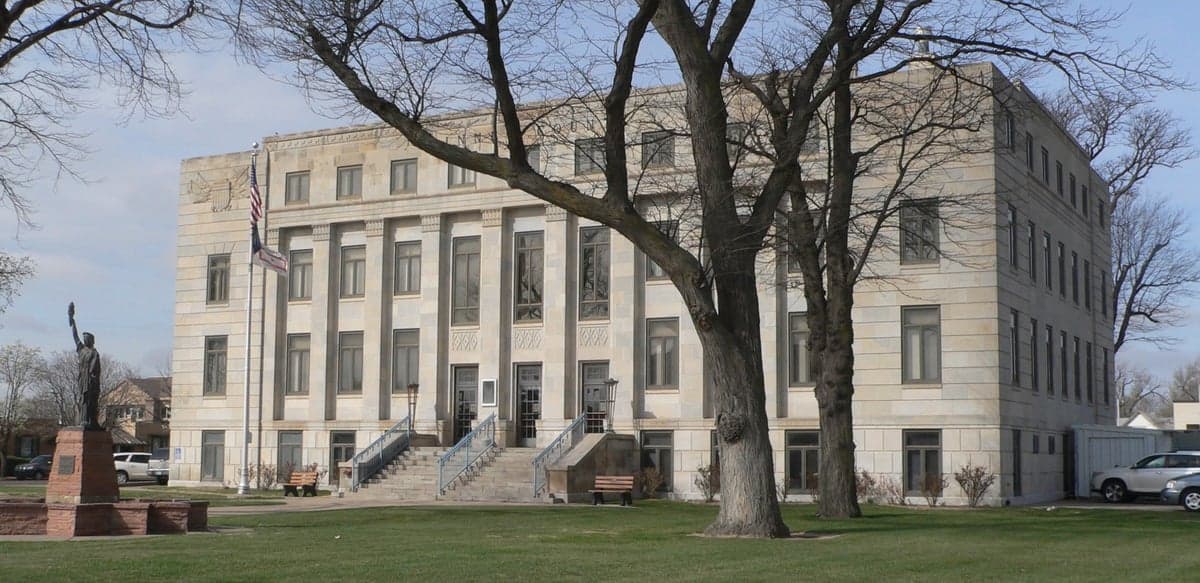
Today, Finney County’s 38,001 residents form one of Kansas’s most ethnically diverse rural populations, with a Hispanic majority at 52.4% and notable East/Southeast Asian (3.9%) and Black (4.2%) communities. The meatpacking industry anchors the economy and draws a steady stream of immigrants and domestic migrants; over 13% of residents are foreign-born. Population is heavily concentrated in Garden City and Holcomb, while smaller settlements like Kalvesta, Pierceville, and Plymell remain predominantly white and of older European stock. Nearly one in five adults holds a college degree, reflecting a growing service and trades sector alongside the blue-collar core.
Settlement & growth (pre-1960)
Before American settlement, the high plains of western Kansas were home to nomadic plains tribes—most notably the Cheyenne, Arapaho, and Comanche—who followed bison herds across the Arkansas River valley. Spanish explorers briefly traversed the region in the 16th century, but no permanent European colonization occurred until the United States acquired the area through the Louisiana Purchase (1803). The Santa Fe Trail passed just north of present-day Finney County, yet the first wave of Euro-American settlers did not arrive until after the Kansas–Nebraska Act (1854) and the subsequent Homestead Act of 1862.
Railroad construction in the 1880s—the Santa Fe line extended through the area—triggered the county’s first real settlement. Garden City was founded in 1879 as a railroad town and quickly became the county seat. The largest demographic wave in this early period came from Volga German immigrants who arrived between 1875 and 1890, recruited by railroad agents to farm the arid shortgrass prairie. These German-speaking families from Russia settled not only in Garden City but also in the rural hamlets of Kalvesta, Pierceville, Plymell, Friend, and Eminence, where they established tight-knit Lutheran congregations and built a dryland wheat and cattle economy. By 1900, a smaller number of Irish, English, and native-born Midwesterners had augmented the population, but the Volga Germans remained the dominant ethnic group in the countryside.
Drought and the Dust Bowl of the 1930s sent many families fleeing western Kansas, but those who stayed adapted through irrigation. After World War II, the Ogallala Aquifer was tapped for center-pivot irrigation, transforming agriculture and stabilizing population. The 1950 census recorded 15,092 residents, still overwhelmingly white (over 95%) and mostly of Volga German or other northern European ancestry. Holcomb, platted in the early 1900s, remained a tiny farming hamlet until mid-century.
Modern era (post-1965)
The 1965 Hart-Cellar Act fundamentally reshaped U.S. immigration, but Finney County’s demographic transformation did not begin until the 1970s, when the meatpacking industry moved to western Kansas to be closer to cattle supplies. IBP (later Tyson) opened a major beef-processing plant in Garden City in 1980, and a second plant followed in Holcomb. These plants recruited

* Values derived from national, state, county, city and local statistics and may differ in a specific area. Last updated: 2026-07-17T01:56:51.000Z
Narrative content on this page is AI-generated and may contain mistakes. Verify any details that matter before acting on them.
ReloMaps may earn a commission from affiliate links at no extra cost to you.

