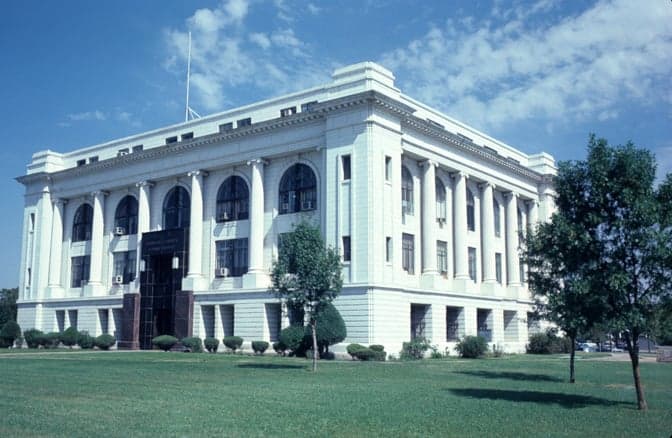
Photo: Wikipedia
Demographics of Barton County
Affluence Level in Barton County
A middle-class area roughly in line with national averages across income, home values, education, and employment.
People of Barton County
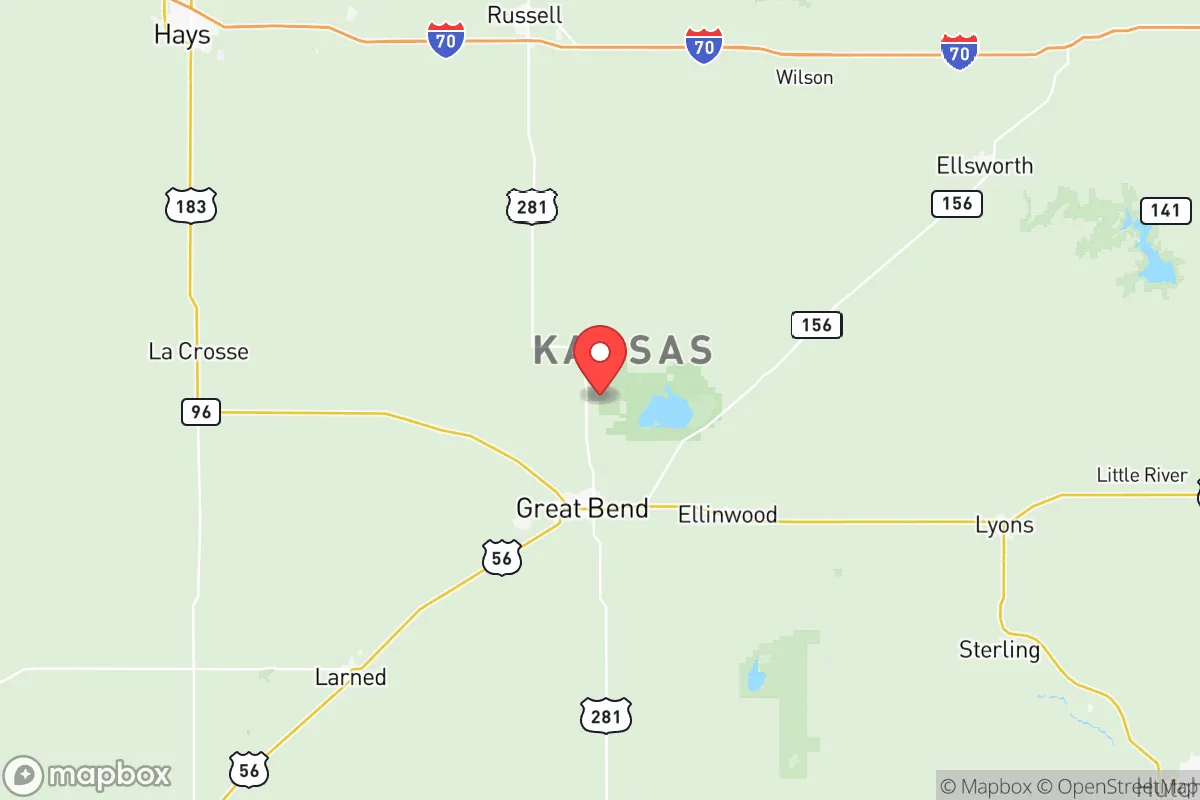
Barton County, Kansas, is a predominantly white, rural community of 25,275 residents, anchored by the city of Great Bend and characterized by a strong agricultural and energy-sector identity. With a population that is 79.4% white and 16.4% Hispanic, the county’s demographic profile reflects its deep roots in 19th-century European settlement, followed by a steady, smaller-scale influx of Hispanic workers tied to farming and meatpacking. The county’s foreign-born population is a low 2.2%, and its college attainment rate of 21.7% is below the national average, signaling a workforce oriented toward blue-collar and land-based industries rather than knowledge-economy jobs.
Settlement & growth (pre-1960)
Before American settlement, the area now known as Barton County was part of the ancestral territory of the Pawnee and Kiowa nations, who followed bison herds across the central plains. The region was sparsely populated by nomadic bands, with no permanent agricultural villages. The first European-American presence came in the 1540s with Spanish explorer Francisco Vázquez de Coronado’s expedition, which likely crossed the county’s southern edge in search of Quivira, but no permanent Spanish settlement took root. French fur traders passed through in the 1700s, but the land remained under Native control until the mid-19th century.
Organized American settlement began after the Kansas-Nebraska Act of 1854 opened the territory to homesteaders. Barton County was formally established in 1867, and the first wave of settlers were predominantly Anglo-American farmers from the Midwest—Ohio, Indiana, Illinois, and Iowa—who claimed 160-acre parcels under the Homestead Act. These early arrivals founded the county seat of Great Bend in 1871, named for its location at the great bend of the Arkansas River. The town quickly became a supply hub for cattle drives along the Chisholm Trail, with cowboys and merchants swelling its population.
The second major wave came with the railroad boom of the 1870s and 1880s. The Atchison, Topeka and Santa Fe Railway pushed through Barton County, spurring the founding of towns like Ellinwood (1871), Hoisington (1886), and Claflin (1887). These rail stops attracted a mix of German-Russian Mennonites and Volga Germans, who were recruited for their expertise in dryland wheat farming. They established tight-knit farming communities, particularly around Odin and Pawnee Rock, where German was spoken in churches and schools well into the 20th century. The Mennonite introduction of Turkey Red winter wheat transformed the county into a breadbasket.
A third, smaller wave arrived during the Dust Bowl and Great Depression (1930s), when displaced farmers from the Oklahoma and Texas panhandles—often called “Okies”—moved into Barton County seeking work on remaining farms and in the newly discovered oil fields around Ellinwood and Great Bend. The discovery of the Ellinwood oil field in the 1930s diversified the economy, drawing in roughnecks and drilling crews from Texas and Oklahoma. By 1960, the county’s population peaked at roughly 32,000, with a demographic makeup that was overwhelmingly white, native-born, and rural.
Modern era (post-1965)
The 1965 Hart-Cellar Act had a minimal direct impact on Barton County, as the region did not attract the large-scale immigration seen in coastal or urban areas. The foreign-born share has remained below 3% for decades. However, the county did experience a notable demographic shift beginning in the 1970s and 1980s, driven by the expansion of the meatpacking industry. The opening of a large beef processing plant in Great Bend—and the proximity of larger plants in Dodge City and Garden City—pulled in a wave of Hispanic immigrants, primarily from Mexico and Central America. These workers settled in Great Bend and Hoisington, forming the foundation of the county’s current 16.4% Hispanic population. Unlike the earlier German enclaves, this community is more concentrated in lower-cost rental housing near the industrial corridors.
Domestic migration since 1965 has been a story of rural outmigration. Young adults have left for college and jobs in larger Kansas cities like Wichita and Kansas City, while retirees have largely stayed put. The county’s population declined from its 1960 peak to around 25,000 by 2020, a loss driven by farm consolidation and the decline of small-town retail. The East/Southeast Asian population remains tiny at 0.3%, mostly comprising a handful of professionals in healthcare at the Great Bend Regional Hospital. The Indian subcontinent population is negligible at 0.1%, and the Black population is 0.7%, largely descendants of railroad workers who settled in Great Bend in the early 20th century.
Suburbanization has been limited. The county has no major suburbs; instead, the small towns of Albert, Susank, and Galatia have seen population stagnation or decline, while Great Bend has absorbed most new housing developments, primarily single-family homes on the city’s west side.
The future
Barton County’s population is projected to continue a slow decline, with the white population aging and shrinking while the Hispanic share gradually rises. The Hispanic community, now at 16.4%, is younger and has higher birth rates, so its proportion will likely reach 20-25% by 2040, barring a major economic shock. This growth is not creating distinct ethnic enclaves; rather, Hispanic families are integrating into existing neighborhoods in Great Bend and Ellinwood, with bilingual signage and Hispanic-owned businesses becoming more visible. The foreign-born share may tick up slightly if meatpacking plants continue to recruit immigrant labor, but it will remain far below state or national averages.
The county is not tribalizing into separate enclaves. Instead, it is slowly homogenizing into a binational, bicultural community where English remains dominant but Spanish is increasingly common in schools and workplaces. The white population, while still the majority, is aging and less likely to be replaced by in-migration, as young people continue to leave for urban opportunities. The cultural identity of the county is shifting from a purely German-American, wheat-farming heritage toward a more layered identity that includes Hispanic traditions, though the pace of change is slow enough that long-time residents may not perceive a dramatic shift.
For someone moving in now, Barton County offers a stable, low-cost, conservative-leaning environment with a strong sense of place but limited economic dynamism. The population is becoming slightly more diverse, but remains overwhelmingly white and native-born, with a Hispanic minority that is integrating rather than segregating. The next 10-20 years will likely see a continuation of slow decline in total numbers, a gradual increase in Hispanic representation, and a cultural landscape that remains rooted in its agricultural and oil heritage.

* Values derived from national, state, county, city and local statistics and may differ in a specific area. Last updated: 2026-05-11T23:27:15.000Z
Narrative content on this page is AI-generated and may contain mistakes. Verify any details that matter before acting on them.
ReloMaps may earn a commission from affiliate links at no extra cost to you.

