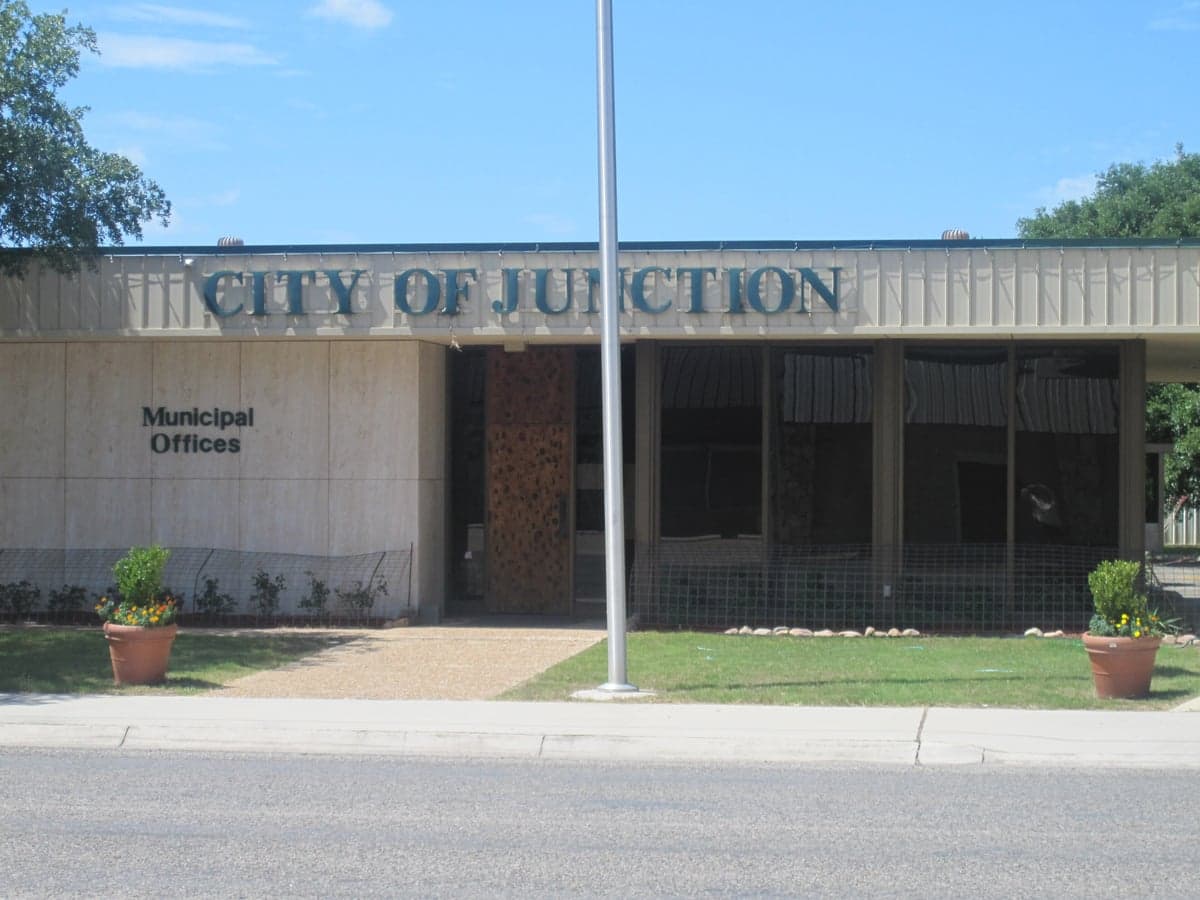
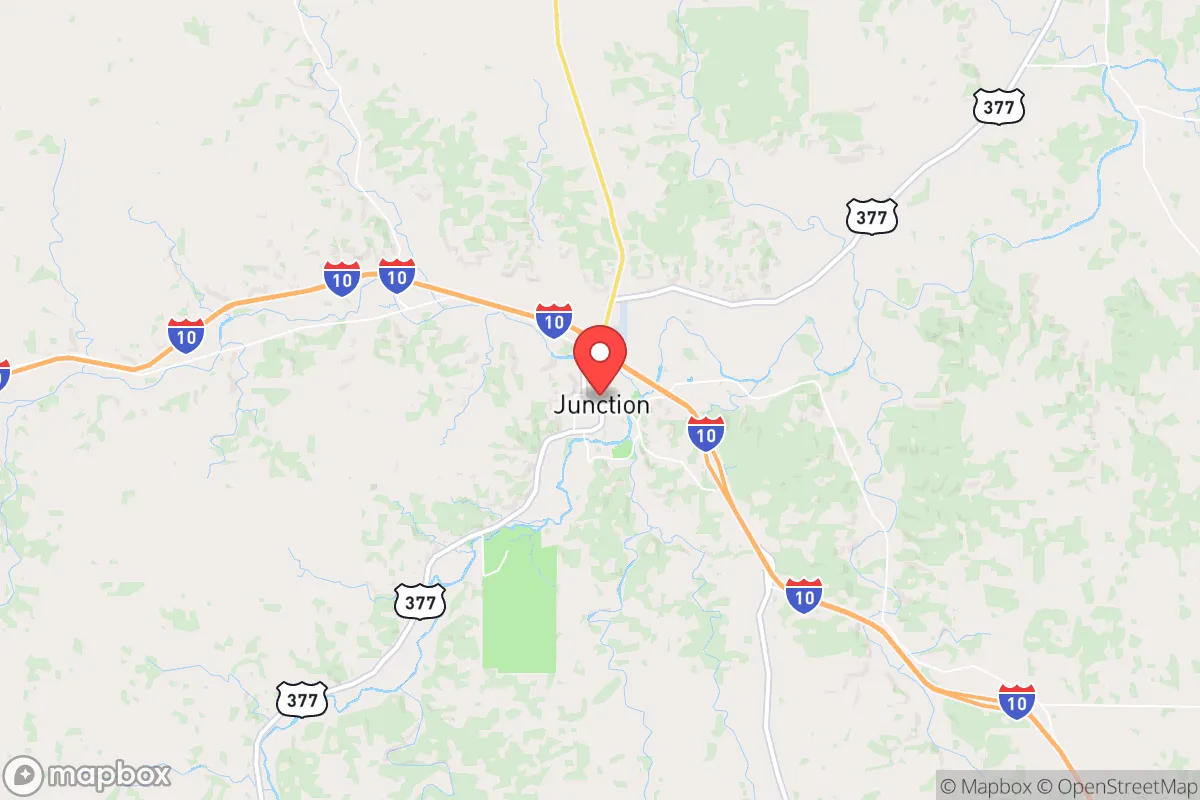
Photo: Wikipedia
Demographics of Junction, TX
Affluence Level in Junction, TX
A below-average socioeconomic profile. Incomes, home values, and educational attainment trail the U.S., with higher poverty and unemployment.
People of Junction, TX
The people of Junction, Texas, today number 2,439, forming a small, tight-knit community where a White majority (58.7%) and a substantial Hispanic population (37.4%) coexist with a very small Black community (1.6%) and virtually no Asian or Indian residents. The city’s identity is rooted in its role as a rural trade and government hub for Kimble County, with a notably low college attainment rate (17.7%) reflecting a workforce concentrated in ranching, oil-field services, and local government. Despite its small size, Junction maintains a distinct character as a conservative, family-oriented town where generational ties run deep and newcomers are often drawn by outdoor recreation along the South Llano River.
How the city was settled and grew
Junction was founded in 1876 as a railroad town at the confluence of the North and South Llano Rivers, serving as a shipping point for wool, mohair, and cattle from the surrounding Hill Country ranches. The original settlers were predominantly Anglo-American ranchers and farmers from the Deep South and Midwest, drawn by cheap land grants and the promise of the expanding Texas & Pacific Railway. The earliest residential area, Old Town Junction (centered around Main Street and the courthouse square), housed merchants, railroad workers, and teamsters in simple wood-frame homes. By the early 1900s, a small Mexican-American community began forming in Barrio Chihuahua, a neighborhood south of the railroad tracks near the river, where laborers worked on the railroad and in local wool-scouring plants. The city’s population peaked at around 2,800 in the 1950s, supported by a thriving mohair industry and the construction of the Kimble County Hospital, which brought medical professionals to the Hospital District north of downtown.
Modern era (post-1965)
After the 1965 Hart-Cellar Act, Junction saw minimal international immigration—the foreign-born share today is just 3.8%—but experienced significant domestic in-migration from rural Texas counties and, later, from retirees seeking Hill Country scenery. The Hispanic population grew steadily from about 15% in 1970 to 37.4% today, driven by natural increase and migration from South Texas border counties. This growth concentrated in the South Llano Estates subdivision, a working-class neighborhood developed in the 1980s along the river’s south bank, and in the older Barrio Chihuahua area, which expanded with mobile homes and modest ranch-style houses. The White population, while still the majority, declined in relative share as younger Anglo residents moved to larger cities for college and jobs, leaving an older cohort in neighborhoods like Northwood Hills, a 1970s-era subdivision of brick homes near the high school. The Black population has remained tiny (1.6%), with most families living in the East Side area near the old segregated school site, now integrated but still a distinct pocket. The Asian and Indian populations are essentially zero, reflecting the city’s lack of tech or academic employment that typically attracts those groups.
The future
Junction’s population is projected to remain stable or decline slightly over the next decade, as the aging White cohort shrinks and younger Hispanic families have fewer children than previous generations. The Hispanic share will likely continue rising gradually, reaching perhaps 42-45% by 2035, but the city will remain overwhelmingly non-diverse in Asian and Indian terms. New residential development is concentrating in the River Ridge subdivision, a master-planned community of 2-5 acre lots aimed at retirees and remote workers from Austin and San Antonio, which is drawing a slightly more educated and affluent demographic. However, this influx is small—perhaps 50-100 new homes over a decade—and does not fundamentally alter the city’s cultural identity as a conservative, ranching-oriented town. The lack of college-educated job growth (17.7% college attainment) means most young adults will continue to leave for larger cities, reinforcing the community’s older age profile.
For someone moving in now, Junction offers a stable, low-crime environment with strong community ties, but it is not a place of rapid demographic change or new cultural diversity. The population is slowly graying and becoming more Hispanic, yet remains overwhelmingly White and Hispanic with minimal representation from other groups. New arrivals will find a welcoming but insular community where fitting in means embracing local traditions—hunting, fishing, church suppers, and high school football—rather than expecting a cosmopolitan mix of cultures.

* Values derived from national, state, county, city and local statistics and may differ in a specific area. Last updated: 2026-11-15T12:12:39.000Z
Narrative content on this page is AI-generated and may contain mistakes. Verify any details that matter before acting on them.
ReloMaps may earn a commission from affiliate links at no extra cost to you.

