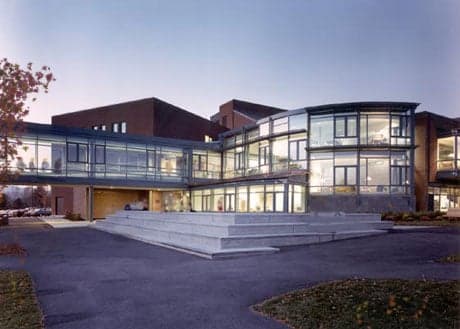
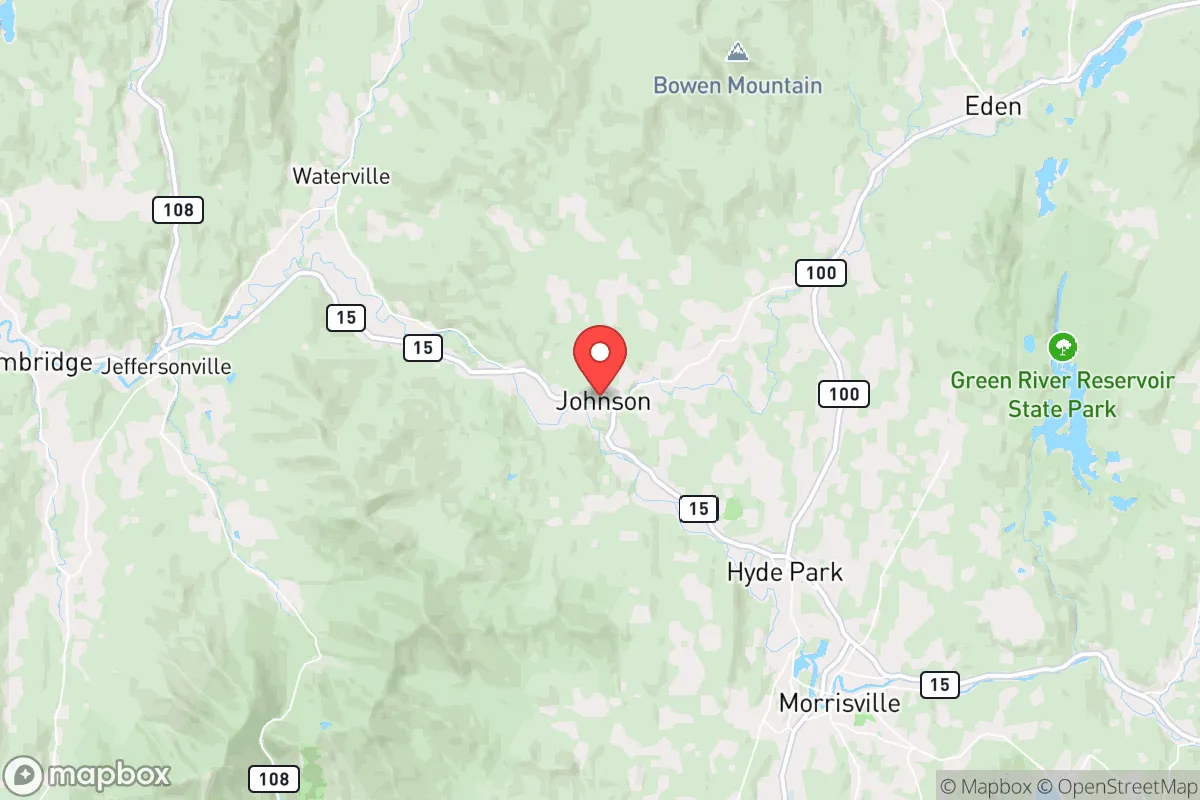
Photo: Wikipedia
Demographics of Johnson, VT
Affluence Level in Johnson, VT
A low-income area with significant economic hardship. Household wealth and educational attainment are well below national averages.
People of Johnson, VT
The people of Johnson, Vermont, today form a small, tight-knit community of 1,668 residents that is overwhelmingly white (89.4%) and notably homogenous, with a foreign-born population of 0.0%. The village carries a distinct identity as a working-class college town, anchored by Vermont State University’s Johnson campus, which injects a transient student population and a modest liberal arts influence into an otherwise rural, conservative-leaning area. With a college-educated rate of 32.6% — above the state average — the permanent population is a mix of longtime farming families, university faculty and staff, and a small but growing number of remote workers drawn by the Lamoille Valley’s scenery and lower cost of living relative to Burlington.
How the city was settled and grew
Johnson’s human history begins with the 1780 land grants awarded to Revolutionary War veterans, with the first permanent settlers arriving around 1790. The village was chartered in 1792 and named after Thomas Johnson, a Maryland governor. The original population was almost entirely of English and Scottish descent, clearing forest for subsistence farming along the Gihon River. The construction of the Lamoille Valley Railroad in the 1870s transformed Johnson into a modest mill town, drawing a wave of French-Canadian laborers who settled in what became known as Lower Village, the area near the river where the old woolen mills and grain elevators once stood. A smaller contingent of Irish immigrants arrived to work on the railroad and established homes along North Main Street, where a few of their original wood-frame houses still stand. By 1900, the population had reached roughly 1,200, and the community was defined by dairy farming, logging, and the Johnson Woolen Mills — a factory that employed generations of local families until its closure in the 1990s.
Modern era (post-1965)
The post-1965 period brought little demographic change to Johnson compared to larger Vermont towns. The Hart-Cellar Act had virtually no effect here; the foreign-born population remains 0.0% today. The most significant shift was the 1963 establishment of what was then Johnson State College, which drew faculty and staff from outside the region — many from the Northeast — who settled in the College Hill neighborhood, the cluster of streets directly east of the campus. These newcomers were predominantly white, college-educated, and more politically liberal than the native population, creating a subtle cultural divide between the college area and the older, more conservative West Johnson district along Route 15. The Hispanic population, now at 3.3%, began appearing in the 1990s, primarily as migrant farm workers on the region’s apple orchards and dairy operations, with a small cluster settling in rental properties along Lower Main Street. The Black population (2.6%) and Indian subcontinent population (0.5%) are very recent arrivals, almost entirely connected to the university — faculty, graduate students, or their families — and are scattered across the village rather than concentrated in any single neighborhood. The East/Southeast Asian population is statistically negligible at -0.5% (effectively zero).
The future
Johnson’s population trajectory points toward slow, modest growth with continued racial homogeneity. The village is not tribalizing into distinct ethnic enclaves; the small Hispanic, Black, and Indian populations are too tiny to form concentrated neighborhoods and are likely to assimilate into the broader white community over the next generation. The biggest demographic pressure comes from out-of-state migration — remote workers and retirees from Massachusetts, New York, and Connecticut seeking lower taxes and rural space — who are buying up older homes in East Johnson and the River Road corridor. This influx is gradually raising home prices and pushing some younger native-born residents out, but the effect is muted compared to towns like Stowe or Waterbury. The university’s enrollment has been flat to declining since 2020, which may reduce the inflow of new faculty and the small non-white population they bring. Over the next 10-20 years, Johnson will likely remain a predominantly white, working-to-middle-class village with a stable population around 1,600-1,800, where the main cultural tension will be between long-term locals and newer amenity migrants rather than between racial or ethnic groups.
For someone moving in now, Johnson offers a safe, affordable, and culturally straightforward environment — a place where nearly everyone speaks English as a first language, community ties are strong, and the pace of change is slow. The trade-off is limited diversity and a social landscape that can feel insular to newcomers, particularly those who do not fit the white, rural Vermont mold. It is best suited for families and individuals who prioritize low crime, outdoor recreation, and a close-knit community over urban amenities or ethnic variety.

* Values derived from national, state, county, city and local statistics and may differ in a specific area. Last updated: 2026-10-10T16:27:48.000Z
Narrative content on this page is AI-generated and may contain mistakes. Verify any details that matter before acting on them.
ReloMaps may earn a commission from affiliate links at no extra cost to you.

