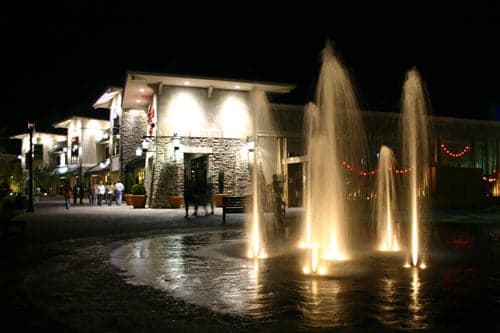
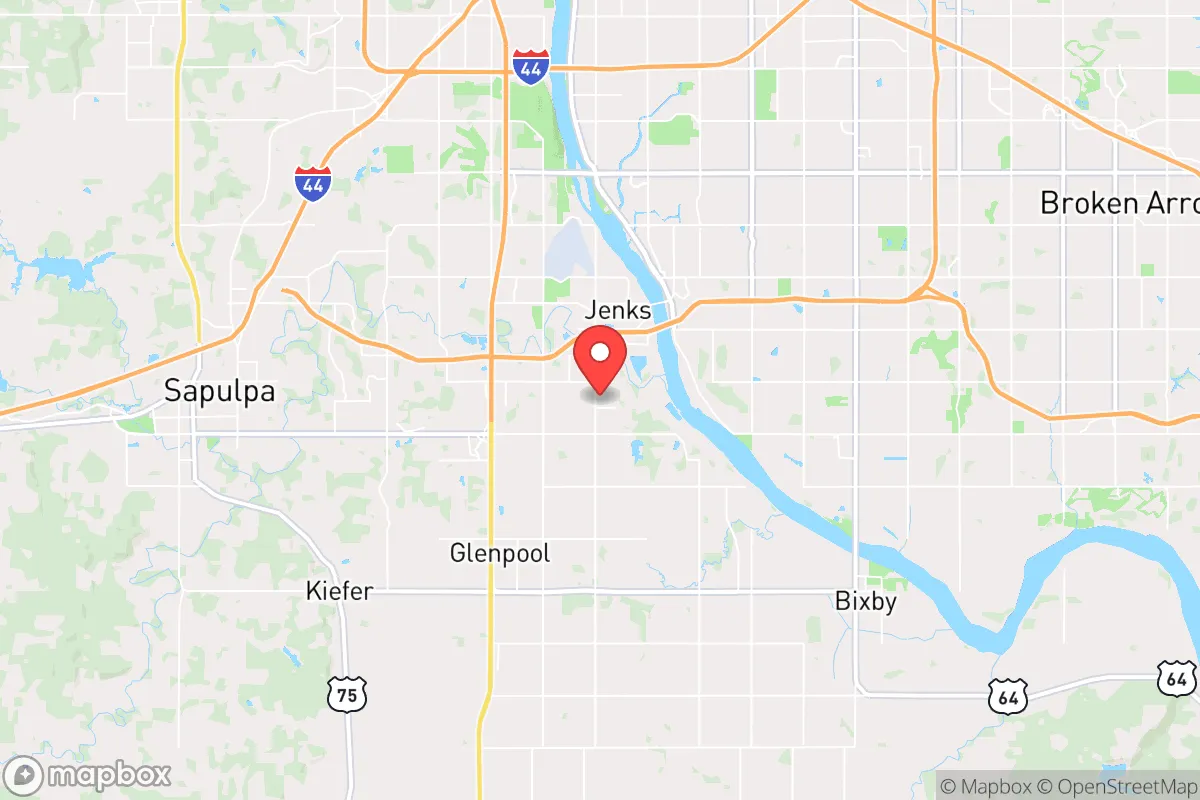
Photo: Wikipedia
Demographics of Jenks, OK
Affluence Level in Jenks, OK
A middle-class area roughly in line with national averages across income, home values, education, and employment.
People of Jenks, OK
The people of Jenks, Oklahoma, today number 26,519, forming a notably educated and economically stable suburban community with a distinctive blend of established white families and growing Asian and Indian populations. The city’s identity is shaped by its 48.2% college-educated adult population, a 64.7% white majority, and significant East/Southeast Asian (7.2%) and Indian (2.4%) communities that have reshaped neighborhoods since the 1990s. With a foreign-born share of 5.2% and a Hispanic population of 8.7%, Jenks is more diverse than many Tulsa suburbs, yet retains a strong conservative character rooted in its oil-boom origins and family-oriented development patterns.
How the city was settled and grew
Jenks was founded in 1904 as a railroad town on the Arkansas River, named after a local merchant. The original population was overwhelmingly white, drawn by the discovery of oil in the nearby Glenn Pool field in 1905, which triggered a boom that made Jenks a supply and housing hub for oil workers. The historic downtown district, centered on Main Street and First Street, was built by these early oil-field laborers and merchants, with modest wood-frame houses and commercial buildings that still anchor the city’s identity. A second wave arrived during the 1920s and 1930s as the oil industry matured, with workers settling in the Riverview neighborhood along the river bluffs, where larger homes for supervisors and engineers were constructed. The city remained small—under 1,000 residents until 1950—and almost entirely white, with a tiny Black population employed in domestic service and railroad maintenance, concentrated in a few blocks near the rail yards that later became part of the South Jenks area. No significant immigrant communities existed in this era; the foreign-born share was negligible until the late 20th century.
Modern era (post-1965)
The post-1965 immigration reforms had little immediate effect on Jenks, which remained a sleepy white suburb of about 3,000 people through the 1970s. The real transformation began in the 1980s and 1990s, driven by domestic in-migration from Tulsa families seeking better schools and lower crime, and by the expansion of the Tulsa metropolitan area eastward. The Village at Stone Creek subdivision, developed in the late 1990s, became a primary landing point for white professionals moving from Tulsa, offering large lots and proximity to the new Jenks Public Schools campus. Simultaneously, a wave of East/Southeast Asian immigrants—primarily Vietnamese and Chinese—began settling in the River Oaks and Pecan Creek neighborhoods, drawn by affordable starter homes and the reputation of Jenks schools. These families often came from Tulsa’s older Asian enclaves, seeking suburban space and better educational outcomes. The Indian community, smaller but growing, concentrated in the Stone Canyon area, where tech and medical professionals from India working at Tulsa’s hospitals and engineering firms bought newer homes. By 2000, Jenks’s population had surged to 9,707, and the Asian and Indian shares had risen to about 4% combined. The Black population remained low (2.9% today), with most Black residents living in the Southwest Jenks area near the river, a historically working-class zone that has seen little new development. The Hispanic population grew more slowly, reaching 8.7% by 2020, with families settling in the West Jenks corridor along 101st Street, where older apartments and duplexes offer lower entry costs.
The future
Jenks is likely to continue its trajectory of moderate diversification, but the pattern is one of assimilation into distinct enclaves rather than wholesale integration. The East/Southeast Asian community, now 7.2% of the population, appears stable and plateauing, with second-generation families moving to newer subdivisions like Stone Creek Estates rather than replacing the original enclaves. The Indian community, at 2.4%, is growing slowly, driven by medical and tech professionals, but remains small enough that it has not formed a distinct ethnic neighborhood—Indian families are scattered across the newer western subdivisions. The white population, while still the majority at 64.7%, is aging and declining in share as younger white families choose newer suburbs farther south. The Hispanic population, at 8.7%, is the fastest-growing segment, concentrated in West Jenks, and is likely to reach 12-15% by 2035, driven by natural increase and continued migration from Texas and Mexico. The Black population is expected to remain low, as Jenks lacks the housing stock or employment base to attract significant Black in-migration from Tulsa. Overall, the city is homogenizing in terms of income and education—the college-educated share is rising across all groups—but tribalizing geographically, with each group occupying a distinct quadrant of the city.
For a conservative-leaning family or individual moving to Jenks now, the city offers a stable, safe, and increasingly diverse environment where the dominant culture remains white and middle-class, but where Asian and Indian neighbors are common in newer subdivisions. The key trade-off is between the older, more established white neighborhoods near downtown and the newer, more diverse subdivisions in the west and south. Jenks is becoming a place where ethnic enclaves coexist rather than fully integrate, but the high educational attainment and low crime rates across all groups suggest a functional, if segmented, community. The next decade will likely see continued Hispanic growth and a gradual whitening of the older neighborhoods as white families age in place, while the Asian and Indian communities consolidate their suburban footholds. For a newcomer, the choice of neighborhood will largely determine the demographic experience of the city.

* Values derived from national, state, county, city and local statistics and may differ in a specific area. Last updated: 2026-04-21T09:12:05.000Z
Narrative content on this page is AI-generated and may contain mistakes. Verify any details that matter before acting on them.
ReloMaps may earn a commission from affiliate links at no extra cost to you.

