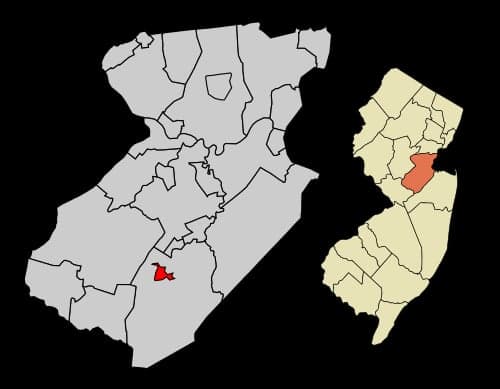
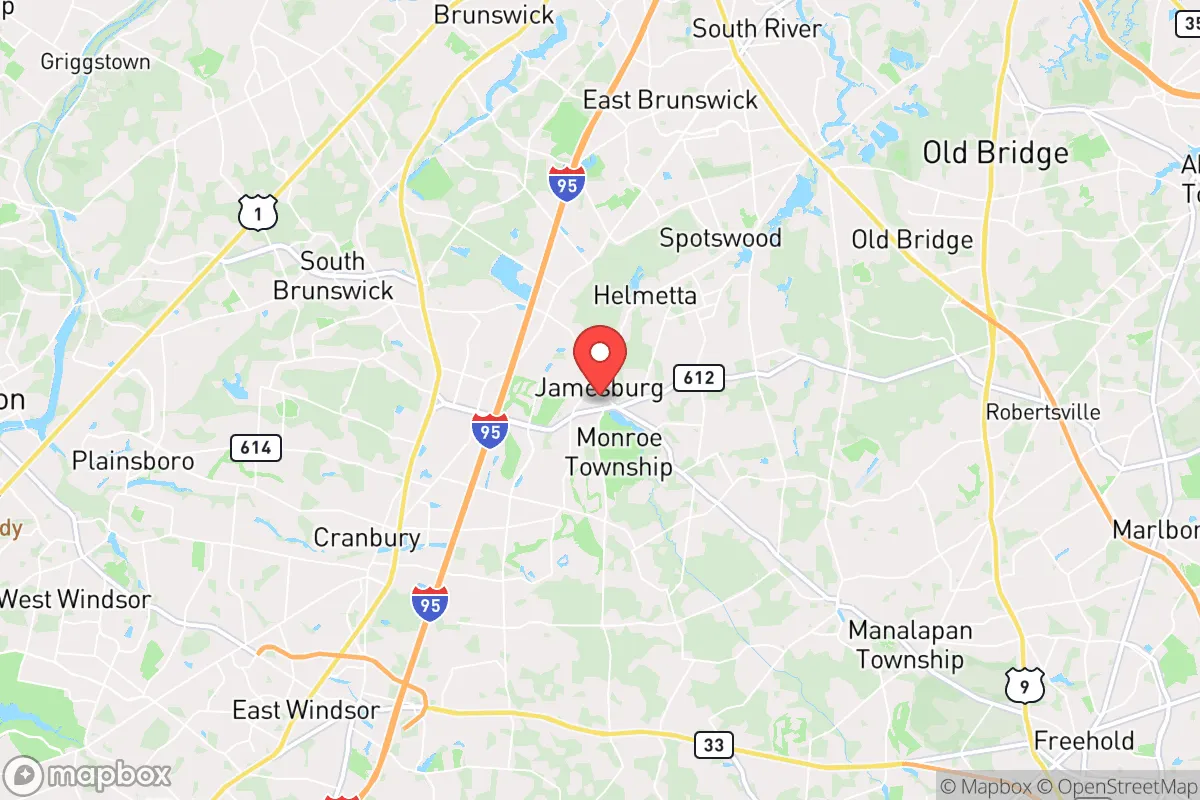
Photo: Wikipedia
Political ClimatePolitical Climate in Jamesburg, NJ
District shown is the primary district for this city’s centroid. Cities may span multiple districts.
Political rankings in New Jersey
- Most Conservative Cities in New Jersey
- Most Liberal Cities in New Jersey
- Best Conservative-Leaning Towns in the Northeast
- Best Conservative-Leaning Towns in the Mid-Atlantic
- Safest Liberal-Leaning Towns on the East Coast
- Safest Conservative-Leaning Towns on the East Coast
- Most Affordable Liberal-Leaning Small Towns in the U.S.
- Safest Liberal-Leaning Cities in the U.S.
- Most Conservative Counties in New Jersey
- Most Liberal Counties in New Jersey
Local Political AnalysisPolitical Analysis of Jamesburg, NJ
Jamesburg is a solidly Democratic town in a state that's already reliably blue, and it's been trending further left over the past decade. With a Cook Partisan Voting Index (PVI) of D+13, the borough votes Democratic by a margin roughly two and a half times stronger than New Jersey as a whole, which sits at D+5. That gap isn't just a statistic — it reflects a real shift in local politics, driven by younger families moving in from more expensive Middlesex County towns and a growing commuter population that aligns with the state's suburban progressive wave.
How it compares
Jamesburg's D+13 PVI puts it in a different political league than most of surrounding Middlesex County, which averages around D+12, but it's notably more liberal than nearby Monroe Township (D+7) or the more conservative-leaning spots in western Monmouth County like Millstone Township (roughly R+4). Drive ten minutes east to Helmetta, and you'll find a D+8 lean — still blue, but less emphatic. The real contrast is with towns like Spotswood (D+6) or Old Bridge (D+5), where the Democratic advantage is much narrower. Jamesburg's trajectory has been steadily leftward since 2016, mirroring national trends in small, dense boroughs with a mix of white-collar commuters and working-class families. In the 2020 presidential election, Joe Biden carried Jamesburg by about 18 points, outperforming his statewide margin of 16 points, and local school board and council races have seen Democratic candidates win unopposed in recent cycles.
What this means for residents
For liberal residents, Jamesburg's lean means local policies tend to align with their priorities — the borough council has supported affordable housing initiatives, maintained strong public school funding, and kept municipal taxes relatively stable despite state mandates. Conservative residents aren't shut out, but they'll find themselves in a clear minority at town hall meetings and in local elections. The Republican municipal committee is active but hasn't won a council seat since 2017, and GOP candidates typically pull around 35-40% of the vote in contested races. That said, the political climate here is more pragmatic than ideological: zoning disputes, road repairs, and school budgets dominate local discourse far more than national culture wars. Both sides tend to agree on keeping Jamesburg's small-town character intact, even if they disagree on how to pay for it.
Cultural and policy distinctions
One thing that sets Jamesburg apart from bluer parts of the state — like Montclair or Maplewood — is its relative lack of activist energy. You won't see many yard signs outside of presidential election years, and the local Democratic club focuses on candidate recruitment rather than protest politics. The borough's policy decisions reflect this: it's a D+13 town that votes like a moderate suburb, not a progressive stronghold. For example, Jamesburg has resisted adopting some of the more aggressive affordable housing mandates pushed by Trenton, and its police department has maintained community support even as neighboring towns have faced reform debates. This pragmatic streak means that while the area's political lean is unmistakably Democratic, the day-to-day experience for residents — regardless of party — is more about potholes and parks than partisan gridlock.

State Political ClimatePolitical Climate in New Jersey
State Political AnalysisPolitical Environment in the State
New Jersey has a solid Democratic lean, with a Cook PVI of D+5, but that number masks a state that is far more politically complex than its national reputation suggests. The state hasn't voted for a Republican presidential candidate since George H.W. Bush in 1988, and Democrats control both legislative chambers and the governorship. However, over the past 10-20 years, the electorate has shifted in subtle but important ways: the Democratic coalition has become more dependent on the densely populated urban corridor, while the once-reliable GOP strongholds in the suburbs have been eroding, and the rural and exurban parts of the state have become more intensely Republican. The result is a state that feels like two different countries depending on whether you're in a commuter suburb or a farm town.
Urban vs. rural divide
The political map of New Jersey is a story of three distinct regions. The northeastern corridor, anchored by Newark, Jersey City, and Hoboken, is the engine of the Democratic vote. These dense, diverse, transit-oriented cities reliably deliver margins of 70-80% for Democratic candidates, driven by a coalition of young professionals, minority communities, and union households. The suburbs immediately surrounding them—places like Montclair, Maplewood, and South Orange—have also moved sharply left over the past decade, as educated, affluent voters have shifted away from the GOP. Meanwhile, the southern and western parts of the state, including Ocean County and the rural areas around Sussex County, are deeply Republican. Toms River and Lacey Township in Ocean County are now reliably red, with many precincts voting 60% or more for Trump in 2024. The divide is stark: the state's 10 most Democratic counties account for roughly 70% of the vote, while the 10 most Republican counties are largely rural and shrinking in population. The few competitive areas left are the "swing" suburbs like Middlesex County and parts of Bergen County, where Asian-American and Hispanic voters are becoming a decisive bloc.
Policy environment
New Jersey's policy environment is defined by its high-tax, high-regulation posture. The state has the highest property taxes in the nation, with an average effective rate of around 2.23%, and a progressive income tax that tops out at 10.75% for income over $1 million. The sales tax is 6.625%, but many municipalities add their own local taxes. The regulatory climate is business-friendly in some sectors (pharmaceuticals, finance) but burdensome for small businesses and manufacturers. Education policy is dominated by the New Jersey Education Association (NJEA), one of the most powerful teachers' unions in the country, which has successfully resisted charter school expansion and voucher programs. Healthcare is heavily regulated, with the state running its own health insurance exchange and expanding Medicaid under the Affordable Care Act. Election laws are among the most accessible in the nation: no-excuse mail-in voting, automatic voter registration at DMV, and same-day registration are all in place. The state also has a "blue" gun law regime, requiring permits to purchase handguns, a background check for all firearm sales, and a ban on many semi-automatic rifles.
Recent policy direction
Over the past five years, New Jersey has moved decisively left on a range of issues. In 2022, the legislature passed the New Jersey Gun Safety Act, which banned carrying firearms in "sensitive places" like parks, libraries, and public transit, and required concealed carry permit holders to prove a "justifiable need" (a provision later struck down by the Supreme Court). On education, the state enacted a law requiring all public schools to teach LGBTQ+ history and banned conversion therapy for minors. On healthcare, the state expanded Medicaid coverage for postpartum women to 12 months and passed a law requiring insurance companies to cover abortion and contraception without cost-sharing. On property rights, the state has been aggressive in using eminent domain for redevelopment projects, particularly in cities like Newark and Jersey City. On voting, the state made mail-in voting permanent after the pandemic and expanded early voting to 10 days. On privacy, the state passed a comprehensive data privacy law in 2023, giving residents the right to opt out of data collection and request deletion of their data. On taxes, the state has not cut rates significantly, but it did increase the Earned Income Tax Credit and create a new child tax credit. For a conservative relocator, the policy direction is clear: the state is becoming more restrictive on gun rights, more expansive on social services, and more protective of LGBTQ+ and abortion rights.
Civil unrest & political movements
New Jersey has a history of organized political activism on both sides. The state was a flashpoint for the Black Lives Matter protests in 2020, with large demonstrations in Newark, Trenton, and Camden. The New Jersey State Police were criticized for their handling of protests, and the state later passed a police reform bill banning chokeholds and requiring body cameras. On the right, the New Jersey 2nd Amendment Society and the Gun Owners of New Jersey have been active in challenging the state's gun laws in court, with some success. The state's sanctuary policies are a major flashpoint: New Jersey is a "sanctuary state" under a 2018 executive order by Governor Phil Murphy, which limits cooperation between local law enforcement and federal immigration authorities. This has led to tensions in towns like Freehold and Perth Amboy, where immigration enforcement is a hot-button issue. Election integrity has been a recurring controversy, with Republicans alleging that the state's mail-in voting system is vulnerable to fraud, though no major cases have been proven. The state also saw a brief secession movement in 2020, when a group of conservative activists proposed splitting New Jersey into two states, but it gained little traction.
Projection
Over the next 5-10 years, New Jersey is likely to become more Democratic, not less. The state's population is aging, but the younger, more diverse voters moving into the urban and suburban areas are overwhelmingly Democratic. The rural counties are shrinking, and the GOP's base is becoming more concentrated in a few areas like Ocean and Sussex counties. The state's high cost of living is driving some middle-class families to leave, but those who stay are increasingly liberal. The Democratic Party's dominance is unlikely to be challenged unless the GOP can make inroads with the growing Asian-American and Hispanic populations, which so far have been voting Democratic by wide margins. A new resident moving in now should expect the state to continue its leftward trajectory on social issues, gun control, and taxation, with no major tax cuts or deregulation on the horizon.
For a conservative relocator, the bottom line is that New Jersey offers a high quality of life in many respects—excellent schools, strong infrastructure, and proximity to New York and Philadelphia—but it comes with a political environment that is increasingly hostile to conservative values on guns, taxes, and social policy. For a liberal relocator, the state is a safe haven where their priorities are likely to be protected and expanded. The practical takeaway is that New Jersey is a state where your vote matters less in statewide elections but where local politics—school boards, town councils, county commissions—can still make a real difference in your daily life. If you're moving here, be prepared to engage at the local level, because that's where the real battles are fought.
* Values derived from national, state, county, city and local statistics and may differ in a specific area. Last updated: 2026-11-13T09:13:52.000Z
Narrative content on this page is AI-generated and may contain mistakes. Verify any details that matter before acting on them.
ReloMaps may earn a commission from affiliate links at no extra cost to you.

