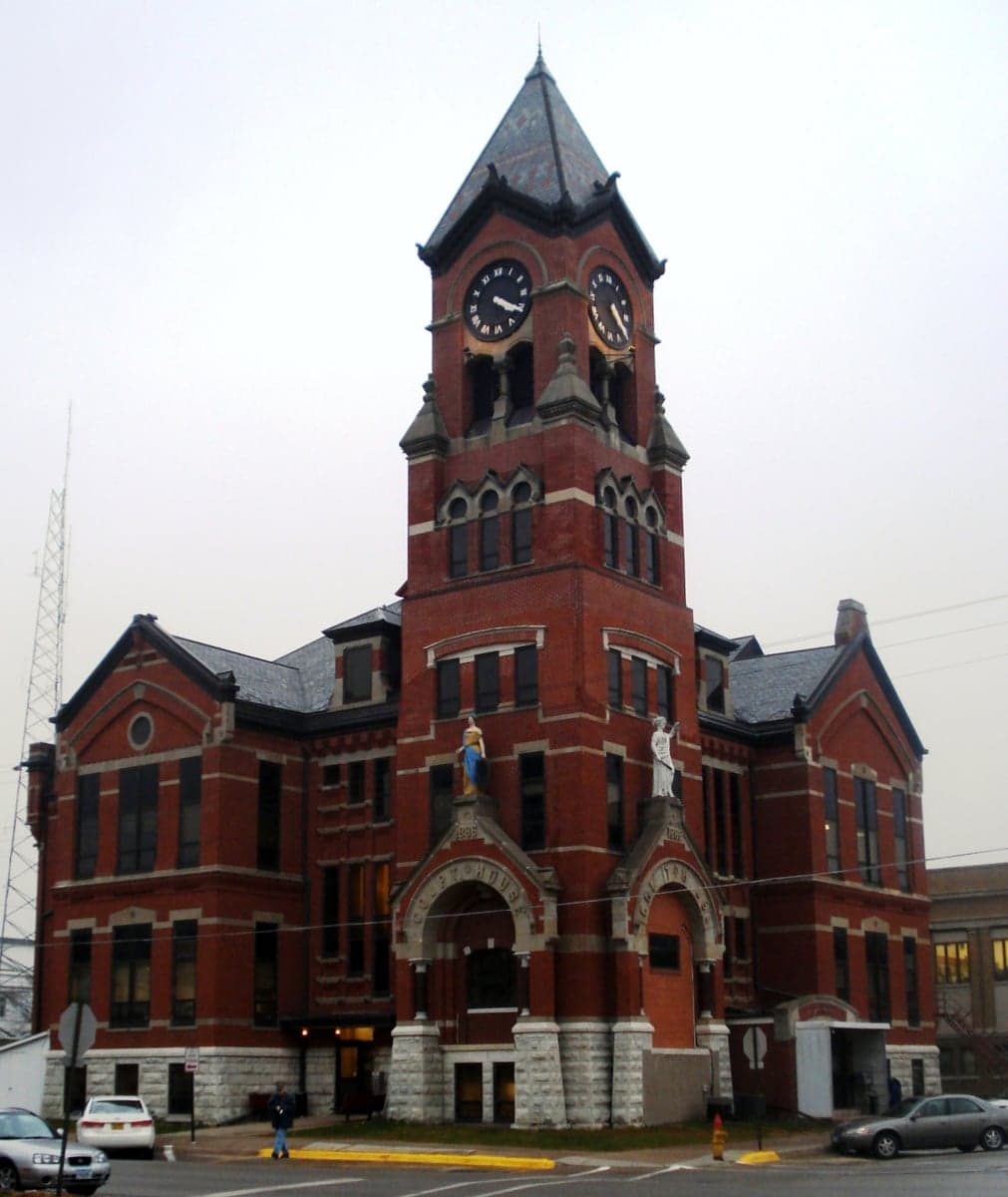
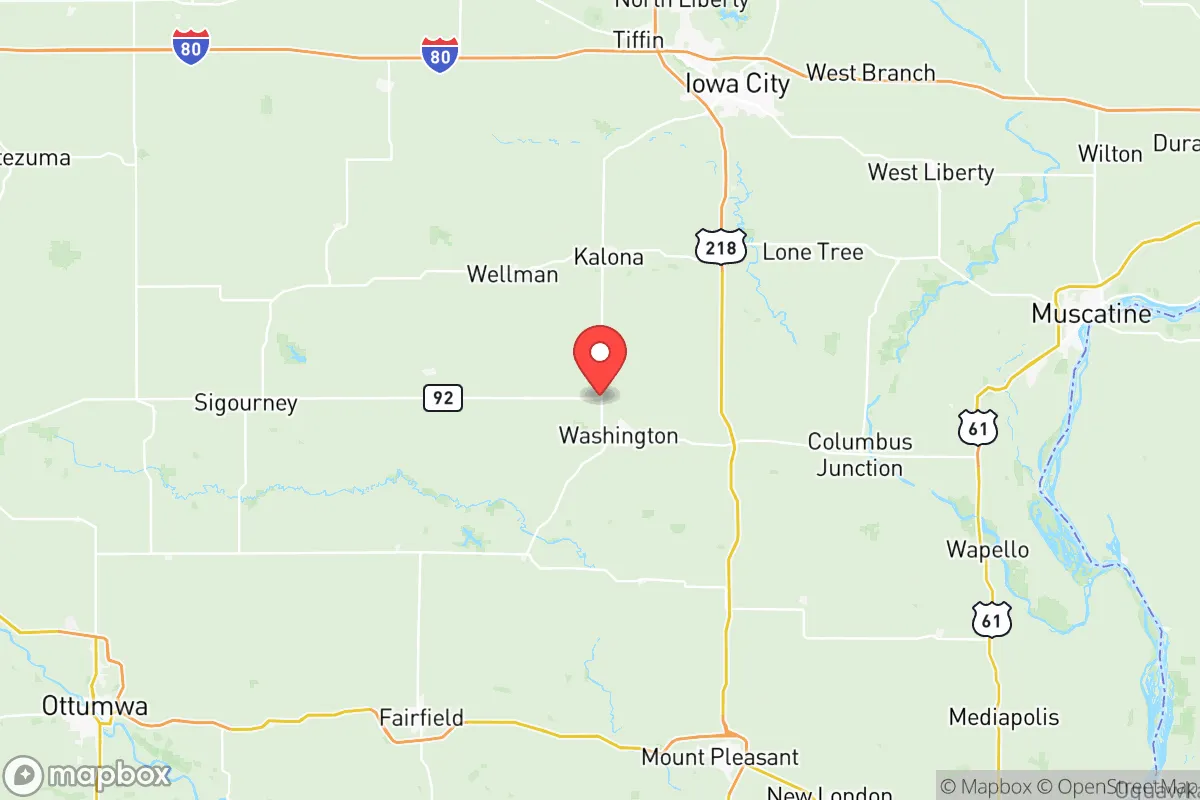
Photo: Wikipedia
Political ClimatePolitical Climate in Washington County
Showing district-level results — no local-only data available.
Local Political AnalysisPolitical Analysis of Washington County
Washington County, Iowa, leans Republican, but with a noticeable moderation compared to the state as a whole. The county’s Cook Partisan Voting Index (PVI) of R+4 is two points less conservative than Iowa’s overall R+6 rating, a gap that reflects a genuine political split between its rural agricultural areas and its small but influential college town. This isn't a deep-red stronghold; it's a place where the local Republican majority has to contend with a persistent, organized Democratic minority, especially in and around the city of Washington itself.
How it compares
The R+4 vs. R+6 difference might sound small, but it’s the difference between a county that can swing in a close statewide race and one that is reliably safe. In practice, this means Washington County is more competitive than most of its neighbors. The real political divide isn't between the county and the state—it’s between the towns. The city of Washington, home to the county seat and a sizable population of educators and healthcare workers, consistently votes more Democratic, often breaking 50-55% for Democratic candidates in recent presidential and gubernatorial cycles. In contrast, the smaller, more rural towns like Kalona, Wellman, and Brighton are deeply conservative, regularly delivering 70% or more of their vote to Republicans. The swing precincts are the suburban fringe of Washington and the unincorporated areas along Highway 1 and 92, where ticket-splitting is common. A Republican candidate who can win the rural towns by a large enough margin can easily overcome the Democratic advantage in Washington city, but a moderate Democrat who runs well in the suburbs can make it a genuine toss-up.
What this means for residents
For a conservative resident, the county feels like home. The county board of supervisors is reliably Republican, and local policy on taxes, land use, and Second Amendment rights reflects that majority. You’ll find strong support for the local GOP and a network of conservative churches and civic groups. For a liberal resident, the picture is more nuanced. You are a clear minority in the county, but you are not isolated. The city of Washington provides a visible, active Democratic base, with a local party organization that holds regular events and fields candidates for local office. You’ll find like-minded neighbors in the college-educated professional class, and the local schools and library tend to be more moderate than the county’s political reputation suggests. The key is that the political climate is not hostile; it’s competitive. People know their neighbors’ politics, and while there’s plenty of disagreement, it rarely turns into the kind of open conflict you see in more polarized urban areas.
Culturally, the county’s strongest distinction is its deep-rooted Czech and German heritage, which manifests in a strong emphasis on community festivals, church suppers, and a general “live and let live” attitude. Policy-wise, the most notable local distinction is the county’s relatively permissive approach to wind energy and solar farms, which has been a source of both economic development and occasional local controversy. This is not a county that is going to make national headlines for its politics. It’s a place where the political reality is shaped by the harvest, the school board budget, and the price of corn, not by cable news. For both conservatives and liberals, the practical takeaway is that your vote matters more here than it does in a deep-red or deep-blue county, and local engagement—showing up at the county fair or the school board meeting—carries real weight.

State Political ClimatePolitical Climate in Iowa
State Political AnalysisPolitical Environment in the State
Iowa has shifted from a classic purple swing state to a solidly Republican one, carrying a Cook PVI of R+6 that reflects a rightward march over the past two decades. The state voted for George W. Bush in 2004, then flipped to Barack Obama twice before swinging hard for Donald Trump in 2016 and 2020, and backing him again in 2024 by a comfortable margin. The dominant coalition today is a mix of rural and small-town conservatives, evangelical Christians, and a growing number of working-class voters who have abandoned the Democratic Party over cultural and economic issues, while the Democratic base is increasingly concentrated in a handful of college towns and the state’s largest metros.
Urban vs. rural divide
The political map of Iowa is a textbook case of the urban-rural chasm. The Democratic strongholds are Polk County (Des Moines), Johnson County (Iowa City), and Story County (Ames)—home to the state capital, the University of Iowa, and Iowa State University, respectively. These three counties alone deliver a massive Democratic vote margin, but they are increasingly isolated. The rest of the state’s 99 counties have trended hard red, with many rural counties like Sioux County (northwest) and Decatur County (south-central) routinely voting 75-80% Republican. The suburbs around Des Moines, such as Ankeny and Waukee, have become key battlegrounds—they were once reliably Republican but have shifted slightly toward the center as younger families and professionals move in. Meanwhile, smaller industrial cities like Dubuque and Council Bluffs have flipped from blue-leaning to reliably red over the past decade, driven by working-class voters who feel left behind by the national Democratic brand.
Policy environment
Iowa’s policy environment is unmistakably conservative, with a low-tax, limited-government posture that has been sharpened by unified Republican control of the governorship and legislature since 2017. The state has a flat income tax of 3.8%, set to drop to 3.5% by 2027, and no estate or inheritance tax. Property taxes are relatively low, though local levies vary. The regulatory climate is business-friendly, with a right-to-work law on the books and no state-level minimum wage above the federal $7.25. On education, Iowa has a robust school choice program: the Students First Act (2023) created universal Education Savings Accounts, allowing any K-12 student to use state funds for private school tuition or homeschooling expenses. The state also passed a law banning instruction on sexual orientation and gender identity through sixth grade (SF 496, 2023). Healthcare policy is mixed—Iowa expanded Medicaid under the Affordable Care Act in 2014, but the state has also imposed work requirements for able-bodied adults on the program, and abortion is effectively banned after about six weeks under a 2023 law (HF 732) that was upheld by the Iowa Supreme Court in 2024.
Recent policy direction
The last three years have seen a flurry of legislation that signals where Iowa is heading. On gun and self-defense law, Iowa became a permitless carry state in 2021 (SF 507), allowing any legal gun owner to carry a concealed firearm without a permit. On parental and education rights, the state passed a law in 2023 requiring school districts to notify parents if a child requests a name or pronoun change, and banning books with sexually explicit content from school libraries (SF 496). On speech and privacy, Iowa passed a law in 2024 restricting the use of “deepfake” technology in political ads, but has not enacted broad social media content regulations. On medical and bodily autonomy, the near-total abortion ban is the headline, but the state also passed a law in 2023 banning gender-affirming care for minors (HF 565). On property rights, Iowa has strong eminent domain protections for landowners, and a 2022 law (HF 2586) restricts the ability of counties to regulate agricultural land use. On taxation, the trajectory is toward lower rates—the flat income tax is scheduled to drop further, and the corporate income tax is being phased down to a flat 5.5% by 2027. On voting and ballot access, Iowa passed a strict voter ID law in 2017 (SF 440), and in 2021 shortened the early voting window and reduced polling hours (HF 590), moves that critics say suppress turnout but supporters argue ensure election integrity.
Civil unrest & political movements
Iowa is not a hotbed of civil unrest, but it has seen its share of organized political activity. The Black Lives Matter protests in Des Moines and Iowa City in 2020 were large for the state, drawing thousands, but they were peaceful and did not result in sustained unrest. On the right, the Iowa Freedom Riders—a group that protested COVID-19 restrictions in 2020-2021—remain an active grassroots force, and the state has seen a rise in county-level “Second Amendment sanctuary” resolutions, with over 30 counties passing symbolic measures opposing gun control. Immigration politics are relatively low-key compared to border states, but Governor Kim Reynolds has deployed the Iowa National Guard to the Texas border twice (2021 and 2024) as part of a multi-state Republican effort. There are no sanctuary cities in Iowa; in fact, a 2024 law (HF 2640) requires local law enforcement to cooperate with federal immigration authorities. Election integrity controversies flared after 2020, with some Republican county auditors questioning the use of drop boxes, but no widespread fraud was found. The most visible flashpoint for a new resident would likely be the Iowa State Fair in Des Moines, which has become a must-stop for presidential candidates and a stage for political protests from both sides.
Projection
Over the next 5-10 years, Iowa is likely to become more Republican, not less. The demographic trends driving this are clear: rural counties are aging and shrinking, but they are also becoming more conservative, while the Democratic-leaning urban cores are growing slowly. The in-migration pattern is modest—Iowa gains about 10,000-15,000 net new residents per year, many of them retirees from Illinois and Minnesota who are drawn by lower taxes and a lower cost of living. These newcomers tend to be conservative-leaning. The wild card is the Des Moines suburbs: if Ankeny and Waukee continue to attract young professionals from out of state, they could become more competitive, but the state legislature’s aggressive gerrymandering (the 2021 map is widely seen as favoring Republicans) will likely keep the statehouse in GOP hands for the foreseeable future. A new resident moving in now should expect a state where conservative policies on taxes, education, and social issues continue to deepen, and where the Democratic Party remains viable only in a few urban islands.
Bottom line for a new resident: If you’re a conservative, you’ll find a state that largely aligns with your values—low taxes, school choice, gun rights, and a government that is actively pushing a culturally conservative agenda. If you’re a liberal, you’ll find a state where your vote matters most in Des Moines, Iowa City, or Ames, but where state-level policy will consistently run against your preferences. Either way, the political climate is stable, predictable, and unlikely to surprise you—Iowa is a place where the politics match the landscape: flat, steady, and trending one direction.
* Values derived from national, state, county, city and local statistics and may differ in a specific area. Last updated: 2026-10-17T01:17:46.000Z
Narrative content on this page is AI-generated and may contain mistakes. Verify any details that matter before acting on them.
ReloMaps may earn a commission from affiliate links at no extra cost to you.

