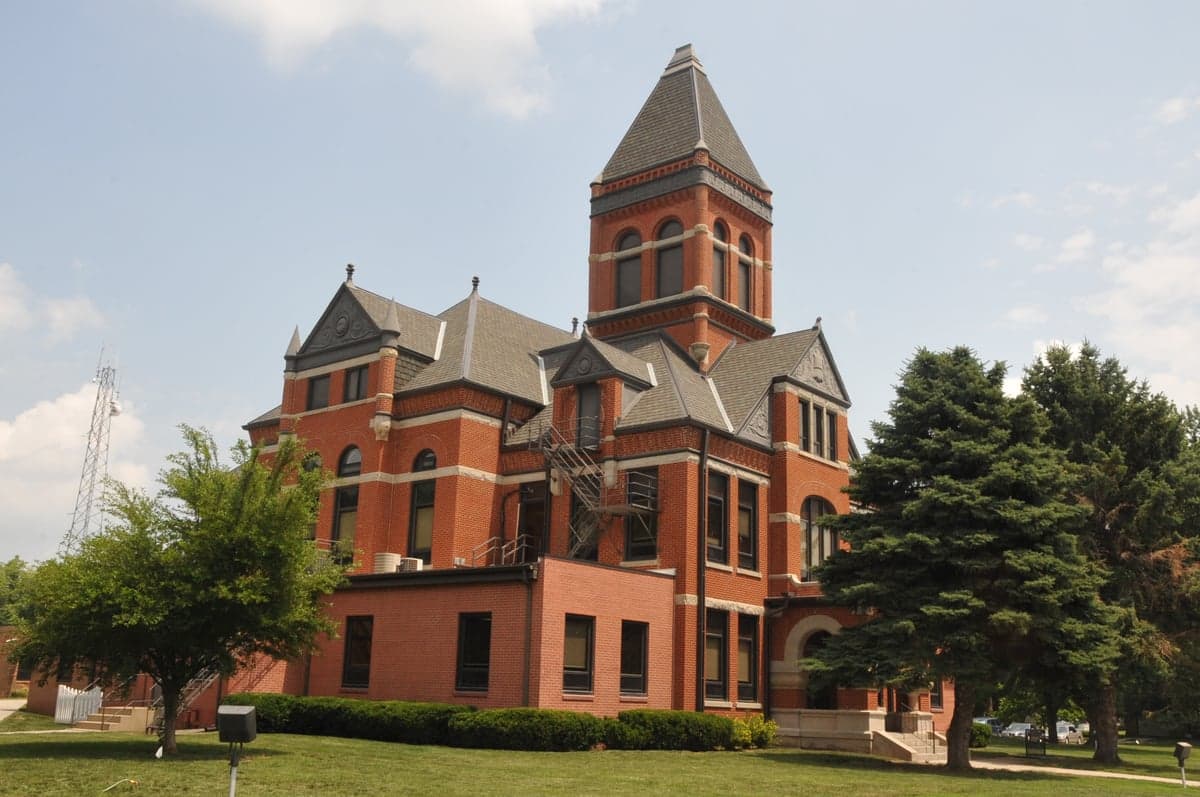
Photo: Wikipedia
Demographics of Monona County
Affluence Level in Monona County
A middle-class area roughly in line with national averages across income, home values, education, and employment.
People of Monona County
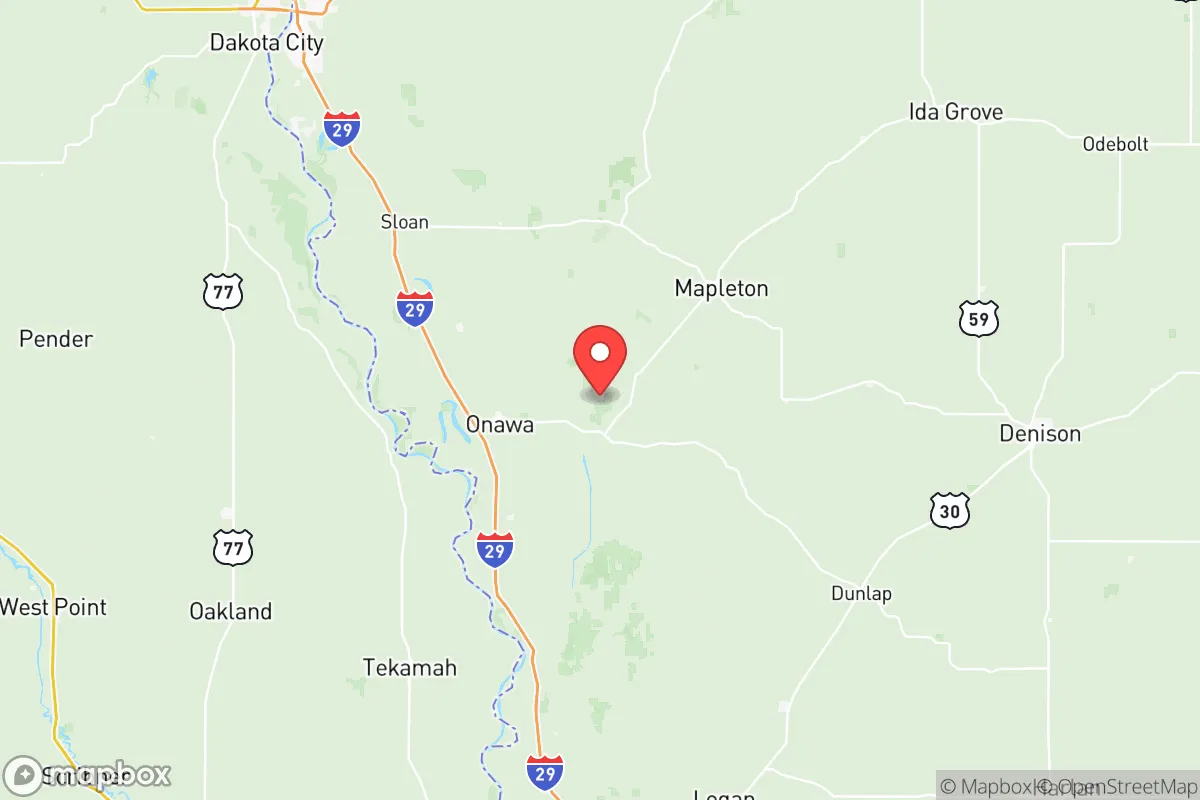
Monona County, Iowa, is home to roughly 8,619 residents, making it one of the state's most sparsely populated counties, with a population density of just over 12 people per square mile. The county is overwhelmingly white (93.3%), with a Hispanic population of 2.5% and a foreign-born share of just 0.1% — one of the lowest in the nation. Its identity is rooted in a deep agricultural heritage, small river towns, and a distinctly rural, self-reliant character shaped by generations of German, Scandinavian, and Yankee settlers who arrived in the mid-19th century.
Settlement & growth (pre-1960)
Before American settlement, the land that became Monona County was home to the Omaha, Ponca, and Sioux nations, who used the Missouri River bottomlands for hunting and seasonal camps. The region was part of the Louisiana Purchase of 1803, and for decades it remained a frontier borderland. The first permanent American presence came in the 1830s and 1840s, when fur traders and military surveyors passed through, but organized settlement did not begin until after the Iowa Territory was opened to homesteading in the 1840s and the Omaha people were removed by treaty in 1854.
The county was formally organized in 1851, and the first major wave of settlers arrived in the 1850s and 1860s. These were primarily Yankee migrants from New England and upstate New York, drawn by cheap federal land under the Preemption Act and the promise of fertile prairie soil. They founded the county seat of Onawa in 1858, naming it after a Native American word for "awakening." Simultaneously, a significant wave of German immigrants — many fleeing political unrest after the failed 1848 revolutions — settled in the northern and eastern parts of the county, establishing the towns of Whiting and Castana. These German families brought a tradition of mixed farming, livestock raising, and strong Lutheran and Catholic parish life that still defines the county's cultural character.
The 1870s and 1880s brought a second wave of Scandinavian settlers, primarily Danes and Norwegians, who took up land in the western townships near the Missouri River. They established the small community of Turin and contributed to the growth of Mapleton, which became the county's second-largest town. The arrival of the Chicago & North Western Railroad in the late 1870s was the pivotal economic event: it connected Monona County to national grain markets and triggered a land boom. By 1890, the county's population peaked at over 16,000 residents, nearly double today's figure.
The early 20th century brought slow decline. The agricultural depression of the 1920s and the Dust Bowl years of the 1930s pushed many young families off the land. Unlike eastern Iowa, Monona County did not receive significant new immigrant waves during this period; its population remained almost entirely native-born white, with a small but persistent Irish Catholic community in Ute and Soldier. The post-World War II era saw the beginning of farm consolidation, and by 1960 the county's population had fallen to roughly 10,500.
Modern era (post-1965)
The 1965 Hart-Cellar Act, which transformed U.S. immigration policy, had virtually no direct effect on Monona County. The county's foreign-born population today stands at 0.1% — essentially zero — and there are no immigrant enclaves or ethnic neighborhoods anywhere in the county. The demographic story of the past six decades is not one of new arrivals but of out-migration and aging.
Since 1970, the county has lost roughly 25% of its population. The primary driver has been the mechanization of agriculture: larger farms require fewer workers, and the county's youth have consistently left for college and jobs in the Omaha-Council Bluffs metro area, about 60 miles south, or Des Moines, about 100 miles east. The towns of Onawa and Mapleton remain the population anchors, together holding about 60% of the county's residents, while smaller towns like Whiting, Castana, and Turin have seen their populations dwindle to a few hundred each.
The Hispanic population, while small at 2.5%, has grown modestly since the 1990s, driven by Latino families working in meat processing and agricultural support roles. Most of these families live in or near Onawa, where the school district has seen a gradual increase in English-language-learner students. The Black population (0.2%) and East/Southeast Asian population (0.0%) are negligible, and there is no measurable Indian-subcontinent community. The county's college-educated share is just 18.7%, reflecting the dominance of blue-collar agricultural and manufacturing employment.
The future
Monona County's demographic trajectory points toward continued slow decline and further aging. The county's median age is already in the mid-40s, well above the national average, and the under-18 population has shrunk by nearly 20% since 2010. Projections from the Iowa State Data Center suggest the county could fall below 8,000 residents by 2040 if current trends hold.
The county is not becoming more diverse in any meaningful sense. The Hispanic share may creep toward 4-5% over the next two decades, driven by natural increase among existing families, but there is no economic engine — no major employer, no interstate corridor, no university — to attract new domestic or international migrants. The one countervailing trend is a small but steady influx of retirees and remote workers drawn by the county's low property taxes, the Loess Hills scenery, and the proximity to the Missouri River recreation areas around Onawa and Turin. These newcomers are predominantly white, middle-aged, and from other parts of Iowa or Nebraska.
Culturally, the county is likely to remain what it has been for over a century: a conservative, agrarian, predominantly Protestant and Catholic community where church attendance remains high, hunting and fishing are central leisure activities, and the county fair in Onawa is the social highlight of the summer. The school districts in Onawa and Mapleton are consolidating services, and the smaller towns will continue to lose their grocery stores, gas stations, and post offices.
For someone moving to Monona County today, the bottom line is this: you are choosing a place that is stable, safe, and deeply rooted in its agricultural past, but also one that is shrinking and aging. The county offers affordable housing, low crime, and a genuine sense of community, but it offers few jobs outside of farming, education, and healthcare, and it is a long drive from major urban amenities. The people who thrive here are those who value quiet, self-sufficiency, and neighborly connection — and who are comfortable with the fact that the county's best days, demographically speaking, are behind it.

* Values derived from national, state, county, city and local statistics and may differ in a specific area. Last updated: 2026-10-28T01:03:20.000Z
Narrative content on this page is AI-generated and may contain mistakes. Verify any details that matter before acting on them.
ReloMaps may earn a commission from affiliate links at no extra cost to you.

