Photo: Wikipedia
Demographics of Johnson County
Affluence Level in Johnson County
A middle-class area roughly in line with national averages across income, home values, education, and employment.
People of Johnson County
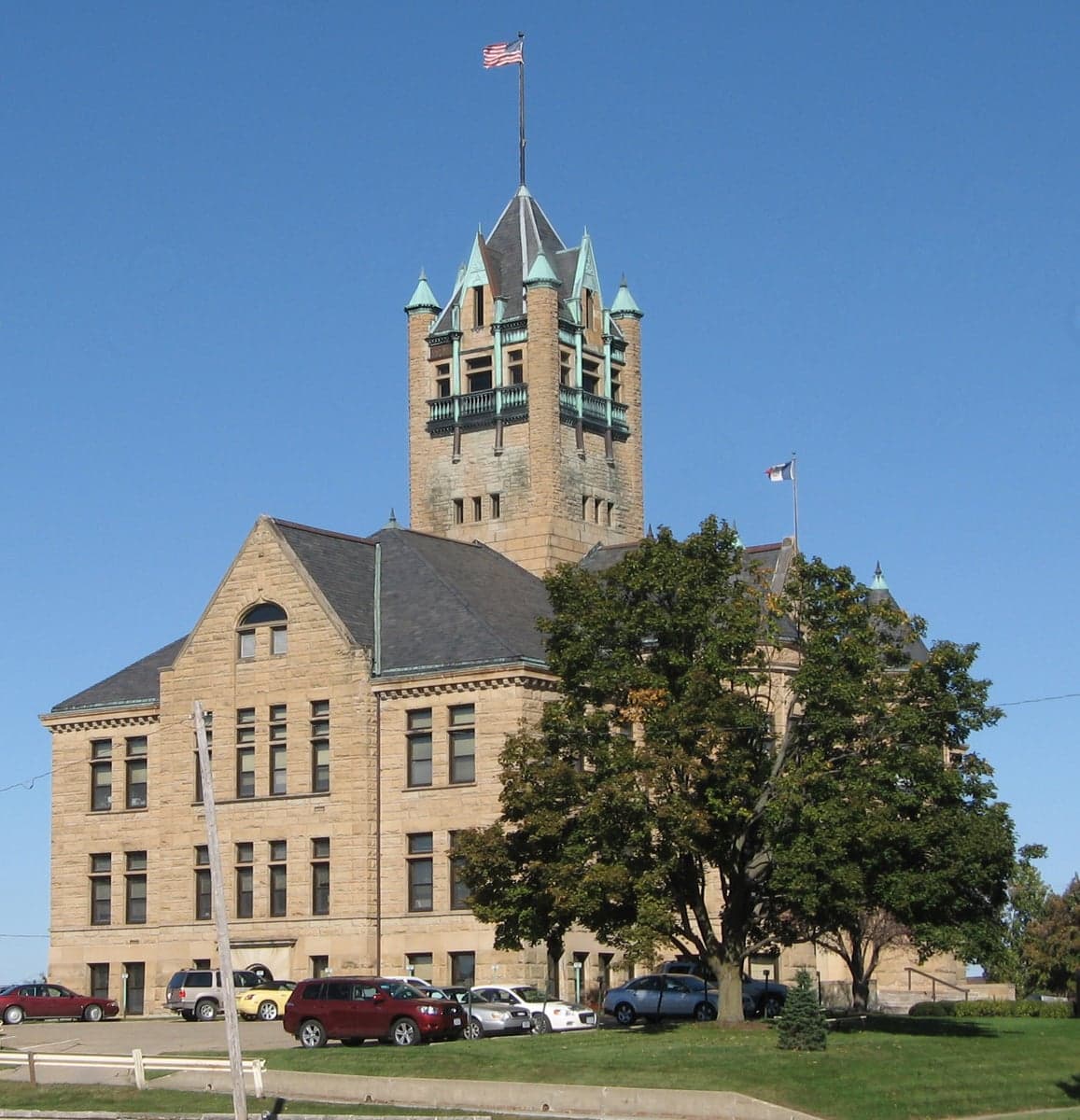
Johnson County, Iowa, is a politically and culturally distinct island within a conservative state, anchored by the University of Iowa in Iowa City. Its population of 154,881 is notably young, highly educated (54.6% hold a bachelor’s degree or higher), and racially diverse compared to the rest of Iowa, with a significant East/Southeast Asian community (4.2%) and a growing Indian-subcontinent population (1.6%). The county’s identity is shaped by a historic tension between the university town’s progressive, transient population and the longer-standing rural and small-town communities that surround it, creating a place that feels both cosmopolitan and deeply Midwestern.
Settlement & growth (pre-1960)
The land that became Johnson County was originally home to the Meskwaki (Fox) and Sauk nations, who used the Iowa River valley for seasonal hunting and farming. European-American settlement began in earnest after the Black Hawk Purchase of 1832 opened the region to white settlers. The first permanent Euro-American settlers arrived in the late 1830s, primarily from the Upland South (Kentucky, Tennessee, and Virginia) and the Mid-Atlantic states (Pennsylvania, Ohio, and New York). These early settlers were largely of English, Scots-Irish, and German descent, drawn by the promise of fertile, inexpensive prairie land for family farms.
The founding of Iowa City in 1839 as the new territorial capital triggered the first major population wave. The city was deliberately platted to be the seat of government, attracting lawyers, merchants, and craftsmen. When the capital moved to Des Moines in 1857, the University of Iowa (founded 1847) became the county’s economic and cultural anchor. The university drew a steady stream of faculty, students, and support staff from across the Midwest and Northeast, giving Iowa City a more educated and less insular character than surrounding counties from its earliest decades.
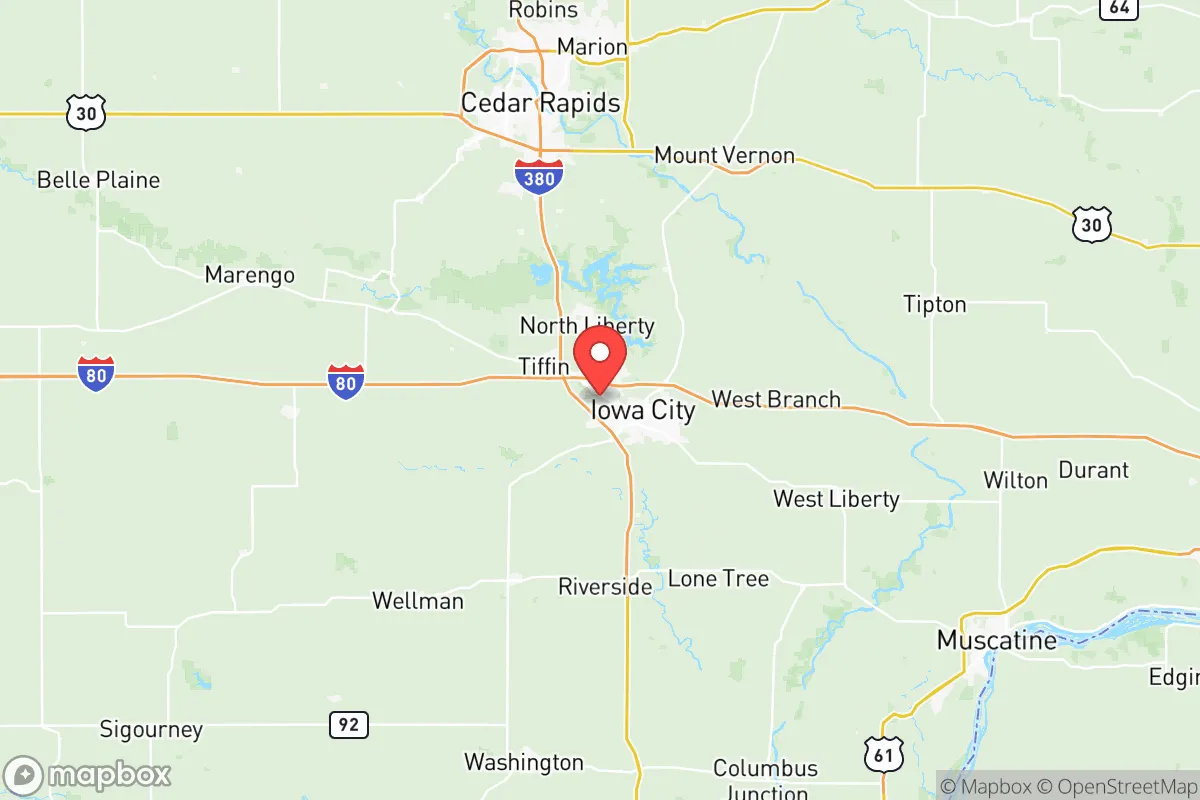
A second significant wave came with German and Irish immigration in the 1850s through 1880s. German farmers settled in the rural townships around North Liberty, Tiffin, and Solon, establishing Lutheran and Catholic churches that remain community anchors today. Irish immigrants, many fleeing the Great Famine, found work on the railroad and in the limestone quarries near Riverside and Hills. A smaller but notable group of Swedish immigrants settled in the northern part of the county, near Swisher and Shueyville, where their Lutheran church still stands.
African American settlement in Johnson County was minimal before the 20th century. A small community of freedmen and their descendants lived in Iowa City’s “Goosetown” neighborhood near the railroad tracks, working as porters, domestics, and laborers. The Great Migration (1910-1970) brought a modest number of Black families from the Deep South to Iowa City, drawn by industrial jobs at the state university and the nearby meatpacking plants in Coralville. By 1960, the Black population remained under 2%, concentrated in Iowa City’s near-south side.
The post-World War II era saw the first major suburban expansion. The GI Bill enabled thousands of veterans to attend the University of Iowa, swelling the student population. The university’s rapid growth in the 1950s and 1960s, combined with the construction of Interstate 80, transformed Coralville from a small river town into a bedroom community and commercial hub. North Liberty, then a village of fewer than 500 people, began its slow transition from a farming crossroads to a commuter suburb.
Modern era (post-1965)
The 1965 Hart-Cellar Act fundamentally reshaped Johnson County’s demographics, though the effects were slower to arrive than in coastal cities. The first major post-1965 immigrant group was East/Southeast Asian, beginning with Vietnamese refugees in the late 1970s and early 1980s. Many were sponsored by university-affiliated churches and settled in Iowa City, finding work in the service industry and at the university. A smaller wave of Korean and Chinese immigrants followed in the 1980s and 1990s, primarily graduate students and their families who stayed after completing degrees. Today, the East/Southeast Asian population stands at 4.2%, with a visible concentration in Iowa City’s southeast side and near the university campus.
The Indian-subcontinent population (1.6%) grew rapidly after 2000, driven by the university’s strong engineering, medical, and business programs. Unlike earlier immigrant groups, this wave is almost entirely composed of highly educated professionals—doctors, researchers, and tech workers—who often arrive on H-1B visas and settle directly in Iowa City and Coralville. The community has established temples and cultural organizations, but remains more dispersed than the East/Southeast Asian population.
The Hispanic population (6.7%) grew steadily from the 1990s onward, driven by labor demand in construction, meatpacking, and agriculture. Unlike the university-linked Asian and Indian populations, Hispanic immigrants—primarily from Mexico and Central America—settled in Riverside, Kalona, and the rural townships, where they found work in hog farming, grain processing, and light manufacturing. The Amish and Mennonite communities in the Kalona area, who arrived in the 1970s from Pennsylvania and Ohio, have employed Hispanic workers on their farms, creating an unusual cross-cultural dynamic.
Domestic migration has been equally transformative. Since the 1990s, Johnson County has attracted a steady stream of out-of-state newcomers from the coasts and the Rust Belt, drawn by the university’s research sector and the area’s relatively low cost of living. This in-migration has been overwhelmingly white and college-educated, accelerating the county’s political and cultural divergence from the rest of Iowa. The Black population (7.5%) grew modestly through both domestic migration and births, but remains concentrated in Iowa City’s south side and in Coralville’s older neighborhoods.
Suburbanization has reshaped the county’s geography. North Liberty grew from 500 residents in 1980 to over 20,000 by 2025, becoming the county’s third-largest city and a magnet for young families priced out of Iowa City. Tiffin and Solon have seen similar, if smaller, booms. These suburbs are overwhelmingly white and politically moderate, serving as a buffer zone between the progressive university core and the conservative rural townships.
The future
Johnson County is likely to continue its trajectory toward greater diversity and urbanization, but the pattern is one of tribalization rather than homogenization. The university-anchored core—Iowa City and Coralville—will become more racially and ethnically diverse, with the East/Southeast Asian and Indian populations growing through both immigration and natural increase. The Hispanic population is expected to grow steadily, spreading from rural enclaves into the suburbs. The white, college-educated in-migration from the coasts will continue, reinforcing the county’s progressive political character.
However, the suburbs and rural townships are likely to remain predominantly white and more conservative. North Liberty and Tiffin will absorb most of the county’s domestic growth, attracting families who want proximity to the university’s amenities but not its political culture. The Amish and Mennonite communities in Kalona will remain culturally distinct, though their reliance on Hispanic labor may slowly diversify their towns.
The key demographic question is whether the immigrant and minority populations will integrate into the county’s existing social fabric or form separate enclaves. The East/Southeast Asian and Indian communities, being highly educated and English-proficient, are likely to assimilate into the university’s professional class. The Hispanic population, more economically stratified, may face greater barriers to integration. The Black population, small and historically rooted, is likely to remain stable but not grow rapidly.
For a newcomer moving in now, Johnson County offers a rare combination: a world-class university town with genuine diversity and cultural amenities, surrounded by affordable small towns and working farmland. The trade-off is clear—you are moving into a place where the university’s progressive values dominate the public square, even as the surrounding county votes Republican. The population is heading toward a future where these two Johnson Counties—the university city and the rural-suburban ring—coexist but do not fully merge.

* Values derived from national, state, county, city and local statistics and may differ in a specific area. Last updated: 2026-05-15T02:25:23.000Z
Narrative content on this page is AI-generated and may contain mistakes. Verify any details that matter before acting on them.
ReloMaps may earn a commission from affiliate links at no extra cost to you.

