Photo: Wikipedia
Political ClimatePolitical Climate in Henry County
Showing district-level results — no local-only data available.
Local Political AnalysisPolitical Analysis of Henry County
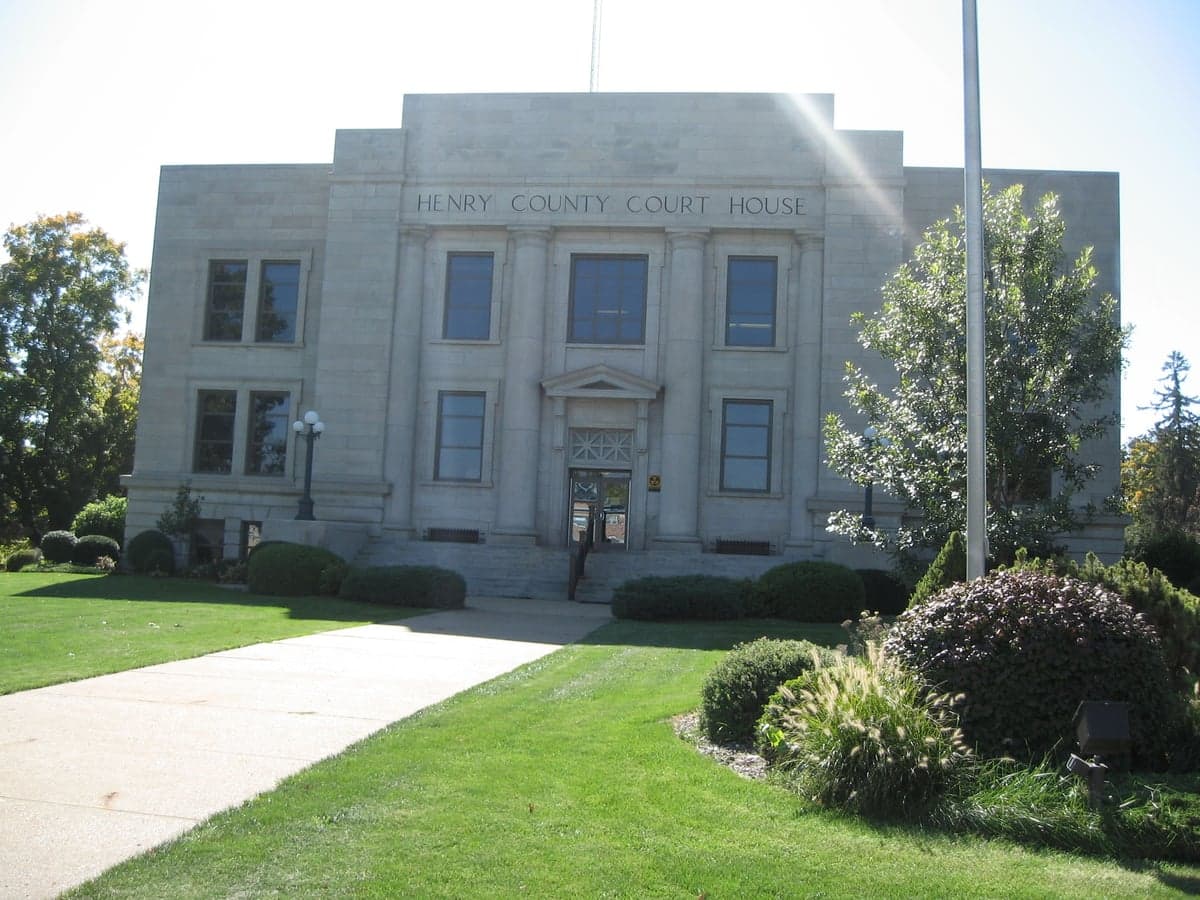
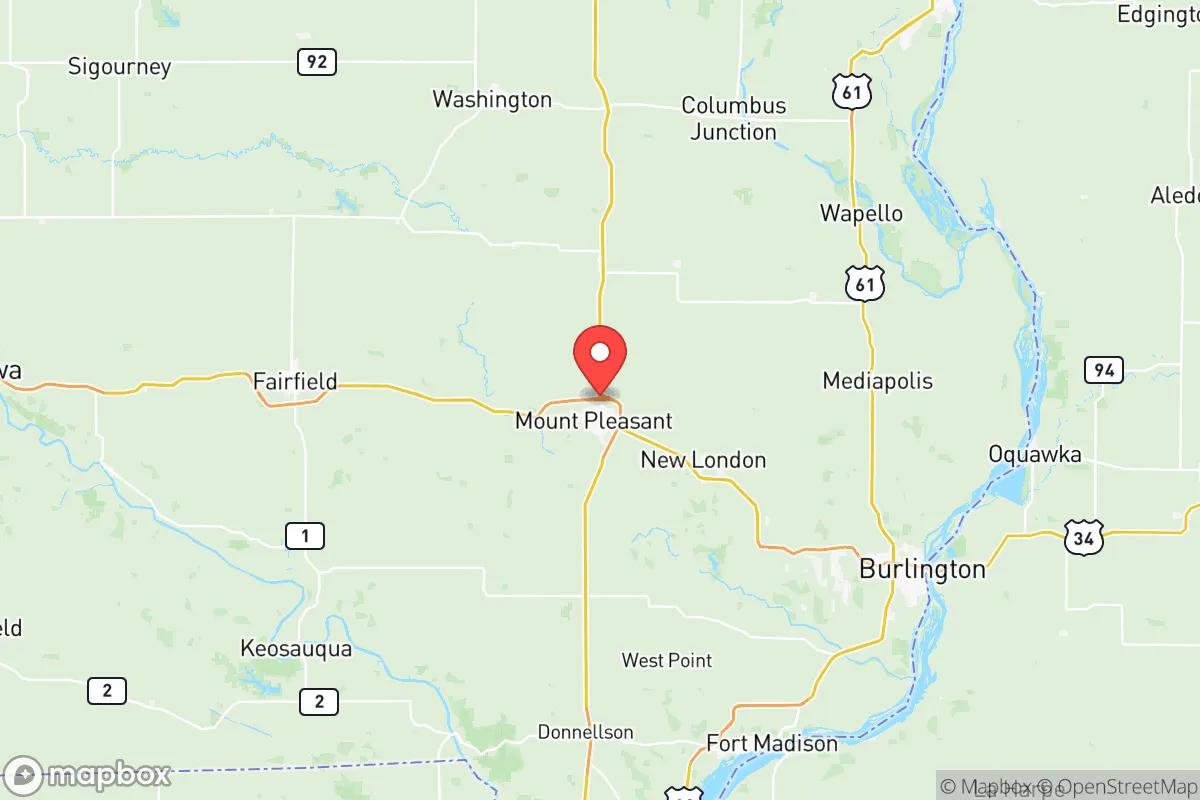
Henry County, Iowa, leans Republican but in a notably tempered way compared to the rest of the state. With a Cook PVI of R+4, it’s two points less conservative than Iowa’s overall R+6 rating, making it a genuine swing county in a state that’s become reliably red. The real story, though, is the internal split: the county seat, Mount Pleasant, has been drifting leftward over the past decade, while the smaller towns and rural townships—places like Winfield, Wayland, and New London—have held steady or moved right. That tension between the county’s one small city and its agricultural hinterland defines the local political climate more than any single number.
How it compares
Iowa as a whole has trended R+6, a shift driven by rural consolidation and the GOP’s strength in the northwest and central parts of the state. Henry County’s R+4 reflects a more moderate electorate, largely because of Mount Pleasant. In 2020, Mount Pleasant’s precincts—especially those around Iowa Wesleyan University and the downtown core—voted for Joe Biden by margins of 5 to 8 points, while the surrounding townships went for Donald Trump by 20 to 30 points. That’s a wider urban-rural gap than you see in, say, Washington County to the north, which is R+5 but lacks a comparable blue-leaning town. The county’s overall PVI hasn’t budged much since 2016, suggesting it’s not following the state’s rightward march as aggressively. If anything, Mount Pleasant’s growth as a regional hub for healthcare and manufacturing—think Iowa Wesleyan’s slow rebuild and the BorgWarner plant—has kept the county from tipping further red.
What this means for residents
For conservatives, Henry County is comfortable but not a lock. You can win local races—the county board of supervisors is currently all Republican—but you’ll need to actually campaign in Mount Pleasant, not just run on the R next to your name. For liberals, the county offers a rare thing in rural Iowa: a genuine political foothold. Mount Pleasant’s precincts are organized enough that a Democrat can win a county-level seat if they focus on city issues like housing and downtown development. The practical upshot is that policy debates here are less ideological than in deep-red counties like Lyon or Sioux. School board meetings in Mount Pleasant, for instance, have seen real fights over curriculum and library books, but they’re fought with a level of civility that’s increasingly rare elsewhere. The county’s political middle—the swing voters in places like Salem and Rome—tend to be fiscal conservatives who’ll cross over for a local Democrat they trust on infrastructure or education funding.
Culturally, Henry County’s moderation shows up in its policy choices. The county has a 29% higher property tax levy than the state average, funding a solid public school system and a county conservation board that’s actually active. That’s not something you see in a hard-right county, where such spending would be a nonstarter. The local GOP is more Chamber of Commerce than culture-war: the county party’s platform emphasizes economic development and agriculture over social issues. For a liberal resident, that means you’re not going to feel isolated in the way you might in a place like Osceola County. For a conservative, it means you’re part of a coalition that governs, not just opposes. The trajectory? Mount Pleasant’s growth—the city added about 300 residents between 2020 and 2025—will likely nudge the county leftward over the next decade, but the rural townships aren’t going anywhere. Henry County will probably stay R+4 to R+5 for the foreseeable future, a blue dot in a red sea that forces both sides to actually talk to each other.

State Political ClimatePolitical Climate in Iowa
State Political AnalysisPolitical Environment in the State
Iowa has shifted from a classic purple swing state to a solidly Republican one, carrying a Cook PVI of R+6, meaning it votes about six points more Republican than the national average. This transformation has been dramatic over the past 15 years: in 2008 and 2012, the state was a toss-up, backing Obama once and then splitting tickets, but since 2016, it has swung hard right, with Trump winning it by 9 points in 2016 and 8 points in 2020. The dominant coalition is now a mix of rural and small-town voters, evangelical Christians, and older, white working-class residents, while the state’s few urban centers—Des Moines, Iowa City, and Cedar Rapids—remain Democratic strongholds that are increasingly outmatched by the surrounding countryside.
Urban vs. rural divide
The political map of Iowa is a textbook case of the urban-rural split. The state’s two major metros, Des Moines (Polk County) and Iowa City (Johnson County), are reliably blue—Johnson County voted for Biden by 35 points in 2020, and Polk County by 16 points. These areas drive the state’s Democratic base, fueled by younger professionals, university faculty, and a growing Latino population in Des Moines. In contrast, the vast rural expanse—counties like Sioux, Plymouth, and Lyon in the northwest, and Davis, Van Buren, and Decatur in the south—routinely vote 70-80% Republican. The suburbs around Des Moines, like Ankeny and Waukee, have been a key battleground; they were once swing areas but have trended right since 2016, with Ankeny’s fast-growing population leaning increasingly conservative. The real story, though, is the collapse of Democratic support in small industrial towns like Ottumwa and Fort Dodge, which were union strongholds 20 years ago but now vote Republican by double digits. This geographic chasm means that state-level politics are dominated by rural and small-town interests, even as the population slowly concentrates in the Des Moines metro.
Policy environment
Iowa’s policy environment is defined by a low-tax, limited-government approach that has been aggressively pursued since Republicans gained full control of the legislature and governorship in 2017. The state has a flat income tax rate of 3.8%, phased down from a progressive system, and property taxes are relatively low, with a median effective rate of about 1.5% of home value. There is no state estate tax. The regulatory posture is business-friendly, with right-to-work laws and a weak labor union presence—union membership is around 8%, well below the national average. Education policy has been a flashpoint: in 2023, the state passed a universal school voucher program (Education Savings Accounts) that allows any family to use public funds for private or homeschool expenses, a major win for school-choice advocates. Healthcare is mixed—Iowa expanded Medicaid under the Affordable Care Act, but the state has also imposed work requirements for able-bodied adults on the program. Election laws have tightened: voter ID is required, early voting windows have been shortened, and drop boxes are restricted. For a conservative relocator, the tax and school-choice environment is a clear draw; for a liberal one, the voting restrictions and union policies are significant drawbacks.
Recent policy direction
The last five years have seen Iowa move decisively on a range of liberty-related issues. On gun rights, the state passed permitless carry (constitutional carry) in 2021, allowing any legal adult to carry a concealed firearm without a permit or training—one of the most permissive laws in the Midwest. On parental and education rights, the 2023 voucher law was paired with a ban on teaching critical race theory and gender identity in K-12 schools (HF 802), and a law requiring schools to notify parents if a student requests a name or pronoun change (SF 496). On speech and privacy, Iowa passed a law in 2024 restricting social media platforms from censoring political speech, though it faces legal challenges. Medical and bodily autonomy is sharply divided: the state banned abortion at roughly six weeks (a heartbeat bill) in 2023, with no exceptions for rape or incest, making it one of the most restrictive in the nation. However, medical marijuana is legal for qualifying conditions, and there is no ban on gender-affirming care for adults, though a ban for minors was enacted in 2023. Property rights are strong, with no statewide zoning mandates and a recent law limiting local governments’ ability to regulate short-term rentals like Airbnb. On taxation, the flat income tax is set to drop to 3.5% by 2027, and the corporate tax rate is being phased down to a flat 5.5%. Voting access has been restricted, as noted, but the state also passed a law requiring audits of election results, which has been popular with both parties. For a relocator, the bottom line is that Iowa is moving in a consistently conservative direction on nearly every front, with the notable exception of medical marijuana, which remains limited.
Civil unrest & political movements
Iowa has not seen the kind of large-scale civil unrest common in coastal states, but there have been notable flashpoints. The 2020 Black Lives Matter protests in Des Moines and Iowa City were relatively small and peaceful, with no major property damage or curfews. The most visible political movements are on the right: the Iowa Faith and Freedom Coalition is a powerful force, driving evangelical turnout, and the state has a strong network of Second Amendment activists who were instrumental in passing permitless carry. Immigration politics are a hot-button issue, particularly in meatpacking towns like Storm Lake and Postville, which have large immigrant populations. The state has no sanctuary cities, and in 2024, the legislature passed a bill requiring local law enforcement to cooperate with ICE detentions. There has been no serious secession or nullification rhetoric, but election integrity remains a live issue—after the 2020 election, Republican legislators held hearings on alleged irregularities, though no evidence of widespread fraud was found. A new resident would notice that political signs and bumper stickers are common, but the tone is generally civil, with most people keeping their views to themselves in daily interactions. The one exception is around the state’s 99 county fairs, where political booths and candidate meet-and-greets are a staple of summer life.
Projection
Over the next 5-10 years, Iowa is likely to remain solidly Republican, but the margin may narrow slightly as the Des Moines metro continues to grow and attract younger, more diverse residents. The state’s population is aging and slowly declining in rural areas, which could weaken the GOP’s rural base, but in-migration from blue states like Illinois and California is still relatively small—about 15,000 net new residents per year, many of whom are retirees or remote workers drawn by low taxes. The biggest wildcard is the state’s education and abortion policies: if the voucher program leads to a hollowing out of rural public schools, or if the abortion ban causes a backlash among suburban women, the GOP could lose ground in places like Ankeny and Waukee. However, the state’s political infrastructure is deeply entrenched, with Republicans holding supermajorities in both legislative chambers and every statewide office. A relocator moving in now should expect that in a decade, Iowa will still be a red state, but with a more competitive Des Moines suburbs corridor and a continued rural-urban divide. The policy direction will likely stay the same—more tax cuts, more school choice, and continued restrictions on abortion and voting—unless a national Democratic wave temporarily flips the governorship.
For a new resident, the practical takeaway is that Iowa offers a stable, predictable political environment that is very friendly to conservative values—low taxes, strong gun rights, school choice, and a culture of self-reliance. For liberal residents, the state can feel restrictive, particularly on abortion and voting access, but the urban centers of Des Moines and Iowa City provide a blue bubble with progressive amenities and a tolerant social scene. The key is to pick your location wisely: if you want a conservative community, look at the suburbs of Des Moines like Ankeny or the small towns of northwest Iowa like Sioux Center; if you want a liberal enclave, Iowa City or the Des Moines’ East Side are your best bets. Either way, the state’s politics are unlikely to surprise you—they are what they are, and they’re trending in a clear direction.
* Values derived from national, state, county, city and local statistics and may differ in a specific area. Last updated: 2026-10-17T01:14:35.000Z
Narrative content on this page is AI-generated and may contain mistakes. Verify any details that matter before acting on them.
ReloMaps may earn a commission from affiliate links at no extra cost to you.

