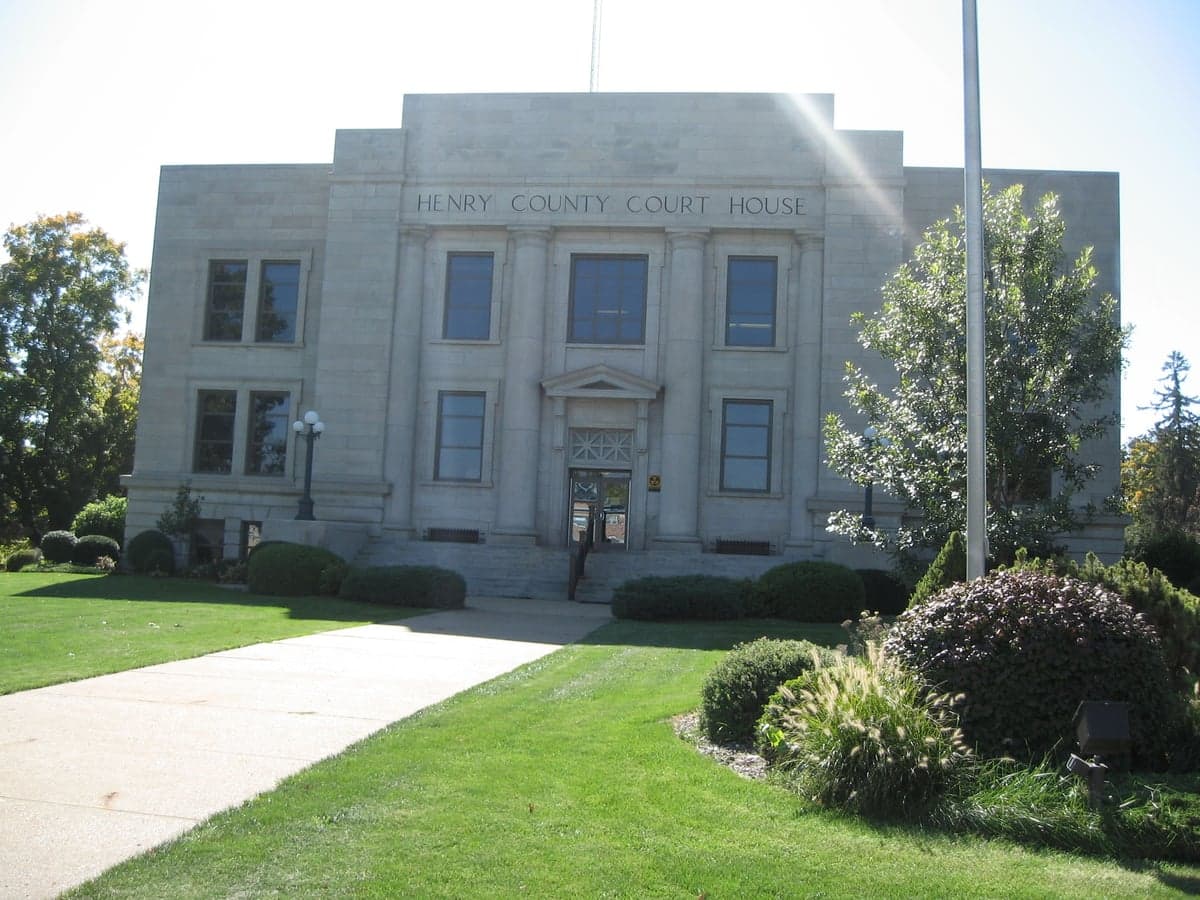
Photo: Wikipedia
Demographics of Henry County
Affluence Level in Henry County
A middle-class area roughly in line with national averages across income, home values, education, and employment.
People of Henry County
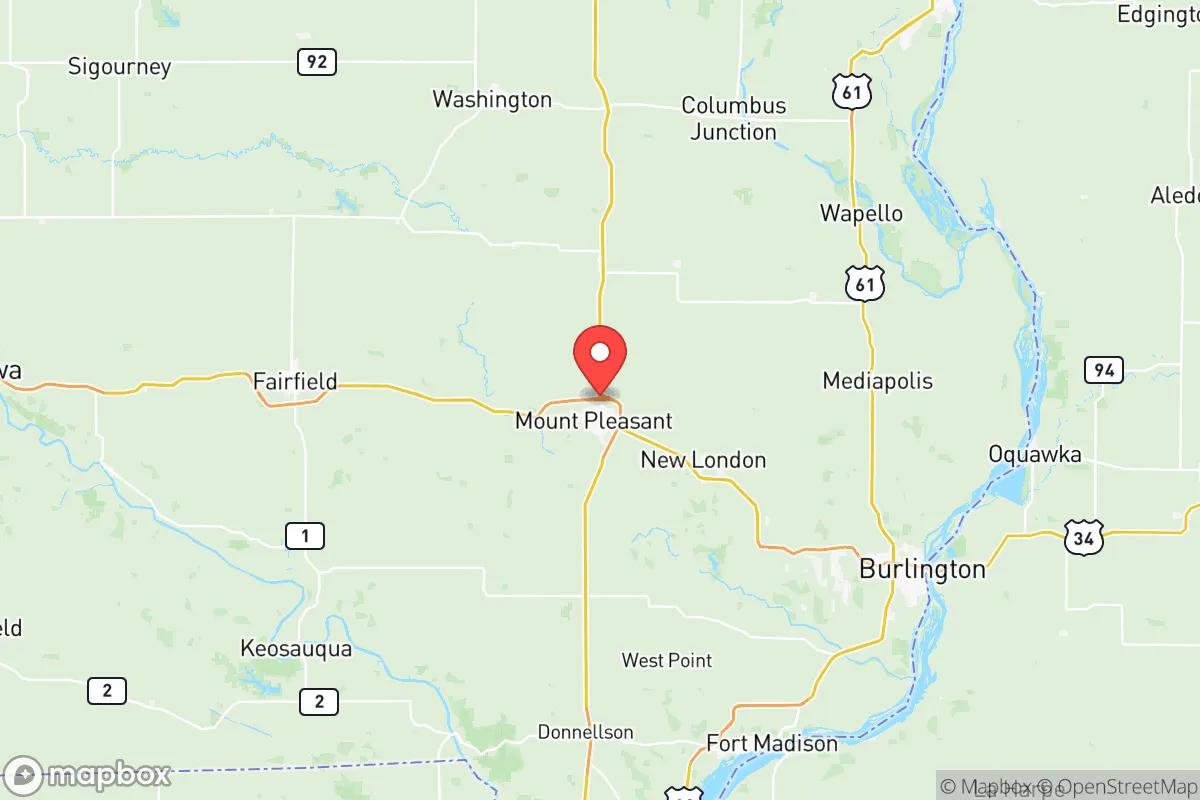
Henry County, Iowa, today is a predominantly white, rural community of 20,228 residents, characterized by a strong agricultural heritage and a slower pace of life. With a foreign-born population of just 1.5% and a college attainment rate of 22.5%, the county is less diverse and less formally educated than the state average, reflecting its deep roots in family farming and small-town manufacturing. The population is concentrated in the county seat of Mount Pleasant, along with smaller towns like New London, Winfield, and Wayland, where a sense of community and traditional values remain central to daily life.
Settlement & growth (pre-1960)
The land that became Henry County was originally home to the Ioway and Sac and Fox (Meskwaki) nations, who used the region for hunting and seasonal camps along the Skunk River and its tributaries. The area was ceded to the United States through a series of treaties in the 1830s, and the first permanent Euro-American settlers arrived in the mid-1830s, primarily from Kentucky, Tennessee, and Ohio. These early pioneers were of Scots-Irish and English descent, drawn by the promise of fertile, inexpensive prairie land under the federal land auction system. They established the first settlements at Mount Pleasant (1834) and Salem (1835), the latter becoming a notable stop on the Underground Railroad due to the strong abolitionist sentiments of its Quaker founders.
The next major wave came in the 1840s and 1850s, when German immigrants began arriving in significant numbers. They were attracted by the availability of farmland and the construction of the Burlington and Missouri River Railroad, which reached Mount Pleasant in 1855. These German settlers concentrated in the northern and western parts of the county, founding or heavily populating towns like Wayland and Olds. They brought with them a tradition of Lutheran and Catholic church-building, hardscrabble farming, and a preference for tight-knit, ethnically homogeneous communities. A smaller but notable group of Swedish immigrants also arrived in the 1860s and 1870s, settling primarily around Swedesburg, a tiny unincorporated community that still bears their name.
By the early 20th century, the county's population had peaked at over 20,000, driven by the prosperity of corn and hog farming. The Great Depression and the subsequent Dust Bowl years saw a modest out-migration of younger residents to cities like Des Moines and Chicago, but the county's agricultural base kept it relatively stable. The post-World War II era brought a small influx of returning veterans who took advantage of the GI Bill to buy farms or start small businesses in Mount Pleasant. The 1950s also saw the establishment of Iowa Wesleyan University (founded 1842) as a local anchor, though its student body remained overwhelmingly white and from the Midwest. No significant non-white population developed during this period; the county remained nearly 99% white through 1960.
Modern era (post-1965)
The 1965 Hart-Cellar Act had a minimal direct impact on Henry County. Unlike urban centers or Sun Belt boomtowns, the county did not attract new immigrant communities from Asia, Latin America, or Africa in any substantial numbers. The foreign-born population today sits at just 1.5%, a figure that has barely budged in decades. The most notable demographic shift since the 1970s has been domestic out-migration of young adults seeking education and employment in larger metropolitan areas, a trend common across rural Iowa. The county's population has declined from a peak of roughly 20,600 in 1980 to 20,228 today, with the loss concentrated in the smallest towns like Rome and Mount Union.
The Hispanic population, now at 5.4%, represents the most significant change. This growth began in the 1990s and accelerated in the 2000s, driven by Mexican and Central American workers recruited by agribusiness operations and the Mount Pleasant pork processing plant (now operated by Smithfield Foods). These workers and their families have concentrated in Mount Pleasant, particularly in the city's older, more affordable neighborhoods near the plant. The Black population (2.6%) is also largely centered in Mount Pleasant, with a small but established community that traces its roots to a handful of families who moved to the area for manufacturing jobs in the 1970s and 1980s. The East/Southeast Asian community (1.0%) is tiny and dispersed, with no identifiable enclave. The Indian subcontinent population is effectively zero (0.0%).
Suburbanization has been minimal. Mount Pleasant has seen some new housing developments on its outskirts, but the county lacks the commuter-shed dynamics that drive growth near larger cities like Iowa City or Burlington. The closure of Iowa Wesleyan University in 2023 was a major blow, removing a key source of cultural and economic vitality and accelerating the loss of young, college-educated residents.
The future
The population of Henry County is projected to continue a slow decline over the next 10-20 years, driven by an aging demographic profile and the ongoing out-migration of young adults. The county's median age is already above the state average, and the school-age population in towns like Winfield and New London is shrinking. The Hispanic share is expected to grow modestly, potentially reaching 8-10% by 2040, as existing families have children and a small number of new workers arrive for agricultural and processing jobs. However, the county is unlikely to become significantly more diverse in the near term, as it lacks the economic magnets—major universities, tech hubs, or logistics centers—that attract international migration.
Culturally, Henry County will likely remain a predominantly white, conservative, and agriculturally oriented community. The Mount Pleasant area will continue to be the most diverse part of the county, while the smaller towns will become even more homogenous as younger residents leave. The loss of Iowa Wesleyan has removed a liberalizing influence, and the county's political and social character is expected to become more closely aligned with the deeply conservative rural Iowa norm. For someone moving in now, the county offers a stable, quiet, and safe environment with strong community ties, but with limited economic opportunity and little demographic change on the horizon.
Henry County is becoming a quieter, older, and slightly more Hispanic version of its former self—a place where the past is still very much present, and where the future will be shaped more by who stays than by who arrives.

* Values derived from national, state, county, city and local statistics and may differ in a specific area. Last updated: 2026-10-17T01:14:35.000Z
Narrative content on this page is AI-generated and may contain mistakes. Verify any details that matter before acting on them.
ReloMaps may earn a commission from affiliate links at no extra cost to you.

