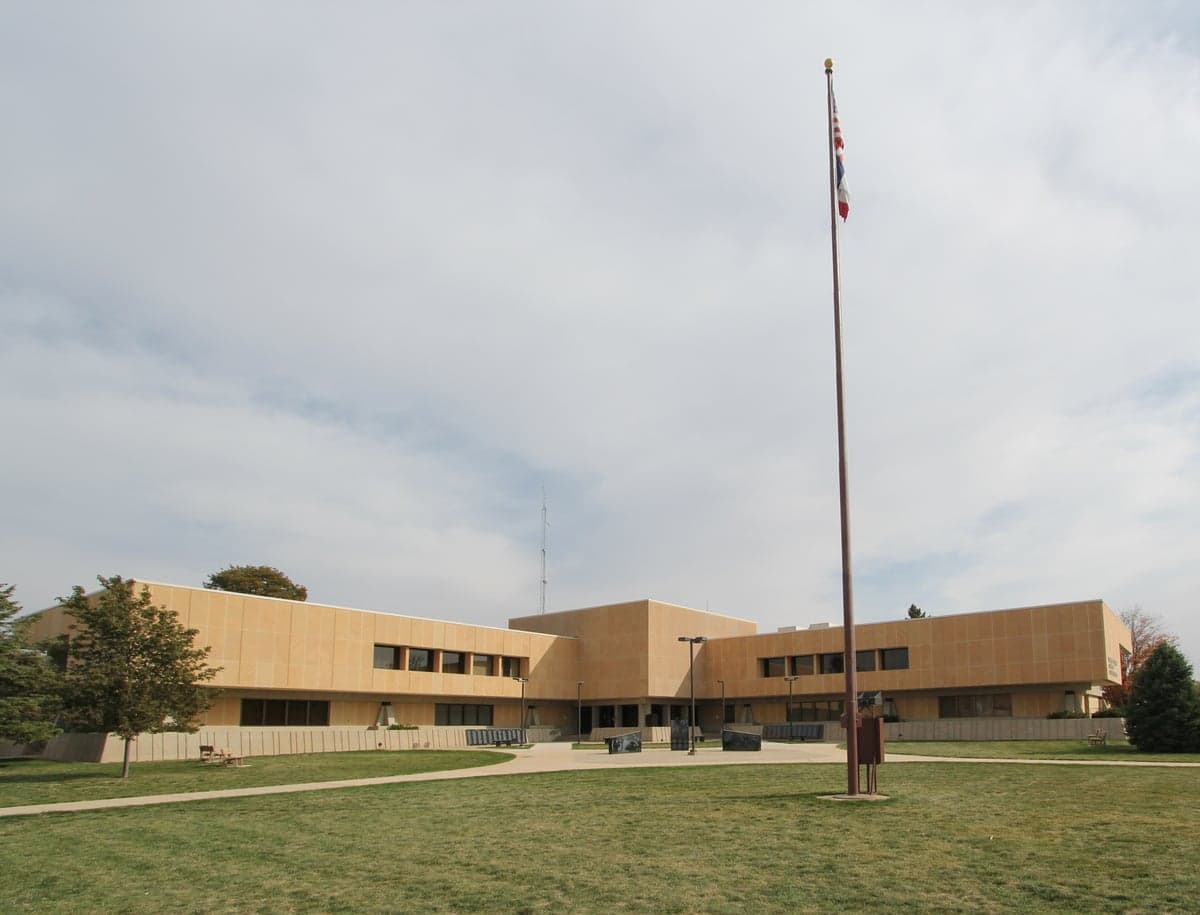
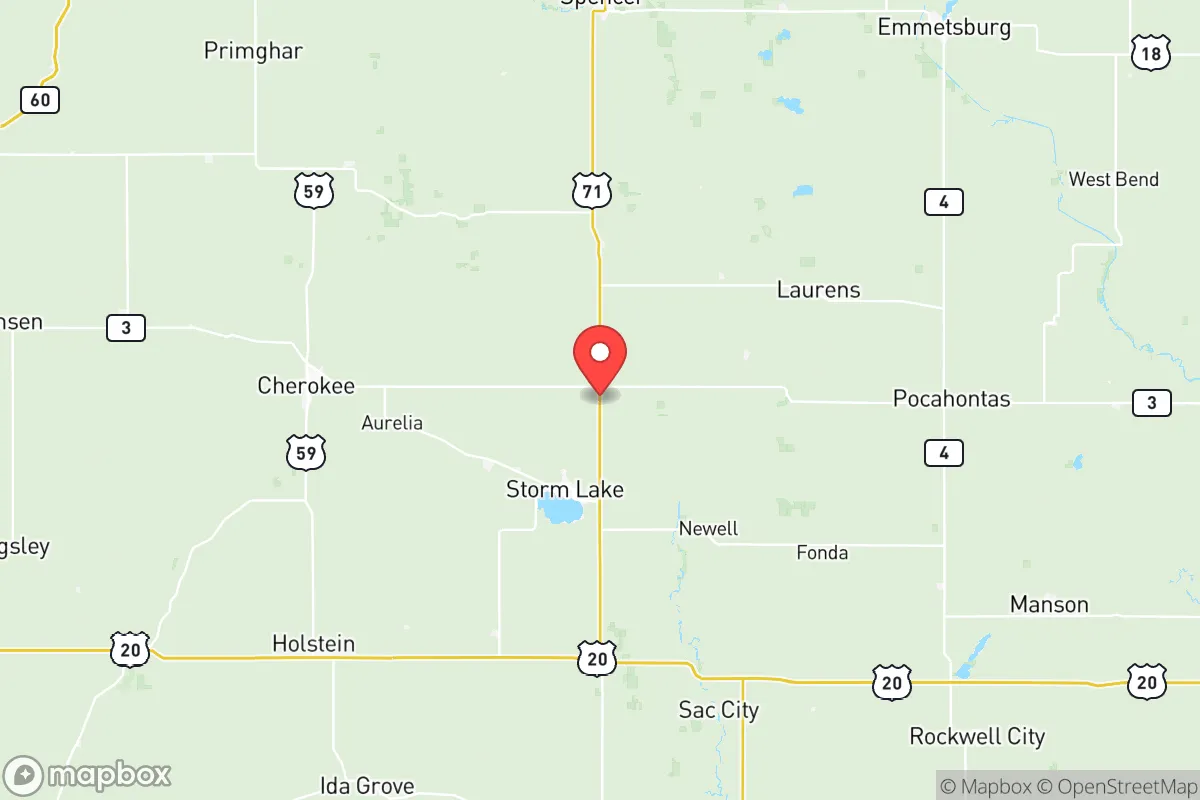
Photo: Wikipedia
Demographics of Buena Vista County
Affluence Level in Buena Vista County
A middle-class area roughly in line with national averages across income, home values, education, and employment.
People of Buena Vista County
Buena Vista County, Iowa, is home to 20,684 residents, a population defined by its deep agricultural roots and a striking demographic transformation over the past three decades. The county is now a majority-minority community, with a population that is 53.5% white, 28.6% Hispanic, 10.0% East and Southeast Asian, and 3.1% Black. This blend of long-standing farming families, a substantial Hispanic workforce, and a significant Asian community—largely concentrated in the county seat of Storm Lake—makes it one of the most ethnically diverse rural counties in the Midwest, a place where the traditional and the new are woven together in daily life.
Settlement & growth (pre-1960)
The land that became Buena Vista County was originally inhabited by the Sioux people, particularly the Yankton and Santee bands, who used the region for hunting and seasonal camps. European-American settlement began in earnest after the 1851 Treaty of Traverse des Sioux opened the area to white homesteaders. The county was officially organized in 1859, and the first wave of settlers were primarily Yankees from New England and New York, followed by a significant influx of German immigrants in the 1860s and 1870s. These German families, many of whom were farmers and craftsmen, established the foundational agricultural communities of Storm Lake, Alta, and Newell, building the region's first grain elevators, churches, and schools.
A second major wave arrived in the 1880s and 1890s: Danish and Swedish immigrants, drawn by the promise of cheap, fertile prairie land. They concentrated in the northern and western parts of the county, founding towns like Lakeside and Linn Grove. These Scandinavian settlers brought a strong tradition of cooperative farming and Lutheran faith, which shaped the county's social and political character for generations. By 1900, the population had swelled to over 16,000, and the economy was almost entirely tied to corn, oats, and livestock. The early 20th century saw a smaller but notable arrival of Irish and Czech families, who settled in Schaller and Rembrandt, adding to the county's ethnic patchwork. The period from 1900 to 1960 was one of relative stability, with the population hovering around 20,000 and the white, Protestant, and Catholic farming communities forming the core of civic life.
Modern era (post-1965)
The 1965 Hart-Cellar Act, which abolished national-origin quotas, had a delayed but profound impact on Buena Vista County. The real catalyst for change came in the 1980s and 1990s, when the meatpacking industry—specifically the Iowa Beef Processors (IBP) plant in Storm Lake—became the county's dominant employer. The plant, now owned by Tyson Foods, actively recruited immigrant labor to fill demanding, low-wage positions that local workers increasingly avoided. This created a dramatic demographic shift.
The first major group to arrive were Hispanic workers, primarily from Mexico and later from Central America. They began settling in Storm Lake in the late 1980s, forming a vibrant barrio in the city's older, central neighborhoods. Today, the Hispanic community makes up 28.6% of the county's population, and their presence is visible in the Spanish-language signage, taquerias, and Catholic masses celebrated in Spanish at St. Mary's Church. The second major group, arriving in the 1990s and 2000s, were East and Southeast Asian immigrants, predominantly from Laos and Vietnam, many of whom were refugees or secondary migrants from other U.S. states. They now account for 10.0% of the population, with a strong concentration in Storm Lake's southeast side, where Lao Buddhist temples and Vietnamese grocery stores anchor the community. A smaller but significant Black community (3.1%) also grew during this period, with many families arriving from Chicago and other Midwestern cities for work at the plant.
This rapid influx transformed Storm Lake from a nearly all-white town of 8,000 in 1980 into a majority-minority city of over 10,000 by 2020. The surrounding towns—Alta, Newell, and Schaller—have remained predominantly white, though they have seen a modest increase in Hispanic families working in agriculture and construction. The county's foreign-born population now stands at 13.5%, a figure that is more than double the state average and places Buena Vista among the most immigrant-heavy rural counties in Iowa. The college-educated share of the population is 22.1%, reflecting the educational attainment of the white professional class and the growing number of second-generation immigrant students attending Iowa Central Community College in Storm Lake.
The future
The population of Buena Vista County is projected to remain stable or grow slightly over the next decade, driven by continued immigration and higher birth rates among Hispanic and Asian families. The county is becoming more diverse, not less, as the white population ages and the younger, non-white population grows. The Hispanic share is expected to rise toward 35% by 2035, while the Asian community will likely hold steady or increase modestly as families reunite and new arrivals are drawn by the steady availability of meatpacking jobs. The key challenge is economic integration: the plant jobs are physically demanding and offer limited upward mobility, meaning that the county's future depends on creating a more diverse economy in Storm Lake and the surrounding towns.
Culturally, the county is evolving into a genuinely multi-ethnic rural community, where the old Lutheran church and the new Buddhist temple coexist within a few blocks. The public schools in Storm Lake are now majority-minority, and the annual "San Juan Festival" and "Lao New Year" celebrations are as much a part of the civic calendar as the county fair. For a newcomer, this means moving into a place that is both deeply traditional in its agricultural rhythms and strikingly global in its daily interactions. The bottom line: Buena Vista County is a working-class, immigrant-driven community that offers a unique blend of Midwestern stability and multicultural vitality, but it is a place where economic opportunity is still heavily tied to a single industry. For those willing to engage with that reality, it offers a chance to be part of one of the most interesting demographic experiments in rural America.

* Values derived from national, state, county, city and local statistics and may differ in a specific area. Last updated: 2026-07-16T00:59:12.000Z
Narrative content on this page is AI-generated and may contain mistakes. Verify any details that matter before acting on them.
ReloMaps may earn a commission from affiliate links at no extra cost to you.

