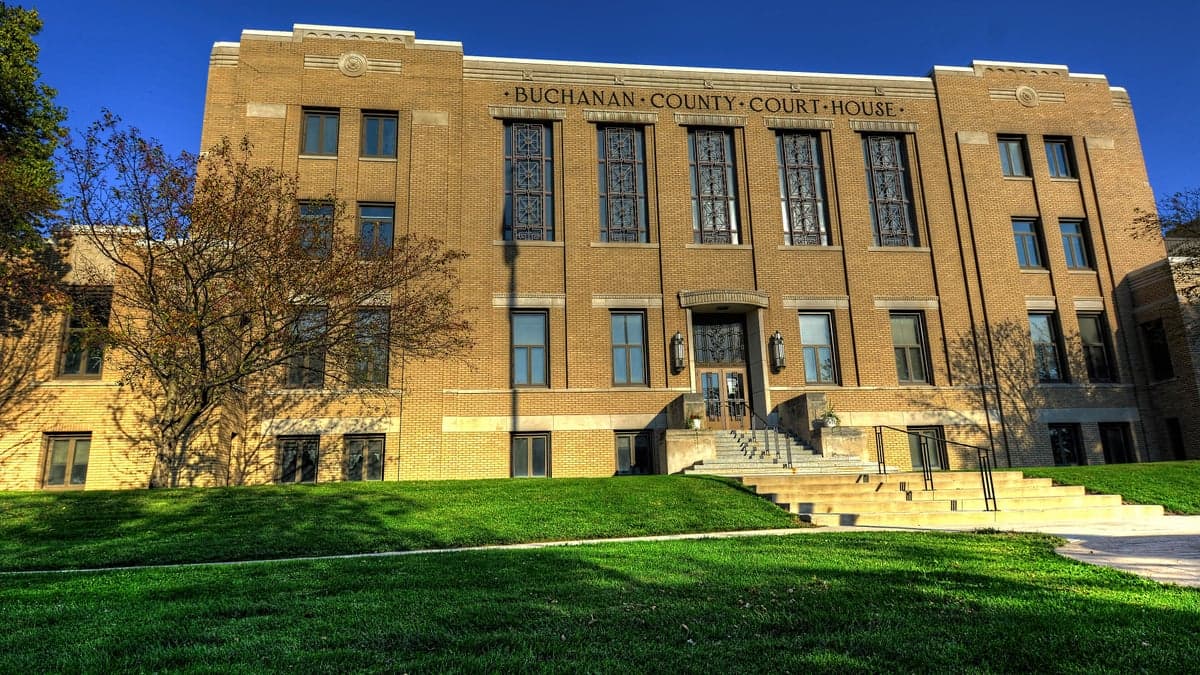
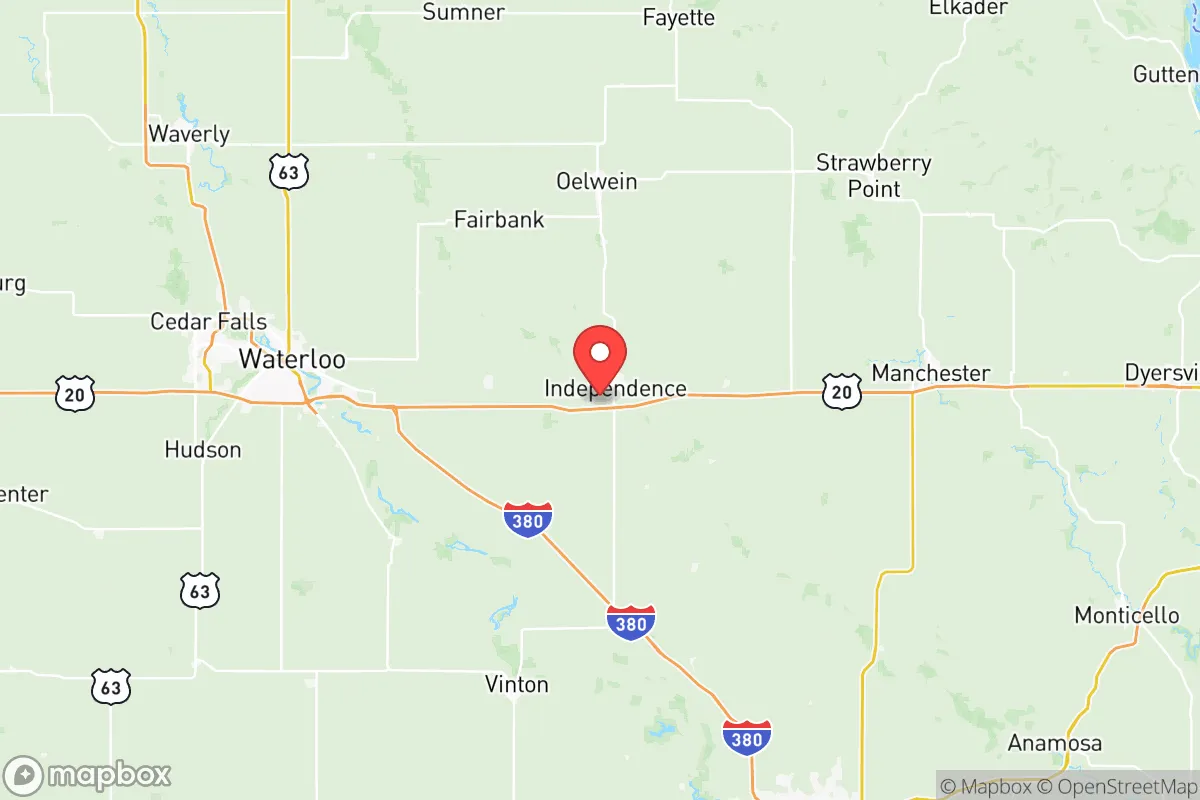
Photo: Wikipedia
Political ClimatePolitical Climate in Buchanan County
Showing district-level results — no local-only data available.
Local Political AnalysisPolitical Analysis of Buchanan County
Buchanan County, Iowa, sits in a reliably Republican column, but it’s not a deep-red monolith. With a Cook Partisan Voting Index (PVI) of R+4, the county leans right of the national average, yet it’s actually a touch less conservative than the state of Iowa as a whole, which carries an R+6 PVI. That two-point gap is the key to understanding the local political landscape: Buchanan County is a place where Democrats can still win local races and where the rural-urban divide within the county itself creates real variation from precinct to precinct.
How it compares
The R+4 rating puts Buchanan County in a different category than the deep-red rural counties to its west and north. For example, neighboring Delaware County is R+16, and Fayette County is R+12. The county’s relative moderation is driven by its two main population centers. Independence, the county seat and home to about 6,000 people, is the blue-leaning anchor. The city’s precincts have voted for Democratic candidates in recent statewide races, thanks to a mix of union households (John Deere’s Waterloo works is a short commute away), a small but active college presence at the Independence campus of Hawkeye Community College, and a historic Democratic tradition among older residents. In contrast, the smaller towns like Jesup, Fairbank, and Lamont are solidly Republican, often voting 65-70% for GOP candidates. The swing precincts are the rural townships surrounding Independence, where a few dozen farm votes can tip a supervisor race. This internal split means the county’s overall R+4 is a genuine average, not a reflection of a uniform electorate.
What this means for residents
For conservative residents, Buchanan County is a comfortable place to live. The county commission and most local offices are held by Republicans, and the school boards in Jesup and Independence reflect conservative values on curriculum and spending. You’ll see Trump signs on farm fences and in town squares, and the local GOP is well-organized. For liberal residents, the picture is more nuanced but not hostile. Independence provides a genuine blue bubble where Democrats hold city council seats and the local Democratic party is active enough to field candidates. The county’s R+4 lean means that a well-funded, moderate Democrat can win a countywide race—something that’s nearly impossible in R+12 counties. The practical effect is that political conversations are less polarized than in the state’s deep-red corners; neighbors in Independence might disagree on the presidential race but still cooperate on the school levy or the county fair.
What this means for residents
The cultural and policy distinctions within Buchanan County are subtle but real. Independence has a small but visible progressive community centered around the library, the local arts council, and the farmers market, while Jesup and Fairbank are more likely to host church-sponsored events and gun club gatherings. The county’s zoning and land-use policies are typical of rural Iowa—minimal regulation, strong support for agriculture—but Independence has adopted a few modest sustainability initiatives, like a community garden and a bike trail plan, that wouldn’t fly in the more conservative towns. The biggest practical difference is in how residents talk about politics: in Independence, you can bring up a Democratic candidate at the coffee shop without getting a cold shoulder; in Lamont, you probably wouldn’t. That’s the real story of Buchanan County—a place where the political climate is Republican-leaning but not suffocating, and where the local culture still allows for genuine disagreement without social penalty.

State Political ClimatePolitical Climate in Iowa
State Political AnalysisPolitical Environment in the State
Iowa is a solidly Republican state with a Cook PVI of R+6, but it wasn't always that way. For decades, Iowa was a classic purple state, a national bellwether that swung between parties and hosted the first-in-the-nation caucuses that forced candidates to grapple with its moderate, pragmatic electorate. Over the past 10-20 years, however, a decisive shift has occurred: the rural and small-town base has hardened for the GOP, while the urban cores have become Democratic strongholds, with the suburbs splitting more sharply. The result is a state that now reliably votes Republican in statewide races, though it still elects a mix of conservatives and moderates at the local level, and its political culture remains more neighborly and less bombastic than in many other red states.
Urban vs. rural divide
The political map of Iowa is a textbook study in the urban-rural split. The state's two largest metros, Des Moines and Iowa City, are the Democratic anchors. Polk County (Des Moines) has become a reliable blue county, delivering margins of 15-20 points for Democrats in recent presidential elections. Johnson County, home to the University of Iowa in Iowa City, is the most liberal county in the state, often voting Democratic by 40 points or more. These two counties alone generate a huge chunk of the statewide Democratic vote. In contrast, the rest of the state is overwhelmingly Republican. The rural northwest and north-central regions — places like Sioux County (home to conservative Dordt University) and Lyon County — are among the most Republican counties in the nation, routinely voting 80%+ for GOP candidates. The shift is most visible in the suburbs of Des Moines. Places like Ankeny and Waukee, once reliably Republican, have become competitive swing areas, while older suburbs like West Des Moines have moved left. Meanwhile, smaller industrial cities like Council Bluffs and Sioux City have trended Republican as their blue-collar, union-heavy bases have shifted right. The net effect is a state where the political geography is stark: the Des Moines-to-Iowa City corridor is blue, and everything else is red.
Policy environment
Iowa's policy environment is now firmly conservative, with a focus on tax cuts, school choice, and limited government. The state has a flat income tax rate of 3.8% (phased down from a top rate of 8.98% in 2018), and the corporate tax rate is also being flattened. Property taxes are relatively low, and there is no inheritance tax. The regulatory posture is business-friendly, with a right-to-work law and a tort reform system that caps non-economic damages in medical malpractice cases. On education, Iowa has a robust school choice program: the Education Savings Account (ESA) program, enacted in 2023, allows any family to use state funds for private school tuition, homeschooling, or other educational expenses. The state also has a "Parents Bill of Rights" that requires schools to notify parents about curriculum changes and medical services. On healthcare, Iowa expanded Medicaid under the Affordable Care Act, but the state has also pursued conservative reforms like work requirements for able-bodied adults. Election laws have been tightened: voter ID is required, early voting windows have been shortened, and drop boxes are restricted. The state also has a constitutional amendment on the ballot (likely 2026) that would require a two-thirds legislative supermajority to raise income or corporate taxes.
Recent policy direction
The last five years have seen a rapid acceleration of conservative policy in Iowa. On gun and self-defense law, Iowa became a permitless carry state in 2021, allowing any legal gun owner to carry a concealed firearm without a permit. The state also has a "stand your ground" law and preempts local gun ordinances. On parental and education rights, the 2023 law banning instruction on sexual orientation and gender identity in K-6 classrooms (SF 496) and the 2024 law requiring schools to adopt policies on restroom and locker room access based on biological sex have been major flashpoints. On speech and privacy, Iowa has a law prohibiting public universities from requiring diversity statements in hiring, and it has joined other states in restricting TikTok on government devices. On medical and bodily autonomy, the state enacted a six-week abortion ban in 2023 (the "fetal heartbeat" law), which was upheld by the Iowa Supreme Court in 2024. The law includes exceptions for rape, incest, and life of the mother. On property rights, Iowa has strong eminent domain protections, and a 2022 law restricted the use of eminent domain for carbon capture pipelines, a major issue in rural areas. On taxation, the flat tax is being phased in, and the state has eliminated the inheritance tax. On voting and ballot access, the 2021 law (SF 413) reduced early voting from 29 to 20 days, closed polls at 8 p.m. instead of 9 p.m., and required absentee ballot applications to be returned by mail or in person, not by third parties. The overall direction is clear: Iowa is moving to lock in conservative policies across the board.
Civil unrest & political movements
Iowa is not a state known for large-scale civil unrest, but it has seen organized activism on both sides. The most visible flashpoint in recent years has been the carbon capture pipeline controversy. A coalition of landowners, environmentalists, and local officials — a rare left-right alliance — has fought the proposed Summit Carbon Solutions pipeline, which would carry captured CO2 from ethanol plants to North Dakota for sequestration. The fight has led to county-level ordinances restricting pipeline placement, and the Iowa Utilities Commission has been the scene of heated hearings. On the left, the Iowa City and Des Moines areas have seen protests over abortion rights, racial justice, and LGBTQ+ issues, particularly after the 2023 abortion ban. On the right, the Moms for Liberty chapter in Ankeny has been active in school board elections, and the Iowa Firearms Coalition is a powerful lobbying force. Immigration politics are less heated than in border states, but there have been controversies over local "sanctuary" policies: in 2024, the state passed a law requiring local law enforcement to cooperate with federal immigration authorities and banning sanctuary city policies. Election integrity remains a live issue: the 2020 and 2022 elections saw no major fraud cases, but the GOP base remains skeptical of mail voting, and the 2021 law was explicitly sold as a response to those concerns. A new resident would notice that political signs and bumper stickers are common, but the tone is generally civil — Iowans are famously polite, even when they disagree.
Projection
Over the next 5-10 years, Iowa is likely to become more Republican, but the margin of that shift will depend on two factors: the continued growth of the Des Moines metro and the political alignment of in-migrants. The Des Moines area is growing, attracting younger, more diverse, and more educated residents — a demographic that tends to lean Democratic. If that trend continues, Polk County and its suburbs could become even more blue, potentially making statewide races more competitive. However, the rural areas are emptying out, and the remaining rural voters are becoming more Republican. The net effect is that Iowa's R+6 lean is likely to hold or shift slightly to R+8, but it's unlikely to become as red as, say, Kansas or Nebraska. The key wildcard is the Iowa Caucuses: if the national GOP moves to demote Iowa's first-in-the-nation status (as the DNC already has), the state could lose its outsized political influence, which might reduce the incentive for national candidates to cater to Iowa's particular brand of conservatism. For a new resident, the practical takeaway is that the state's political direction is set: conservative on social issues, tax policy, and education, but with a pragmatic streak that still allows for moderate Republicans and even some Democrats to win local office. If you're moving to Iowa, expect a state that is comfortable in its red identity, but where the Des Moines-to-Iowa City corridor offers a genuine blue alternative.
Bottom line for a new resident: Iowa is a safe, stable, and increasingly conservative state where your politics will be shaped by where you live. If you're conservative, you'll find a welcoming policy environment and a like-minded community almost anywhere outside of Johnson County. If you're liberal, you'll find a vibrant, active community in Des Moines or Iowa City, but you'll be living in a state where your vote is a minority in statewide elections. The practical reality is that Iowa's politics are less about daily friction and more about the policy landscape: lower taxes, school choice, and a regulated social environment. It's a place where you can live your life largely without political drama, as long as you're comfortable with the direction the state is heading.
* Values derived from national, state, county, city and local statistics and may differ in a specific area. Last updated: 2026-10-15T01:06:16.000Z
Narrative content on this page is AI-generated and may contain mistakes. Verify any details that matter before acting on them.
ReloMaps may earn a commission from affiliate links at no extra cost to you.

