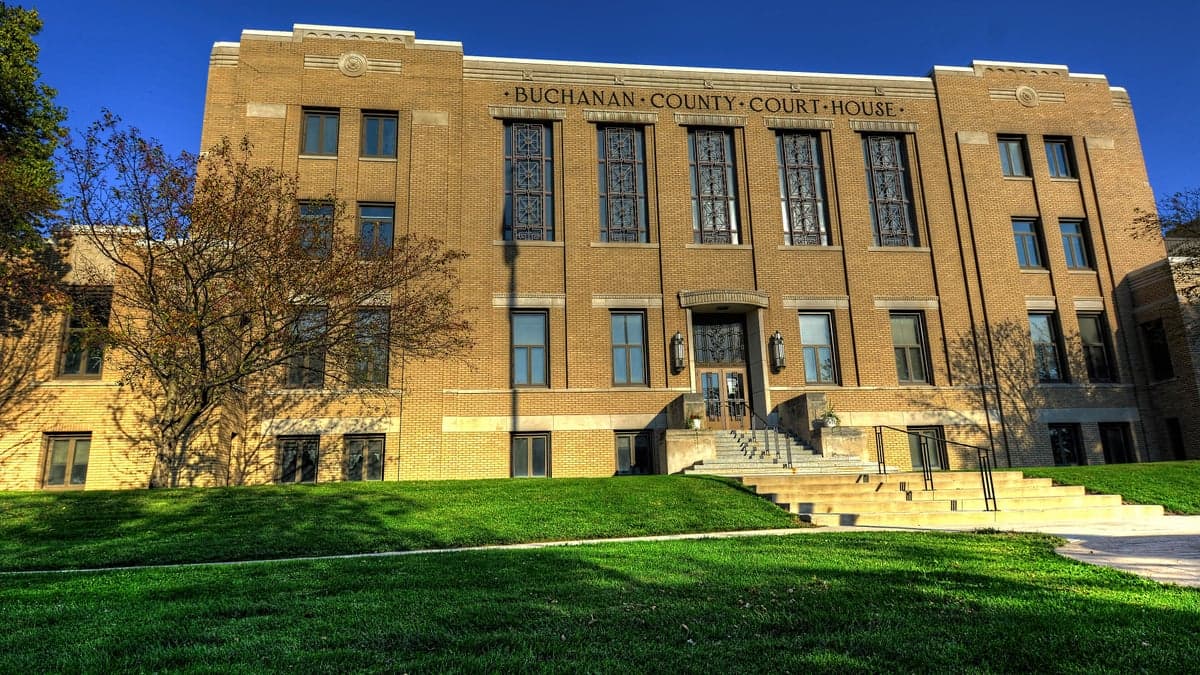
Photo: Wikipedia
Demographics of Buchanan County
Affluence Level in Buchanan County
A middle-class area roughly in line with national averages across income, home values, education, and employment.
People of Buchanan County
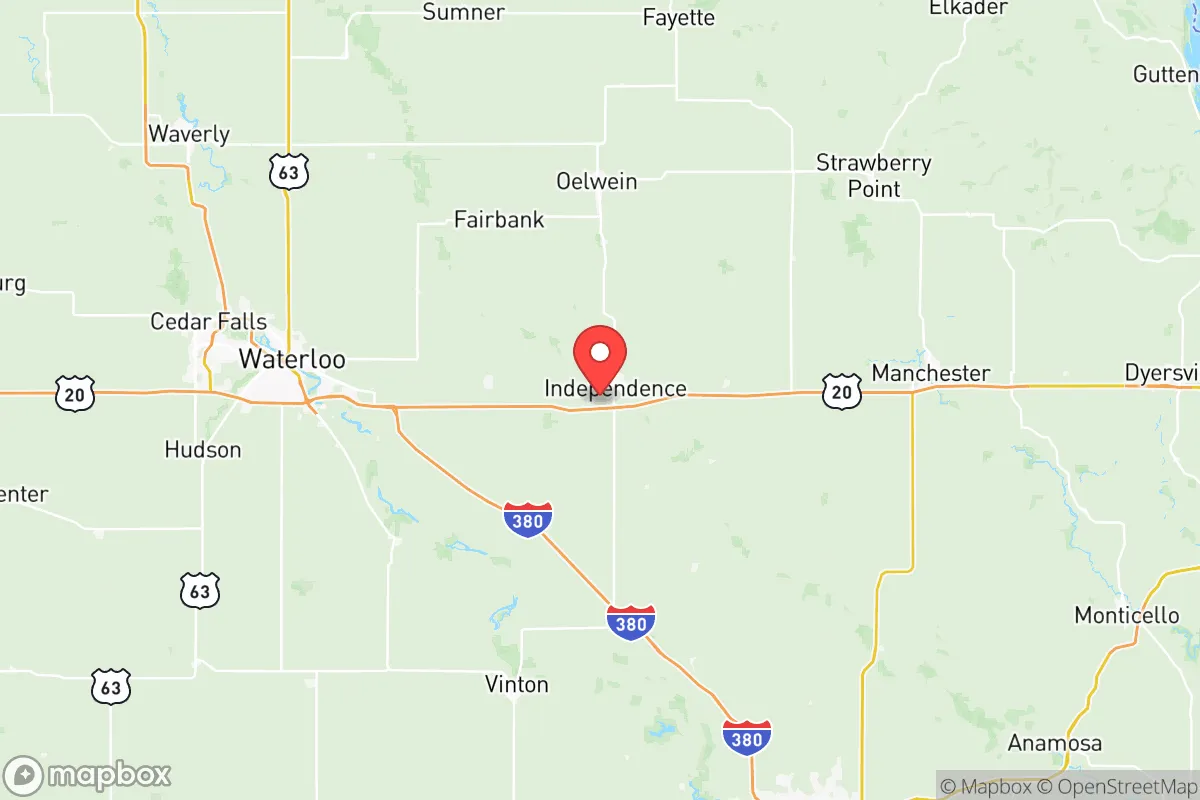
Buchanan County, Iowa, today is a predominantly white, rural community of 20,645 residents, characterized by a strong agricultural heritage and a deeply rooted sense of local identity. With 95.2% of the population identifying as white and only 1.1% foreign-born, the county remains one of the least ethnically diverse in the state, a direct reflection of its 19th-century settlement patterns. The population is spread across small towns like Independence (the county seat), Jesup, Fairbank, and Oelwein, with a median age slightly above the national average and a college attainment rate of 22.3%, indicating a workforce oriented toward farming, manufacturing, and local services rather than knowledge-economy jobs. For a conservative-leaning family or individual considering relocation, Buchanan County offers a quiet, low-crime, and community-focused environment where generational ties to the land remain strong.
Settlement & growth (pre-1960)
The land that became Buchanan County was originally inhabited by the Meskwaki (Fox) and Sioux nations, who used the area for hunting and seasonal camps along the Wapsipinicon River. European-American settlement began in earnest after the Black Hawk Purchase of 1832 opened the region to white homesteaders. The first permanent settlers, primarily of English and Scots-Irish descent, arrived in the late 1830s and 1840s, establishing farms along the river valleys. The town of Independence, founded in 1847, became the county seat and the initial hub for government, trade, and milling.
The major demographic wave came between 1850 and 1880, when German immigrants poured into the county, drawn by the promise of cheap, fertile land and the construction of the Illinois Central Railroad. These settlers clustered in the northern and central parts of the county, founding or heavily populating communities like Jesup (originally a German Catholic settlement), Fairbank, and Hazleton. German farmers brought with them a tradition of mixed livestock and grain farming, and their influence is still visible in the county's many Lutheran and Catholic churches. A smaller wave of Irish immigrants arrived during the same period, often working as railroad laborers before settling on farms near Oelwein and Quasqueton.
The late 19th and early 20th centuries saw modest growth from Czech and Danish families, who established small farming enclaves in the southern townships around Brandon and Rowley. The county's population peaked at around 24,000 in 1910, then stabilized as the agricultural economy matured. Unlike much of the industrial Midwest, Buchanan County did not experience a significant influx of Southern Black migrants during the Great Migration; the county's black population has never exceeded 1% historically. The Dust Bowl and Great Depression years of the 1930s caused some out-migration, but the county's diversified farm economy—corn, soybeans, hogs, and dairy—helped it weather the era better than the Great Plains. By 1960, the population had settled at roughly 21,000, a figure it has maintained with only minor fluctuations ever since.
Modern era (post-1965)
The 1965 Hart-Cellar Act, which reshaped U.S. immigration, had almost no impact on Buchanan County. The county's foreign-born population today stands at just 1.1%, virtually unchanged from 1970. Unlike urban Iowa counties such as Polk (Des Moines) or Johnson (Iowa City), Buchanan County did not attract refugees from Southeast Asia, Latin America, or Africa. The small Hispanic population (1.8%) is largely composed of families who moved from Texas or Mexico to work in the county's meatpacking plants and agricultural operations, primarily in Oelwein and Independence, but this community remains a tiny fraction of the total population.
Domestic migration patterns have been more significant. Since the 1980s, Buchanan County has experienced a slow but steady out-migration of young adults seeking education and employment in larger cities like Cedar Rapids, Waterloo, and Des Moines. This "brain drain" has been partially offset by retirees returning to family farms and by a small number of remote workers and hobby farmers drawn by low land prices. The county's East/Southeast Asian population (0.2%) and Indian subcontinent population (0.0%) are negligible, consisting of a handful of professionals employed at local hospitals or the John Deere plant in Waterloo (just north of the county line). Suburbanization has been minimal; the county's largest town, Independence, has grown only modestly from 5,000 to 6,000 residents since 1970, while Oelwein has actually declined from 8,000 to 6,000. The overall population has remained remarkably stable at roughly 20,600 for the past 60 years, a demographic plateau that reflects the county's limited economic diversification and its distance from major interstate highways.
The future
Buchanan County's population is projected to remain flat or decline slightly over the next 10–20 years, mirroring trends across rural Iowa. The county's white population share is likely to remain above 90%, as there are no significant drivers of ethnic diversification: no major refugee resettlement programs, no large immigrant-employing industries, and no proximity to a diverse metropolitan area. The Hispanic population may grow slowly, perhaps reaching 3–4% by 2040, as younger Hispanic families fill labor gaps in agriculture and light manufacturing, but this will not fundamentally alter the county's character.
The bigger demographic story is aging. The county's median age (roughly 42) is already above the national average, and the cohort of residents over 65 is growing as younger adults leave. This will increase demand for healthcare and senior services in Independence and Oelwein, while straining local school enrollments. Some small towns like Quasqueton and Rowley may see their populations shrink to under 200. On the positive side, the county's low cost of living, strong sense of community, and relatively low crime rates could attract a modest inflow of remote workers and early retirees from more expensive states, particularly if broadband infrastructure improves. The cultural identity of Buchanan County will likely remain rooted in its German-American farming heritage, with local festivals, church suppers, and 4-H programs continuing to define social life.
For someone moving in now, Buchanan County offers a stable, predictable, and deeply traditional rural environment. It is not a place of rapid change or demographic transformation, but rather a community where the population has been remarkably consistent for over a century. The trade-offs are clear: you gain safety, affordability, and neighborly connection, but you sacrifice diversity, urban amenities, and the economic dynamism of a growing region. If your priority is raising a family in a low-stress, land-based community with strong schools and churches, Buchanan County remains a solid choice—but it is a choice for those who value continuity over change.

* Values derived from national, state, county, city and local statistics and may differ in a specific area. Last updated: 2026-10-15T01:06:16.000Z
Narrative content on this page is AI-generated and may contain mistakes. Verify any details that matter before acting on them.
ReloMaps may earn a commission from affiliate links at no extra cost to you.

