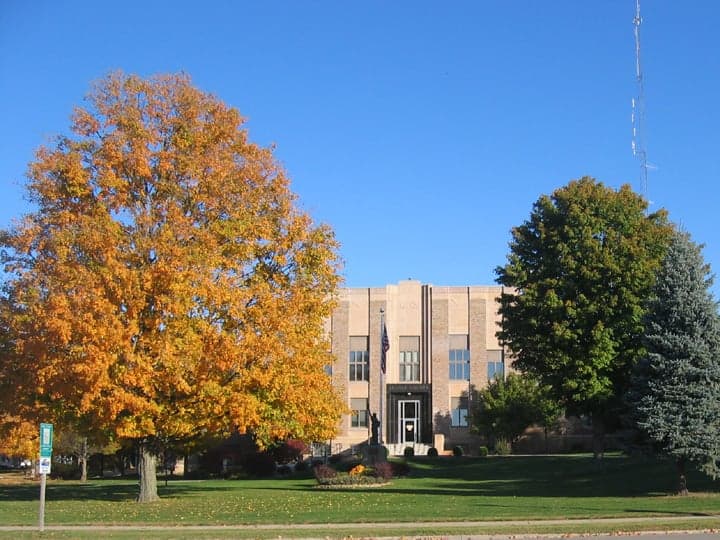
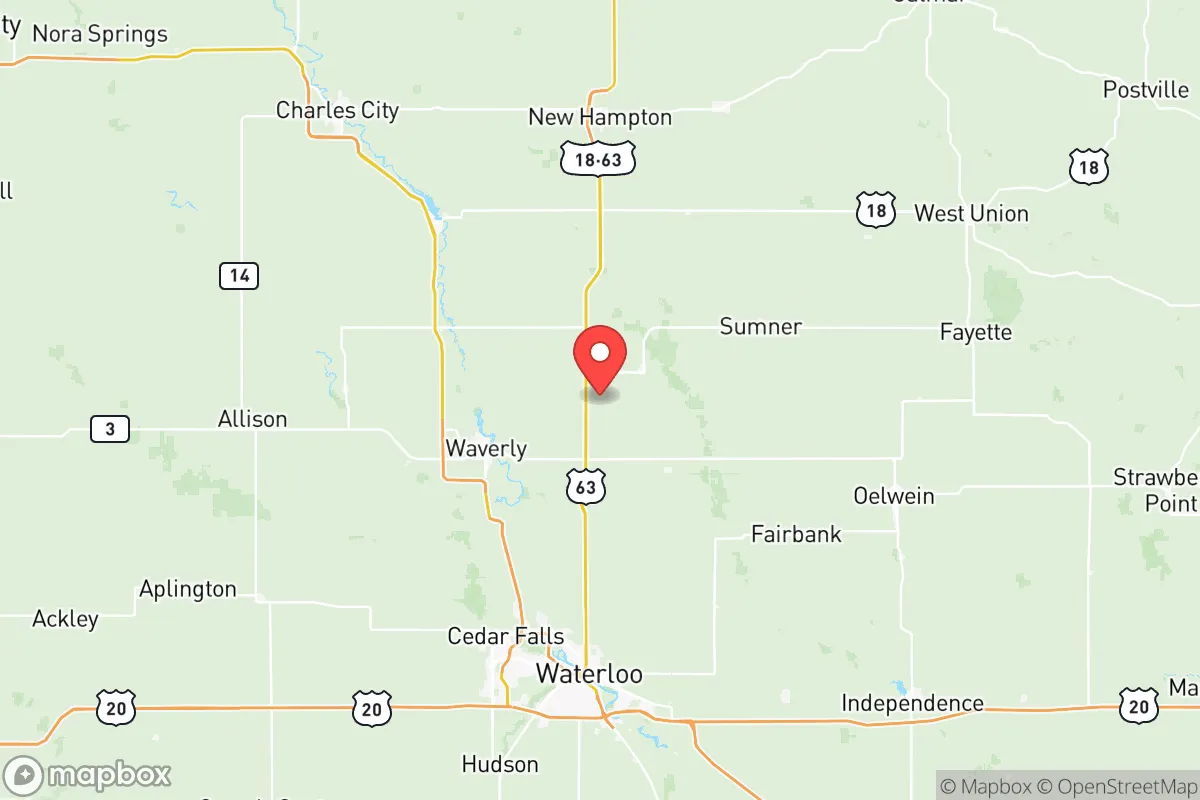
Photo: Wikipedia
Demographics of Bremer County
Affluence Level in Bremer County
A middle-class area roughly in line with national averages across income, home values, education, and employment.
People of Bremer County
Bremer County, Iowa, is home to 25,118 residents who form one of the most ethnically homogeneous populations in the state, with 92.8% identifying as white and a foreign-born share of just 0.4%. The county’s character is shaped by its deep German and Scandinavian roots, a strong agricultural economy, and a network of small towns like Waverly, Sumner, and Tripoli that anchor a quiet, family-oriented lifestyle. With 35.2% of adults holding a college degree—driven largely by Wartburg College in Waverly—the population is slightly more educated than the statewide average, yet it remains notably less diverse than Iowa as a whole. This is a place where community ties run deep, and the demographic story is one of continuity rather than rapid change.
Settlement & growth (pre-1960)
Before European settlement, the area that is now Bremer County was part of the homeland of the Meskwaki (Fox) and Dakota Sioux nations, who used the Cedar River and Wapsipinicon River valleys for seasonal hunting and fishing. The first Euro-American settlers arrived in the 1840s, following the Black Hawk Purchase of 1832 and subsequent treaties that opened eastern Iowa to white settlement. These early pioneers were primarily Yankees from New England and upstate New York, drawn by the promise of fertile, rolling prairie land priced at $1.25 per acre under the Preemption Act of 1841. They founded the county seat of Waverly in 1852, naming it after Sir Walter Scott’s novels, and established the first farms along the Cedar River.
The defining demographic wave came between 1850 and 1880, when German immigrants—many from the regions of Hanover, Westphalia, and Pomerania—flooded into Bremer County. They were attracted by railroad land grants from the Illinois Central and the Burlington, Cedar Rapids & Northern Railway, which opened the county’s rich soil to commercial grain farming. These Germans settled heavily in the northern and eastern townships, founding the towns of Sumner (1874) and Tripoli (1875) as agricultural service centers. German became the dominant language in many rural schools and churches well into the 1890s, and Lutheran and Catholic congregations—like St. John’s Lutheran in Waverly and St. Joseph’s Catholic in Sumner—remain pillars of community life today.
A smaller but significant wave of Norwegian and Danish immigrants arrived in the 1870s and 1880s, clustering in the western part of the county around the town of Readlyn and the unincorporated settlement of Denver. These Scandinavians brought dairy farming and cooperative grain-elevator traditions that still influence the local agricultural economy. By 1900, Bremer County’s population had reached 16,000, with nearly all residents being of German or Scandinavian descent. The county’s growth slowed sharply after World War I, as the children of these farming families began leaving for cities like Waterloo and Cedar Falls, and the population plateaued at around 20,000 for most of the 20th century.
Modern era (post-1965)
The 1965 Hart-Cellar Act, which dramatically reshaped U.S. immigration, had almost no effect on Bremer County. Unlike Iowa’s urban centers—Des Moines, Iowa City, or Waterloo—which saw significant growth in Hispanic and Asian populations after 1970, Bremer County remained overwhelmingly white. The foreign-born population today stands at just 0.4%, compared to 5.6% statewide. The small Hispanic community (2.0% of the county) is concentrated in Waverly and Sumner, where a handful of families work in meatpacking and food processing at plants like the Tyson Foods facility in nearby Waterloo. The East/Southeast Asian population (1.0%) is almost entirely tied to Wartburg College in Waverly, which recruits international students from South Korea, Vietnam, and Japan; most leave after graduation.
Domestic migration has been the more significant force since 1970. The county has experienced a slow but steady outflow of young adults to the Waterloo-Cedar Falls metropolitan area and to Des Moines, offset by some in-migration of retirees and remote workers drawn to the low cost of living and rural quiet. Suburbanization has been minimal: Waverly, the largest town with about 10,000 residents, has expanded modestly with new housing developments along Highway 3, but the county lacks the exurban sprawl seen in counties closer to Des Moines. The Black population (1.1%) is tiny and scattered, with no distinct enclave; most Black residents are military families stationed at the nearby Waterloo Air National Guard base or professionals at Wartburg College.
The future
Bremer County’s population is projected to remain stable or decline slightly over the next 20 years, as the aging farm population (median age 42.5) continues to shrink and younger generations move to larger cities. The county is not becoming more diverse: the Hispanic share may inch up to 3-4% as meatpacking jobs draw a few more families, but the foreign-born rate is unlikely to exceed 1%. The East/Southeast Asian population will fluctuate with Wartburg College’s enrollment, but no permanent ethnic enclave is forming. The most notable demographic trend is the gradual concentration of population in Waverly, which is absorbing the county’s retail, healthcare, and education services, while smaller towns like Tripoli, Sumner, and Readlyn continue to lose residents.
Culturally, the county’s identity remains firmly rooted in its German and Scandinavian heritage, celebrated in events like Sumner’s German Fest and Waverly’s Heritage Days. The political leanings are conservative—Bremer County voted +28 points Republican in the 2024 presidential election—and the social fabric is shaped by Lutheran and Catholic churches, 4-H clubs, and volunteer fire departments. For a newcomer, this is a place where fitting in means participating in those institutions; the county offers safety, good schools, and affordable housing, but little ethnic or cultural diversity.
What Bremer County is becoming is a quieter, older version of itself—a rural stronghold of white, middle-class stability where the biggest change is the slow consolidation of population into Waverly. For someone moving in now, the county offers a predictable, low-crime environment with strong community bonds, but it requires a willingness to embrace a homogeneous, tradition-minded way of life. The future holds more of the same, not transformation.

* Values derived from national, state, county, city and local statistics and may differ in a specific area. Last updated: 2026-06-12T20:43:15.000Z
Narrative content on this page is AI-generated and may contain mistakes. Verify any details that matter before acting on them.
ReloMaps may earn a commission from affiliate links at no extra cost to you.

