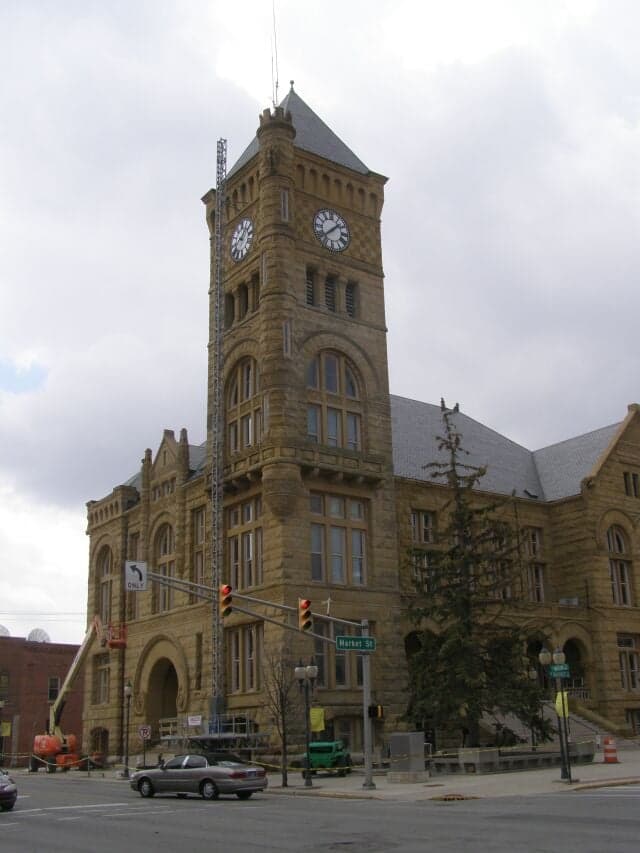
Photo: Wikipedia
Political ClimatePolitical Climate in Wells County
Showing district-level results — no local-only data available.
Local Political AnalysisPolitical Analysis of Wells County
Wells County, Indiana, is a reliably conservative area that has only become more so over the past decade. With a Cook Partisan Voting Index (PVI) of R+16, it sits a solid seven points to the right of the state of Indiana as a whole (R+9). This isn't a place that flips between parties; it's a place where Republican candidates routinely win by double digits, and the local political conversation is largely about who will carry the GOP banner, not whether a Democrat can compete. The shift has been steady—what was once a more moderate, union-influenced Democratic stronghold in places like Bluffton has hardened into a deeply red county, mirroring the broader rural realignment across the Midwest.
How it compares
Indiana as a state is already considered a safe Republican state, but Wells County is in a different league entirely. The R+9 statewide PVI reflects the influence of reliably blue Marion County (Indianapolis) and a handful of college towns like Bloomington and West Lafayette. Wells County, by contrast, has none of those counterweights. The county's largest town, Bluffton, still shows some faint blue streaks—precincts near the downtown core and the industrial parks along the Wabash River occasionally vote closer to the state average, especially in local races. But the rural townships—Lancaster, Harrison, and Rockcreek—routinely deliver 75-80% of the vote to Republican candidates. The small town of Ossian is a good bellwether: it's solidly red but not as extreme as the outlying farm precincts, often splitting its ticket in low-turnout primaries. The county's trajectory is clear: as the older, more union-minded manufacturing workers retire or move, the remaining population is overwhelmingly white, rural, and culturally conservative.
What this means for residents
For conservative residents, Wells County is a comfortable place to live politically. Local government, school boards, and the county commission are reliably Republican, meaning policy debates tend to be about how conservative to be, not whether to be conservative. Taxes are low, gun rights are broadly supported, and social issues like abortion and school curriculum are debated from a right-leaning baseline. For liberal residents, the reality is more isolating. There is no organized Democratic party infrastructure to speak of; the county party is largely a paper organization. Progressive voices are most likely to be heard in Bluffton's arts district or among a small group of faculty at the local community college, but they rarely translate into electoral wins. That said, the political climate is not hostile in a personal sense—most people are neighborly regardless of party, and political arguments are rare in daily life. The biggest practical impact is that if you're a liberal, you'll likely feel like a minority in public meetings and social settings, and your vote will almost never be decisive in a countywide race.
Culturally, Wells County's politics are intertwined with its strong agricultural and manufacturing heritage. The county is home to several large employers like Franklin Electric and Bunge North America, and the local economy is heavily tied to commodity prices and industrial policy. This creates a pragmatic strain of conservatism—residents may vote Republican but they also expect their representatives to fight for farm subsidies and trade protections. There's also a noticeable divide between the more secular, business-oriented Republicans in Bluffton and the more socially conservative, church-going Republicans in the rural townships. This tension occasionally surfaces in school board races or library funding debates, but it rarely breaks into open conflict. Looking ahead, the county's political trajectory seems locked in: as long as the population remains stable and the economy stays tied to agriculture and manufacturing, Wells County will remain one of the most reliably Republican counties in a reliably Republican state.

State Political ClimatePolitical Climate in Indiana
State Political AnalysisPolitical Environment in the State
Indiana is a solidly Republican state with a Cook PVI of R+9, meaning it typically votes about nine points more Republican than the national average. Over the past 10-20 years, the state has shifted rightward, driven by the continued dominance of its rural and suburban areas, even as the Indianapolis metro has become more competitive. While Democrats can still win statewide in wave years (like Joe Donnelly’s 2012 Senate win), the GOP now holds every statewide office, supermajorities in both legislative chambers, and has carried the state in every presidential election since 2008. For a relocator, this means a policy environment that is consistently conservative, with little chance of a near-term flip.
Urban vs. rural divide
The political map of Indiana is a classic study in urban-rural polarization. Marion County (Indianapolis) is the Democratic stronghold, delivering about 60% of its vote to Democratic candidates in recent cycles, but it’s surrounded by a ring of deep-red suburban and exurban counties like Hamilton, Hendricks, and Johnson that vote 60-70% Republican. Lake County in the northwest corner, part of the Chicago metro, is another Democratic anchor, while Monroe County (Bloomington) and Tippecanoe County (West Lafayette) provide liberal pockets driven by university populations. The rest of the state — from the Ohio River towns like Evansville and New Albany to the rural north and east — is reliably red. The key trend: the Indianapolis suburbs have grown faster than the city itself, reinforcing the state’s overall Republican tilt even as the urban core gets bluer.
Policy environment
Indiana’s policy environment is defined by low taxes, limited regulation, and a strong conservative social agenda. The state has a flat income tax rate of 3.05% (scheduled to drop to 2.9% by 2027), a low corporate tax rate, and no inheritance or estate tax. Property taxes are capped at 1% of assessed value for owner-occupied homes, which keeps housing costs predictable. Education policy is dominated by one of the nation’s most expansive school choice programs, including vouchers and charter schools, and the state has banned “critical race theory” and certain diversity initiatives in K-12 classrooms. On healthcare, Indiana expanded Medicaid under the Affordable Care Act via a conservative waiver program (HIP 2.0), but the state has not pursued a state-based exchange. Election laws include strict voter ID requirements, limited early voting windows, and a ban on ballot harvesting. The state also has a right-to-work law (repealed in 2022 but replaced with a weaker version) and is a “shall issue” state for concealed carry permits.
Recent policy direction
In the last few years, Indiana has moved decisively in a conservative direction across multiple fronts. Gun and self-defense law: In 2022, Indiana became a constitutional carry state, allowing permitless carry of handguns for adults 18 and older. Parental and education rights: The state passed a Parents’ Bill of Rights in 2023, requiring schools to notify parents about curriculum changes and medical services, and banned instruction on sexual orientation and gender identity in K-3 (the “Don’t Say Gay” law). Speech and privacy: Indiana has no broad privacy law, but it passed a law in 2023 restricting TikTok on state devices and has debated but not passed a comprehensive data privacy bill. Medical and bodily autonomy: In 2022, Indiana passed a near-total abortion ban (with exceptions for rape, incest, and life of the mother), which was upheld by the state Supreme Court in 2023. The state also banned gender-affirming care for minors in 2023. Property rights: Indiana has strong eminent domain protections and a low property tax burden, but no statewide rent control or tenant protections. Taxation: The flat income tax is being phased down, and the state has no sales tax on groceries. Voting and ballot access: Indiana has some of the strictest voter ID laws in the country, and in 2023 it passed a law requiring absentee ballots to be returned by the voter or a family member, tightening drop-box rules.
Civil unrest & political movements
Indiana has seen its share of political activism, but it’s generally less volatile than neighboring states like Illinois or Ohio. The 2020 George Floyd protests in Indianapolis were large and occasionally violent, leading to property damage and a state of emergency, but the city has since seen a more organized push for police reform, including a civilian review board. On the right, the Indiana Freedom Coalition and local Moms for Liberty chapters have been active in school board races and library content disputes, particularly in Hamilton County and Johnson County. Immigration politics are less heated than in border states, but Elkhart and Goshen have seen tensions over growing immigrant populations in the RV manufacturing sector. There is no serious secession or nullification movement, though some rural counties have passed symbolic “Second Amendment sanctuary” resolutions. Election integrity controversies have been minimal compared to states like Arizona or Georgia, as Indiana’s voting system is widely seen as secure and its Republican dominance reduces the incentive for dramatic challenges.
Projection
Over the next 5-10 years, Indiana is likely to remain solidly Republican, but the margins may tighten slightly as the Indianapolis metro continues to grow and diversify. The suburbs of Carmel, Fishers, and Noblesville are becoming more educated and professional, which could shift them from deep red to light red over time, similar to what happened in the Dallas or Atlanta suburbs. However, the rural and small-town areas that make up most of the state’s landmass and a significant share of its population are not trending left. The biggest wildcard is in-migration: Indiana is attracting new residents from Illinois and California, many of whom are drawn by lower taxes and housing costs, but it’s unclear whether these newcomers will reinforce the state’s conservatism or bring more moderate views. The state’s policy direction — especially on abortion and LGBTQ rights — could also deter some potential movers, particularly younger families and professionals. For now, expect continued GOP control of the legislature and governor’s office, with occasional Democratic wins in down-ballot races if national conditions favor them.
For a new resident, the bottom line is that Indiana offers a stable, predictable conservative policy environment with low taxes, strong gun rights, and a business-friendly regulatory climate. Liberal residents will find the state’s social policies restrictive, especially on abortion and LGBTQ issues, and may feel out of step in most areas outside of Indianapolis, Bloomington, or West Lafayette. Conservative residents will find a state that largely aligns with their values, with the caveat that the Indianapolis suburbs are becoming more moderate and culturally diverse. The state is not a political battleground — it’s a reliably red place where policy changes happen slowly and incrementally, and where the biggest fights are over how conservative, not whether, the state should be.
* Values derived from national, state, county, city and local statistics and may differ in a specific area. Last updated: 2026-10-21T15:14:32.000Z
Narrative content on this page is AI-generated and may contain mistakes. Verify any details that matter before acting on them.
ReloMaps may earn a commission from affiliate links at no extra cost to you.

