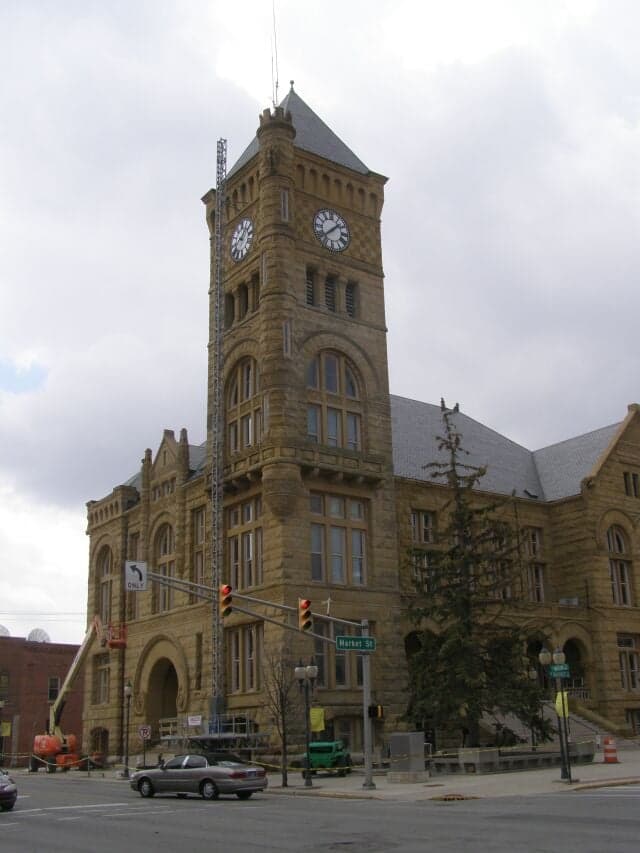
Photo: Wikipedia
Demographics of Wells County
Affluence Level in Wells County
A middle-class area roughly in line with national averages across income, home values, education, and employment.
People of Wells County
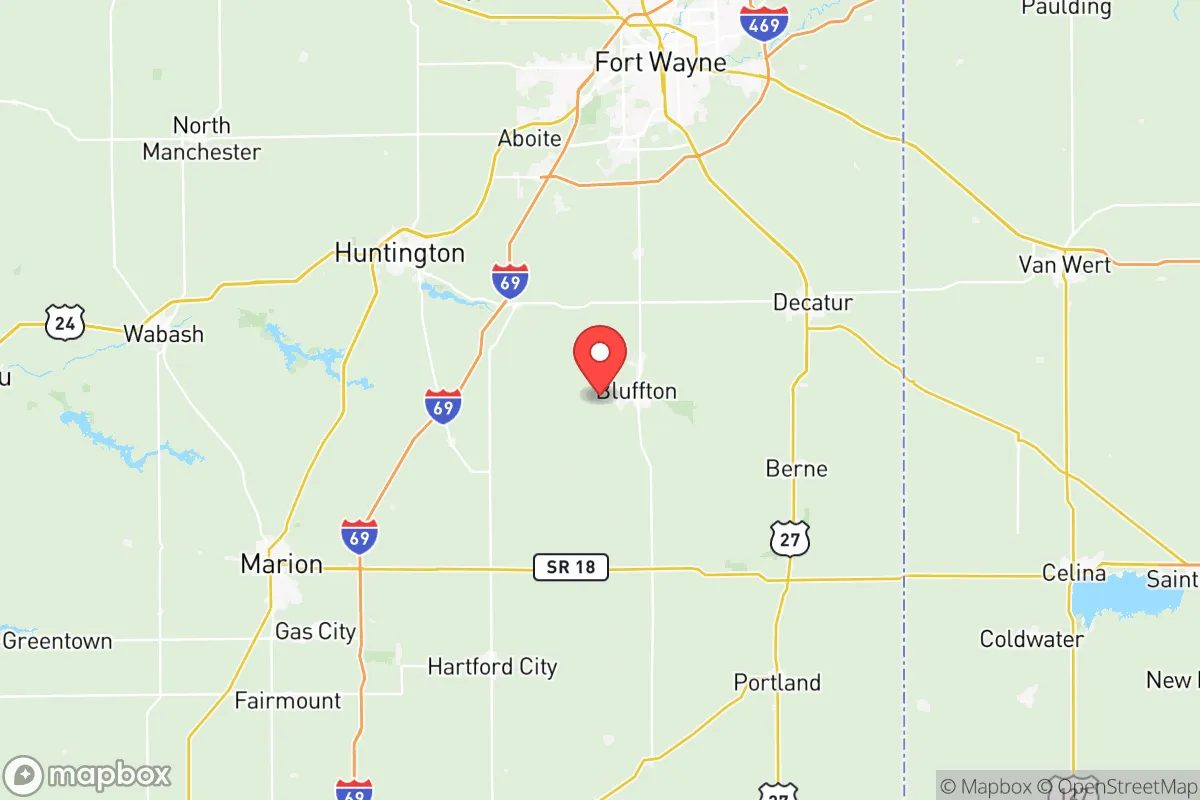
Wells County, Indiana, is a predominantly rural, white, and politically conservative community of 28,261 residents, where a strong German and Amish heritage still shapes daily life and local culture. With a foreign-born population of just 0.6% and a white population of 92.5%, the county remains one of the least ethnically diverse in the state. Its identity is rooted in agricultural traditions, small-town values, and a population density of roughly 60 people per square mile, centered around the county seat of Bluffton and the smaller towns of Ossian, Uniondale, and Poneto.
Settlement & growth (pre-1960)
Before European settlement, the area that is now Wells County was part of the hunting grounds of the Miami and Potawatomi nations, who used the Wabash River and its tributaries for travel and trade. The region was ceded to the United States through a series of treaties in the early 19th century, most notably the 1818 Treaty of St. Mary's, which opened the land for American settlement.
The first wave of permanent settlers arrived in the 1830s and 1840s, primarily from Ohio, Kentucky, and Pennsylvania. These were largely of English, Scots-Irish, and German descent, drawn by the promise of cheap, fertile land in the newly formed county (established in 1837). Bluffton, founded in 1838 along the Wabash River, quickly became the commercial and governmental hub, its location on the river providing a vital transportation route for grain and timber.
A second, more significant wave came in the 1850s through the 1880s, as German immigrants—many from the regions of Hanover, Westphalia, and Bavaria—settled directly in the county. They established farms and small businesses in the towns of Ossian, Uniondale, and Poneto, where German was spoken in homes and churches well into the early 20th century. The German influence is still visible in the county's Lutheran and Catholic church steeples, the names of local families, and the annual Bluffton Free Street Fair, which began in 1879 as a harvest celebration.
A smaller but culturally distinct group arrived in the late 19th and early 20th centuries: the Amish. Beginning around the 1880s, Old Order Amish families from Ohio and Pennsylvania settled in the rural areas south of Bluffton and around the unincorporated community of Craigville. They were drawn by the availability of farmland and the relative isolation from urban centers. Today, the Amish population in Wells County numbers several hundred, concentrated in the southern and eastern townships, and they remain a visible, if separate, part of the community—known for their horse-drawn buggies, plain dress, and avoidance of modern technology.
By 1960, Wells County's population had reached roughly 23,000, a figure that would remain relatively stable for the next six decades. The economy was dominated by agriculture—corn, soybeans, and livestock—alongside light manufacturing in Bluffton, including the Franklin Electric Company (founded in 1944), which became a major employer. The county's population was overwhelmingly white, native-born, and Protestant or Catholic, with the Amish forming the only significant religious minority.
Modern era (post-1965)
The 1965 Hart-Cellar Act, which dramatically reshaped U.S. immigration patterns, had almost no effect on Wells County. Unlike many urban and suburban areas that saw waves of new immigrants from Latin America, Asia, and Africa, Wells County remained demographically static. The foreign-born population today is just 0.6%, a figure that has barely changed since 1970. The county's Hispanic population, at 3.8%, is the only non-white group to have grown measurably, and this growth has been driven primarily by domestic migration—Hispanic families moving from larger Indiana cities like Fort Wayne (20 miles west) and from Texas and California for work in agriculture and manufacturing.
The county's Black population, at 1.1%, is small and concentrated almost entirely in Bluffton, with no distinct neighborhood or enclave. The Asian population (East and Southeast Asian) is negligible at 0.2%, and the Indian-subcontinent population is statistically zero. The county has not attracted significant refugee resettlement or chain migration from any non-European group.
Domestically, the most significant demographic shift since 1965 has been the slow, steady outmigration of young adults to larger cities—particularly Fort Wayne, Indianapolis, and cities in the Sun Belt—for education and employment. This has left Wells County with an older median age (roughly 41) and a population that has grown only modestly, from 23,000 in 1960 to 28,261 in 2024. Suburbanization has been limited; the only notable growth has been in the Bluffton and Ossian areas, where a few new subdivisions have been built for commuters working in Fort Wayne.
The future
Wells County is likely to remain one of Indiana's least diverse counties for the foreseeable future. The white population share, currently 92.5%, is projected to decline slowly—perhaps to 88-90% by 2040—as the Hispanic population continues to grow through both natural increase and continued domestic migration. The Hispanic community, while still small, is becoming more visible in Bluffton's schools and workforce, particularly in construction, food processing, and agricultural labor. However, there is no indication that this will lead to the formation of a distinct ethnic enclave; rather, Hispanic families are dispersing across the county, especially in Bluffton and Ossian.
The Amish population is the fastest-growing segment of the county, with large families and a high retention rate. This growth is putting pressure on farmland prices and leading to the establishment of new Amish settlements in the southern part of the county, near Liberty Center and Vera Cruz. This trend is likely to continue, making the Amish an increasingly important cultural and economic presence.
The county's overall population is projected to remain flat or grow very slowly—perhaps reaching 29,000 by 2035—as outmigration of young adults continues to offset births. The college-educated share, currently 18.9%, is well below the state average of 27%, and this is unlikely to change significantly without a major new employer or economic shift. The county's cultural identity will remain conservative, rural, and rooted in its German and Amish heritage, with a growing but still small Hispanic minority.
For someone moving in now, Wells County offers a stable, safe, and affordable environment where community ties are strong and change comes slowly. It is not a place of rapid demographic transformation or cultural diversity, but rather a place where tradition, agriculture, and small-town life remain the defining features. The county's future is one of continuity, not disruption—a place where the past and present coexist quietly, and where the population is likely to look much the same in 2040 as it does today.

* Values derived from national, state, county, city and local statistics and may differ in a specific area. Last updated: 2026-10-21T15:14:32.000Z
Narrative content on this page is AI-generated and may contain mistakes. Verify any details that matter before acting on them.
ReloMaps may earn a commission from affiliate links at no extra cost to you.

