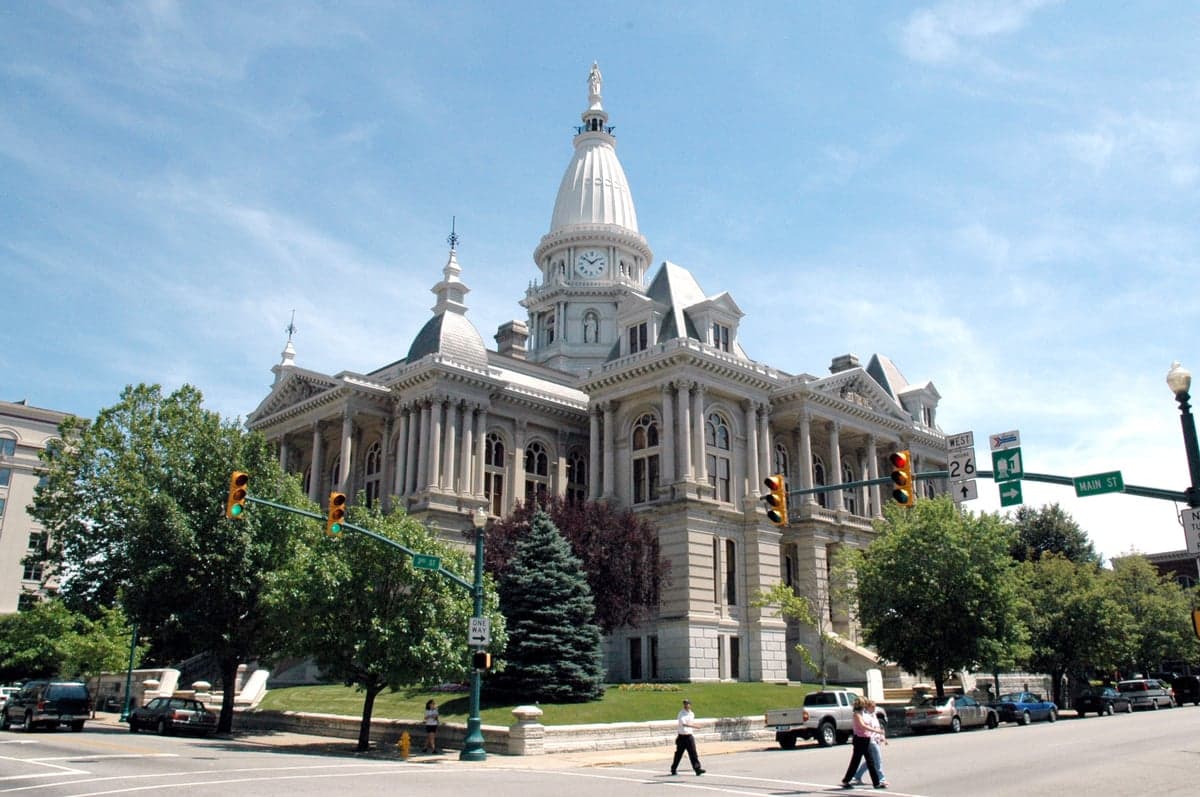
Photo: Wikipedia
Personal Sovereignty in Tippecanoe County
Viable for self-reliance. Generally workable, though some barriers may limit total independence.
What does Personal Sovereignty tell us?
Personal Sovereignty measures your capacity for self-reliance and independence with minimal government friction. Higher scores mean fewer barriers between you and the way you want to live... but it assumes you have the space you need and good neighbors.
What does this tell us?
Personal Sovereignty measures your capacity for self-reliance and independence with minimal government friction. Higher scores mean fewer barriers between you and the way you want to live... but it assumes you have the space you need and good neighbors.
State Policy
Energy independence: Importer (35% of energy produced in-state)
Personal Liberty
Homesteading

Personal Liberty Analysis
Tippecanoe County, Indiana, offers a notably high degree of personal sovereignty, blending a conservative-leaning state legal framework with a local culture that values self-reliance and limited government intrusion. For individuals and families relocating from high-regulation states like California, Illinois, or New York, the county presents a tangible shift in autonomy, particularly in areas of taxation, self-defense, and property use. While the county seat of Lafayette and its twin city West Lafayette (home to Purdue University) introduce a more progressive, university-influenced dynamic, the surrounding towns and unincorporated areas—such as Battle Ground, Dayton, Otterbein, and Westpoint—tend to reflect a stronger, more traditional emphasis on personal freedom and minimal regulatory oversight.
Tax burden and regulatory posture in Tippecanoe County
Indiana’s state-level tax structure is among the most favorable in the Midwest for those prioritizing financial sovereignty. The state imposes a flat income tax rate of 3.15% (as of 2025, with scheduled reductions), and Tippecanoe County adds a local income tax of roughly 1.25% to 1.5%, depending on the specific taxing district. Property taxes are assessed at a rate of approximately 1.0% to 1.2% of market value, which is moderate nationally but low relative to states like Illinois or New Jersey. The regulatory posture in unincorporated areas of the county—such as Shelby Township or Lauramie Township—is notably light, with no county-wide zoning in many rural pockets. This contrasts with the more structured codes within the city limits of Lafayette and West Lafayette, where building permits, land-use restrictions, and rental registration requirements are enforced. For a reader seeking maximum autonomy, the unincorporated townships and small towns like Otterbein and Westpoint offer the least regulatory friction, allowing for activities like vehicle repairs on residential property, keeping of livestock, and construction of accessory structures without the bureaucratic hurdles found in more urbanized zones.
Self-defense and gun law specifics in Tippecanoe County
Indiana is a strong Second Amendment state, and Tippecanoe County reflects that posture. The state enacted constitutional carry in 2022, meaning no permit is required to carry a handgun openly or concealed for any law-abiding adult 18 or older. While a permit is still available for reciprocity purposes, the legal default is permissive. Tippecanoe County does not impose any additional local gun restrictions beyond state law, which is a critical point for sovereignty-minded relocators. Self-defense law in Indiana follows the Castle Doctrine and has a broad Stand Your Ground statute, with no duty to retreat in any place where a person has a legal right to be. The sheriff's office in Tippecanoe County, particularly in rural precincts like those serving Battle Ground and Dayton, is known for a pro-Second Amendment culture, with straightforward permit issuance and no history of local ordinances restricting firearm possession. The only notable carve-out is that Purdue University's West Lafayette campus prohibits firearms in campus buildings under state law, but this does not affect the broader county environment. For families, the ability to train, store, and carry firearms without local interference is a significant factor in the county's appeal.
Self-reliance and homesteading viability across Tippecanoe County
Homesteading and self-reliance are highly viable in Tippecanoe County, particularly outside the Lafayette-West Lafayette urban core. Lot sizes in unincorporated areas can range from one-acre parcels to multi-acre tracts, with no minimum lot size restrictions in many townships. Zoning is minimal to nonexistent in areas like Lauramie Township and Shelby Township, where residents commonly keep chickens, goats, and even small livestock without permits. Off-grid feasibility is moderate: while Indiana law requires connection to a septic system (no composting toilets without a variance), solar panels are permitted statewide with no HOA interference in unincorporated areas, and rainwater collection is legal. In towns like Otterbein and Westpoint, residents routinely operate wood stoves, maintain large gardens, and perform their own well maintenance without county interference. The Tippecanoe County Area Plan Commission has jurisdiction only in the unincorporated areas, but its enforcement is generally complaint-driven rather than proactive, meaning that as long as a property is not creating a nuisance, the county takes a hands-off approach. For those seeking true self-reliance, the rural townships offer a regulatory environment that is among the most permissive in the state.
Personal liberties in Tippecanoe County for families and individuals
Parental rights in Tippecanoe County are strongly protected under Indiana law, which includes a robust school choice system through vouchers, charter schools, and a permissive homeschool statute requiring only a simple notification to the local superintendent. The county is home to several homeschool co-ops and private religious schools, particularly in the Lafayette and Battle Ground areas, giving families wide latitude in educational decisions. Medical autonomy is generally respected, with Indiana having no state-level vaccine mandate for adults and a relatively permissive stance on alternative medical treatments, though the county's healthcare infrastructure is dominated by the IU Health and Franciscan Health systems, which follow standard medical protocols. Free speech and property rights are well-protected: the county has no local ordinances restricting political signage beyond state-mandated election periods, and property owners in unincorporated areas face no HOA-style restrictions on flags, yard displays, or home-based businesses. In Dayton and Battle Ground, it is common to see political signs, American flags, and home-based craft or repair businesses operating openly without any county interference. The only notable limitation is in West Lafayette, where the city enforces stricter noise and land-use codes, but this is a localized exception rather than a county-wide pattern.
Overall, Tippecanoe County ranks as one of the more sovereignty-friendly areas in Indiana, especially when compared to the heavily regulated urban corridors of Indianapolis or Bloomington. The combination of constitutional carry, low and flat taxes, minimal rural zoning, strong parental rights, and a culture of self-reliance creates an environment where individuals and families can exercise a high degree of personal autonomy. The key distinction is geographic: the unincorporated townships and small towns of Otterbein, Westpoint, Dayton, and Battle Ground offer the fullest expression of personal sovereignty, while Lafayette and West Lafayette introduce moderate regulatory constraints typical of mid-sized cities. For a relocator prioritizing freedom over convenience, the rural and small-town portions of Tippecanoe County represent a compelling option within the broader Midwest landscape.

* Values derived from national, state, county, city and local statistics and may differ in a specific area. Last updated: 2026-08-08T16:50:12.000Z
Narrative content on this page is AI-generated and may contain mistakes. Verify any details that matter before acting on them.
ReloMaps may earn a commission from affiliate links at no extra cost to you.

