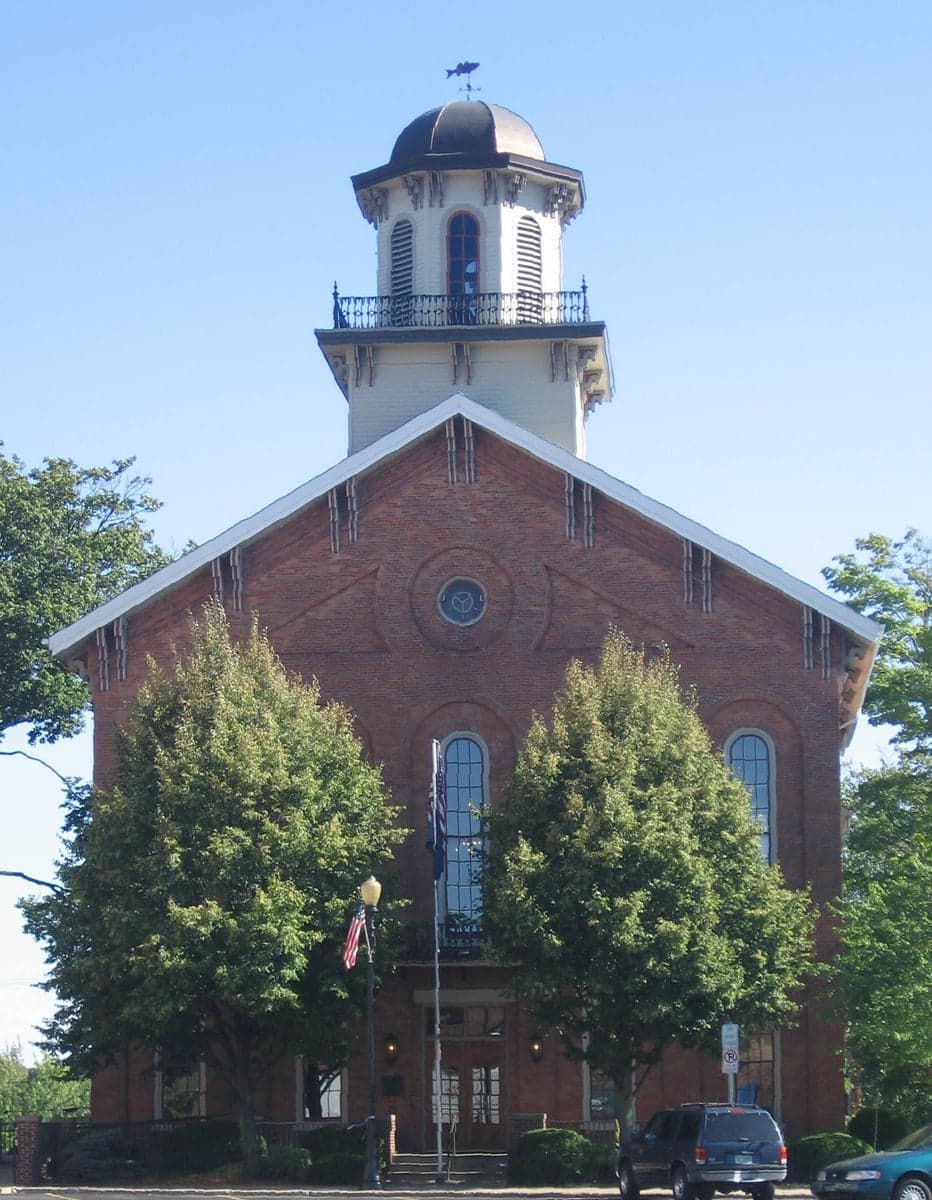
Photo: Wikipedia
Demographics of Steuben County
Affluence Level in Steuben County
A middle-class area roughly in line with national averages across income, home values, education, and employment.
People of Steuben County
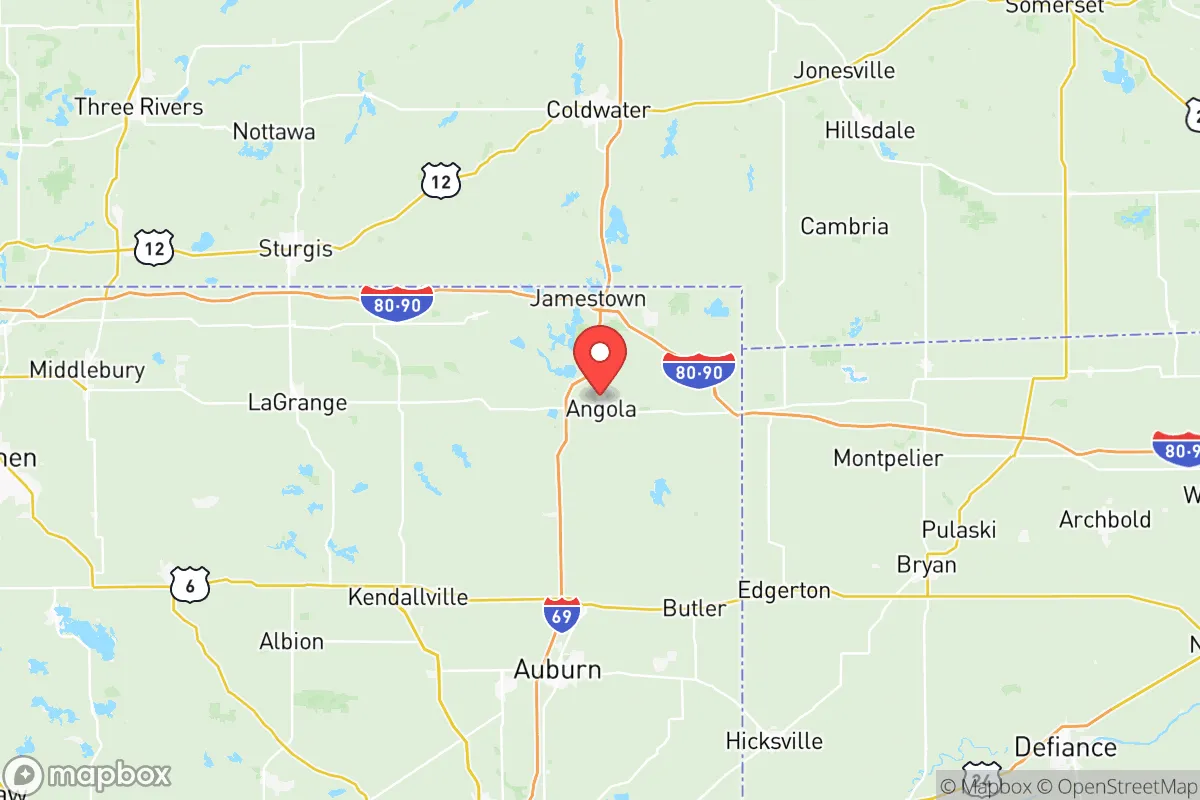
Steuben County, Indiana, is home to 34,648 residents, a population that remains overwhelmingly white (91.9%) and native-born (foreign-born residents account for just 1.0%). The county’s character is shaped by its location on the Michigan and Ohio borders, its chain of glacial lakes, and a quiet, rural identity that has seen only modest demographic change over the past half-century. With a Hispanic population of 4.3% and a Black population of 0.8%, Steuben County is one of Indiana’s least diverse counties, a place where the population is slowly aging and growth is driven more by domestic migration from nearby states than by international arrivals.
Settlement & growth (pre-1960)
Before European settlement, the area now known as Steuben County was part of the hunting and trading grounds of the Miami and Potawatomi nations. The region’s dense forests and numerous lakes made it a seasonal resource zone rather than a permanent village site. The first permanent American settlers arrived after the War of 1812, when the federal government began extinguishing Native land claims through treaties such as the 1826 Treaty of Mississinewas. The county was formally organized in 1837, carved from LaGrange County, and named after Baron von Steuben, the Prussian general who trained Continental Army troops during the American Revolution.
The earliest white settlers were primarily of Yankee stock—English-descended families from New England and upstate New York—who arrived in the 1830s and 1840s. They were drawn by cheap federal land priced at $1.25 per acre and the promise of fertile soil and abundant timber. These settlers founded the county’s first towns: Angola, the county seat, was platted in 1838 and quickly became the commercial and governmental center. Nearby Fremont, Hamilton, and Orland were established in the same period, each serving as a market town for the surrounding farmsteads. The New England influence is still visible in the county’s town squares, Congregational and Methodist church steeples, and a civic tradition of town meetings and local governance.
A second wave arrived in the 1850s and 1860s: German immigrants, many of whom came directly from the Rhineland and Bavaria, as well as German-speaking families who had first settled in Ohio and Pennsylvania. They established farms in the townships around Clear Lake and Lake James, and a small German Catholic community formed in the southern part of the county near Metz, a hamlet named after the French city but settled largely by Germans. These immigrants brought with them a tradition of family farming, Lutheran and Catholic church life, and a preference for tight-knit rural communities that persists in the county’s agricultural areas today.
The late 19th and early 20th centuries saw a trickle of Polish and Irish immigrants, who found work in the county’s small manufacturing sector—sawmills, gristmills, and later the B.F. Goodrich tire plant in Angola, which opened in 1916 and employed several hundred workers. However, Steuben County never experienced the heavy industrial immigration that transformed northern Indiana’s Lake County and St. Joseph County. The county’s population remained overwhelmingly native-born white, with the 1920 census showing a foreign-born share of just 4.2%.
The Great Depression and World War II brought little demographic change. The county’s population actually declined slightly between 1930 and 1950, as young people left for factory jobs in Detroit, Fort Wayne, and Chicago. The post-war period saw the beginning of a new economic driver: tourism. The chain of lakes—including Lake James, Snow Lake, and Crooked Lake—became a summer destination for families from northern Indiana, Ohio, and Michigan. Cottages and resorts sprang up, and the seasonal population swelled, but the permanent population remained stable at around 17,000 through the 1950s.
Modern era (post-1965)
The 1965 Hart-Cellar Act, which dramatically expanded legal immigration from Asia, Africa, and Latin America, had almost no effect on Steuben County. The county’s foreign-born population in 2024 stands at just 1.0%, compared to the national average of 13.7%. The small Hispanic population—4.3% of the total—is the county’s only significant non-white group, and it is largely composed of Mexican-American families who arrived in the 1990s and 2000s to work in agriculture, landscaping, and light manufacturing. These families are concentrated in and around Angola, where a small Spanish-language Catholic Mass is offered at St. Anthony of Padua Church, and in the rural areas south of Hamilton, where migrant farm labor has transitioned into permanent settlement.
The Black population, at 0.8%, is tiny and has been stable for decades. Most Black residents live in Angola, with a few families in Fremont and Orland. There is no historic Black neighborhood or enclave; the county’s Black population is scattered and largely composed of individuals who moved from Fort Wayne or Detroit for employment or family reasons. The East/Southeast Asian population is negligible at 0.1%, and the Indian-subcontinent population is effectively zero.
The most significant demographic shift since 1965 has been domestic migration, not immigration. Beginning in the 1970s, Steuben County began attracting retirees and second-home buyers from the Chicago and Detroit metropolitan areas, drawn by the lakes and lower property taxes. This trend accelerated after 2000, as telecommuting and remote work allowed professionals to relocate permanently. The county’s population grew from 27,000 in 1970 to 34,648 in 2024, a 28% increase. Much of this growth has occurred in the lake townships: Jamestown Township (which includes Lake James and Snow Lake) and Clear Lake Township have seen the fastest housing construction. The town of Angola itself has grown modestly, adding new subdivisions and a Walmart Supercenter, but the county’s rural character remains intact.
Suburbanization has been limited. There is no major city within 30 miles; Fort Wayne is 45 minutes south, and the Michigan cities of Coldwater and Hillsdale are closer but small. Steuben County has not experienced the sprawling exurban development seen in counties closer to Indianapolis or Chicago. Instead, new housing is scattered along lakefronts and in small subdivisions on the outskirts of existing towns.
The future
Steuben County is likely to remain one of Indiana’s least diverse counties for the foreseeable future. The Hispanic population may grow slowly, reaching 6-7% by 2040, as existing families have children and a small number of new arrivals come for agricultural and service-sector jobs. The Black and Asian populations are unlikely to increase significantly without a major employer moving into the area—something that has not happened since the B.F. Goodrich plant closed in 1998. The county’s economic base of tourism, agriculture, and small manufacturing does not attract the skilled immigrants who have driven diversity in larger Midwestern cities.
The county is aging. The median age is 43.5, well above the national median of 38.8. The 65-and-over population is 21.2%, and that share is expected to rise as baby boomers retire to lake homes. Younger families are moving in, but not in numbers sufficient to offset the aging of the existing population. The school-age population has been flat for a decade, and some rural elementary schools have consolidated.
Culturally, Steuben County is becoming more of a retirement and recreation destination and less of a working farm community. The number of farms has declined steadily since 1980, while the number of seasonal and permanent lake homes has increased. This shift is changing the county’s political and social character: the new arrivals tend to be more politically moderate than the native-born population, though the county still votes reliably Republican (Donald Trump won 68% of the vote in 2020). The tension between long-time residents and newcomers—over lake access, property taxes, and development—is the county’s most visible cultural dynamic.
For someone moving in now, Steuben County offers a quiet, safe, and affordable environment with strong community institutions and excellent outdoor recreation. The trade-off is a lack of racial and ethnic diversity, limited job opportunities outside of tourism and healthcare, and a population that is older and more insular than the national average. The county is not becoming more diverse; it is becoming more settled, more affluent, and more oriented toward leisure and retirement. That is the reality of Steuben County in 2026.

* Values derived from national, state, county, city and local statistics and may differ in a specific area. Last updated: 2026-11-05T16:17:52.000Z
Narrative content on this page is AI-generated and may contain mistakes. Verify any details that matter before acting on them.
ReloMaps may earn a commission from affiliate links at no extra cost to you.

