
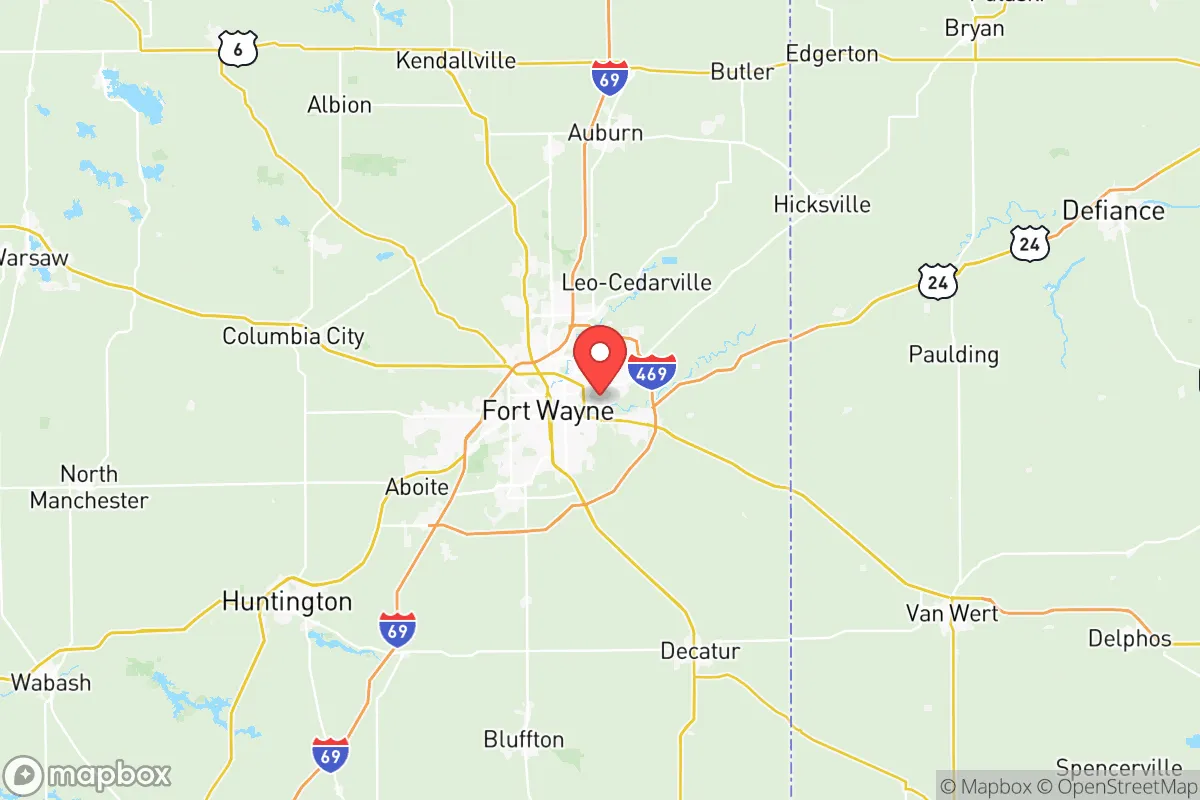
Photo: Wikipedia
Quality of Life in Allen County
A livable area that tracks near national norms for affordability, walkability, and neighborhood health.
What does Quality of Life tell us?
Quality of Life measures an area by evaluating factors like cost of living, nearby amenities, country club access, airport proximity, socioeconomic signals and neighborhood character. For large states, this is a general average — quality of life can vary dramatically between metro areas, suburbs, and rural communities within the same state.
What does this tell us?
Quality of Life measures an area by evaluating factors like cost of living, nearby amenities, country club access, airport proximity, socioeconomic signals and neighborhood character. For large states, this is a general average — quality of life can vary dramatically between metro areas, suburbs, and rural communities within the same state.
Cost of Living
22% below national average
124%
The Real Cost of Living in Allen County for 2026
| Tier | Individual | Family (4) |
|---|---|---|
| Survival | $16k | $29k |
| Comfortable | $38k | $55k |
| Luxury | $121k+ | $187k+ |
| Elite (Top 5%) | $142k+ | $220k+ |
Quality-of-Life Analysis
Allen County, Indiana, offers a broad quality-of-life spectrum that ranges from the urban core of Fort Wayne to quiet agricultural hamlets, drawing residents who want either walkable city amenities, small-town schools, or affordable rural acreage. The county’s overall cost of living index of 78 (well below the U.S. average of 100) and a median home value of $194,300 make it one of the most affordable metro-area counties in the Midwest, while the average commute of just under 22 minutes keeps daily life manageable across all its communities.
Largest town(s) & population centers
Fort Wayne is the county’s dominant population center, home to roughly 270,000 residents and the hub for employment, healthcare, and entertainment. Daily life here centers on neighborhoods like the historic West Central district, the revitalized downtown along the St. Marys River, and suburban corridors such as Jefferson Boulevard and Dupont Road. The city offers a strong job market anchored by major employers like Parkview Health, Fort Wayne Metals, and Lincoln Financial Group, plus cultural amenities including the Fort Wayne Museum of Art, the Embassy Theatre, and the Fort Wayne Children’s Zoo. New Haven, the county’s second-largest town with about 16,000 residents, functions as a quieter, family-oriented alternative just east of Fort Wayne, with its own historic downtown along Broadway and easy access to the Maumee River. Both towns share the county’s low median rent of $976, though Fort Wayne’s downtown apartments and newer subdivisions command higher prices than New Haven’s older housing stock.
Smaller towns & rural pockets
Beyond the urban core, Allen County contains several distinct smaller communities. Huntertown (population roughly 6,500) in the northwest corner is a fast-growing bedroom community with large-lot subdivisions and a strong sense of local identity, anchored by Huntertown Elementary and a small commercial strip along Lima Road. Woodburn (about 1,500 residents) in the southeast offers a classic small-town feel with its grain elevator, volunteer fire department, and annual Woodburn Community Festival. Monroeville (roughly 1,300) sits along the St. Joseph River and provides a slower pace with a handful of local businesses and direct access to the river for fishing and kayaking. Unincorporated areas like Arcola and Yoder are true rural crossroads, where residents live on acreage and commute to Fort Wayne for work, groceries, and medical care. These pockets lack municipal services like public water and sewer, but offer land prices well below the county median — often under $150,000 for a house on a half-acre lot.
Cost & lifestyle range
The cost and lifestyle spread across Allen County is wide. At the higher end, northwest Fort Wayne near the Allen County line and Huntertown feature newer subdivisions with median home values approaching $300,000, larger lots, and top-rated schools like Carroll High School. These areas attract professionals and families who want suburban amenities — chain retail, golf courses, and quick access to I-69 — while still paying well below national averages. At the lower end, south-central Fort Wayne neighborhoods like South Wayne and the rural areas around Monroeville and Woodburn offer median home values under $160,000 and rents often below $800. These areas have older housing stock, fewer nearby retail options, and longer drives to grocery stores, but they provide the county’s lowest cost of entry. The average commute of 21.7 minutes holds steady across most of the county, though residents in far-flung spots like Yoder may face 30-minute drives to Fort Wayne’s employment centers. Property taxes in Allen County average about 1.2% of assessed value, slightly below the Indiana state average, keeping carrying costs low even in the pricier neighborhoods.
Allen County works best for people who want a genuine range of living options within a single county — from the urban energy and cultural density of Fort Wayne to the quiet, land-based lifestyle of its rural towns. Families on a budget, remote workers seeking affordable acreage, and retirees looking for low-cost, low-commute living all find a niche here, provided they are comfortable with a region that values practicality over prestige and where the biggest trade-off is distance from major metropolitan airports and coastal job markets.

Crime in Allen County
Generally safer than 59% of comparable U.S. locations.
Violent CrimeViolent Crime Analysis
Property CrimeProperty Crime Analysis
Crime Analysis
Allen County, Indiana, presents a mixed safety picture where violent crime rates are below the national average but property crime rates exceed both state and national benchmarks. The county, anchored by Fort Wayne, reports a violent crime rate of 263.4 per 100,000 residents, which is notably lower than the U.S. average of approximately 380 per 100,000. However, the property crime rate of 1,095.7 per 100,000 sits above the Indiana state average of roughly 1,800 per 100,000 and the national figure of about 1,950 per 100,000, indicating that theft and burglary are more pressing concerns for residents than violent offenses.
Crime in context
When compared to other Indiana counties, Allen County's violent crime rate is moderate, falling below urban peers like Marion County (Indianapolis) and Lake County (Gary), which both report rates above 500 per 100,000. The property crime rate, however, is elevated relative to surrounding counties such as Whitley County (around 700 per 100,000) and DeKalb County (around 850 per 100,000). This disparity is partly driven by Fort Wayne, the county seat and largest city, which accounts for the majority of reported incidents. The Allen County Prosecutor's Office, led by a Republican, has maintained a generally tough-on-crime stance, but the Fort Wayne City Council and local judiciary have shown progressive leanings in recent years, including support for restorative justice programs and reduced cash bail for non-violent offenders. These policies, while intended to reduce incarceration, can result in repeat property offenders cycling through the system quickly, contributing to the elevated property crime numbers.
What residents experience
Residents in Allen County are most likely to encounter property crime, with larceny-theft and motor vehicle theft being the most common offenses. Neighborhoods in central and southern Fort Wayne, particularly around the South Wayne and East Central districts, report higher concentrations of burglaries and vehicle break-ins. In contrast, suburban communities like Huntertown and Leo-Cedarville experience significantly lower crime rates, with violent incidents being rare. The city of New Haven, located just east of Fort Wayne, has a property crime rate roughly 20% lower than the county average, making it a safer alternative for families. Violent crime, while less common, is concentrated in specific Fort Wayne neighborhoods, including the McKinnie Avenue and South Calhoun Street corridors, where gang-related activity and drug offenses drive the numbers. The Allen County Sheriff's Department has increased patrols in these areas, but the progressive policies of the Fort Wayne City Council have limited the effectiveness of enforcement, as some offenders are released on low bonds or diverted to treatment programs rather than facing jail time.
Neighborhood-level variation
Safety in Allen County varies dramatically by location. The far northern suburbs, including Grabill and Woodburn, report violent crime rates below 100 per 100,000 and property crime rates under 500 per 100,000, making them among the safest areas in the county. In contrast, the near-south side of Fort Wayne, around the Waynedale neighborhood, sees property crime rates approaching 1,500 per 100,000. For those considering relocation, the safest bets are the smaller towns and unincorporated areas outside Fort Wayne's city limits, where the influence of progressive judicial policies is less pronounced and law enforcement maintains a more traditional approach. The Allen County Superior Court system, which handles most felony cases, has seen a shift toward more lenient sentencing for non-violent property crimes under the influence of state-level criminal justice reform, a trend that residents in higher-crime areas should monitor closely.
* Values derived from national, state, county, city and local statistics and may differ in a specific area. Last updated: 2026-07-21T03:16:44.000Z
Narrative content on this page is AI-generated and may contain mistakes. Verify any details that matter before acting on them.
ReloMaps may earn a commission from affiliate links at no extra cost to you.

