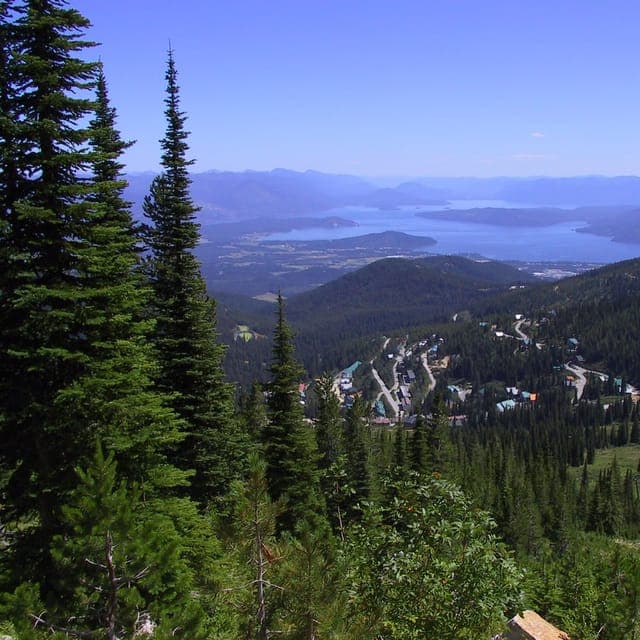
Photo: Wikipedia
Political ClimatePolitical Climate in Idaho
Political Environment in the State
Idaho is a deeply red state, with a Cook PVI of R+18, meaning it votes about 18 points more Republican than the national average in presidential elections. The dominant coalition is a mix of rural conservatives, Mormon cultural conservatives in the southeast, and a growing wave of out-of-state transplants fleeing progressive policies in places like California and Washington. Over the last 10-20 years, Idaho has shifted even further right, driven by rapid population growth in the Treasure Valley and a backlash against the leftward drift of neighboring states, though the influx of new residents has also introduced some suburban moderation in places like Boise and Meridian.
Urban vs. rural divide
The political map of Idaho is stark. The rural north and east—places like Coeur d'Alene, Sandpoint, and Idaho Falls—are reliably deep red, often voting 70-80% Republican. The Treasure Valley, anchored by Boise, is the state's only real metro area and is more mixed. Boise itself has a growing progressive core, especially in the North End and downtown, but the surrounding suburbs—Meridian, Eagle, and Nampa—lean heavily Republican. The southeastern corner, including Rexburg and Pocatello, is dominated by Brigham Young University-Idaho and a strong LDS influence, producing some of the most conservative voters in the nation. The only blue-ish pockets are in Boise's urban core and a few college towns like Moscow, home to the University of Idaho, but even those are surrounded by deep red countryside. The rural-urban divide is widening as Boise's growth brings more moderate and left-leaning voters, while the rest of the state doubles down on conservative values.
Policy environment
Idaho's policy environment is aggressively pro-business and pro-individual liberty. There is no state income tax on personal income—a flat 5.8% rate was eliminated in 2024, replaced by a flat 5.695% rate that is being phased down to 5.3% by 2026. Property taxes are relatively low, with a median effective rate of 0.69%, though they vary by county. The state has a strong right-to-work law, no mandatory union dues, and a regulatory climate that is among the most business-friendly in the nation. Education policy is a flashpoint: the state has a robust school choice movement, with a new Education Savings Account program (HB 93, 2023) that allows parents to use public funds for private school tuition or homeschooling expenses. Healthcare is largely market-driven, with no state-run insurance exchange and limited Medicaid expansion (Idaho did expand in 2019, but with work requirements and a conservative framework). Election laws are strict: voter ID is required, same-day registration is not allowed, and mail-in voting is limited to absentee with an excuse. The state also passed a law in 2023 banning ranked-choice voting, a direct response to progressive experiments in other states.
Trajectory & freedom
Idaho is becoming more free in many respects, especially on gun rights, parental rights, and tax policy. In 2023, the state passed a constitutional carry law (HB 124), allowing any adult who can legally possess a firearm to carry it concealed without a permit. The same year, the "Parental Rights in Education" law (SB 1328) was enacted, requiring schools to notify parents of any curriculum related to sexual orientation or gender identity and prohibiting instruction on those topics in grades K-3. On medical freedom, Idaho passed a law in 2023 banning COVID-19 vaccine mandates by private employers (HB 220) and another prohibiting mask mandates in schools (SB 1075). Property rights are strong, with no statewide zoning mandates and a "takings" law that requires compensation for regulatory restrictions that reduce property value. However, there are concerns about government overreach in the form of a new "critical infrastructure" law (HB 124, 2024) that criminalizes trespassing on energy facilities, which some see as a chilling effect on protest. Overall, the trajectory is toward expanding personal liberty, but with a sharp focus on traditional values and skepticism of federal overreach.
Civil unrest & political movements
Idaho has seen its share of political flashpoints, but they are relatively low-key compared to coastal states. The most visible movement is the "Patriot" and "Constitutionalist" right, with groups like the Idaho Freedom Foundation and the Idaho Republican Assembly pushing for smaller government and stricter immigration enforcement. In 2022, there was a significant protest in Coeur d'Alene over a proposed "sanctuary city" ordinance for the unborn, which drew both pro-life and pro-choice activists. Immigration politics are hot: the state passed a law in 2024 (HB 420) requiring local law enforcement to cooperate with federal immigration authorities, and there have been several high-profile incidents of human trafficking and cartel activity along I-84. The "election integrity" movement is strong, with the state implementing a voter ID law and a ban on ballot drop boxes in 2023. There have been no major riots or sustained civil unrest, but the political climate is tense, with a growing divide between the libertarian-leaning rural population and the more moderate suburbanites. A new resident would notice a lot of "Don't Tread on Me" flags and a general distrust of federal authority, especially in the northern panhandle.
Projection
Over the next 5-10 years, Idaho will likely become even more conservative, but with a twist. The massive in-migration from California, Oregon, and Washington is bringing a wave of people who are fleeing progressive policies but may not be as culturally conservative as native Idahoans. This could create a "purple" corridor in the Treasure Valley, where suburbs like Meridian and Eagle become more moderate on social issues while still voting Republican on economics. The rural areas will remain deep red, and the state legislature will continue to pass laws that push back against federal overreach and progressive trends. The biggest wildcard is the growth of the LDS population, which is already the dominant cultural force in the southeast and is becoming more politically active. Expect more school choice expansion, further tax cuts, and a continued crackdown on illegal immigration. The state's population is projected to grow by 20-30% by 2035, mostly in the Boise area, which will strain infrastructure and housing but also solidify Idaho's status as a red-state stronghold. Someone moving in now should expect to find a state that is fiercely independent, increasingly wealthy, and deeply skeptical of government power—but also one where the culture is being reshaped by newcomers who may not share all the traditional values.
For a new resident, the bottom line is this: Idaho offers a high degree of personal freedom, low taxes, and a government that respects your right to live your life as you see fit—as long as you're not looking for progressive social policies. The political climate is stable and conservative, but the rapid growth is creating friction between old-timers and newcomers. If you value gun rights, parental control over education, and a limited state government, you'll feel right at home. Just be prepared for a housing market that's been squeezed by demand and a political scene that is increasingly focused on preserving the state's identity against outside influence.

Most Conservative Cities in Idaho
Most Liberal Cities in Idaho
* Values derived from national, state, county, city and local statistics and may differ in a specific area. Last updated: 2026-04-14T06:22:46.000Z
Narrative content on this page is AI-generated and may contain mistakes. Verify any details that matter before acting on them.
ReloMaps may earn a commission from affiliate links at no extra cost to you.

