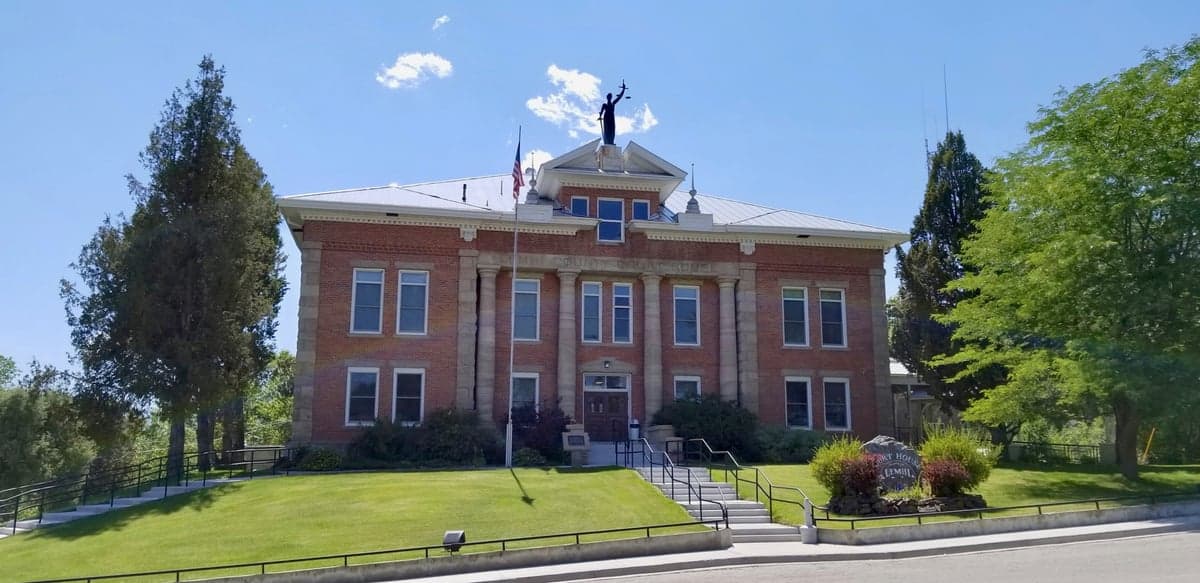
Photo: Wikipedia
Personal Sovereignty in Lemhi County
Moderate friction. Expect trade-offs in some aspect of personal liberty and independence.
What does Personal Sovereignty tell us?
Personal Sovereignty measures your capacity for self-reliance and independence with minimal government friction. Higher scores mean fewer barriers between you and the way you want to live... but it assumes you have the space you need and good neighbors.
What does this tell us?
Personal Sovereignty measures your capacity for self-reliance and independence with minimal government friction. Higher scores mean fewer barriers between you and the way you want to live... but it assumes you have the space you need and good neighbors.
State Policy
Energy independence: Importer (25% of energy produced in-state)
Personal Liberty
Homesteading

Personal Liberty Analysis
Lemhi County, Idaho, offers one of the most robust personal sovereignty environments in the Intermountain West, combining a deeply ingrained culture of self-reliance with a state-level legal framework that consistently prioritizes individual autonomy over government intervention. The county's small population—roughly 8,000 residents spread across a vast, mountainous landscape—naturally limits the scope and reach of local governance, creating a de facto atmosphere of personal freedom that is difficult to replicate in more densely populated areas. For individuals and families who prioritize minimal interference in their daily lives, from tax policy to self-defense to how they raise their children, Lemhi County represents a deliberate choice to live outside the regulatory gravity of urban centers like Boise or even the more populated Treasure Valley.
Tax burden and regulatory posture: How light is the government footprint?
Idaho's state-level tax structure is already favorable to personal sovereignty, and Lemhi County amplifies this through its own local fiscal discipline. The state imposes a flat income tax rate of 5.8% (as of 2025), with no tax on Social Security benefits and a generous grocery tax credit that effectively eliminates sales tax on food for most households. Property taxes in Lemhi County are among the lowest in the state, with the average effective rate hovering around 0.6% of assessed value—significantly below the national average of roughly 1.1%. This is partly because the county lacks the large-scale public infrastructure projects and municipal services that drive up levies elsewhere. The county seat, Salmon, is the only incorporated city, and its regulatory posture is notably hands-off: there is no city-level income tax, no business license requirement for most home-based enterprises, and zoning ordinances are minimal. In unincorporated areas like Carmen, Shoup, or Gibbonsville, the regulatory footprint is even lighter—there are no building permits required for structures under 200 square feet on agricultural land, and the county planning department is known for its practical, non-adversarial approach to code enforcement. The state's "right to farm" law further shields agricultural operations from nuisance lawsuits, a critical protection for anyone raising livestock or running a small farm. Compared to states like Oregon or Washington, where county-level land-use regulations can be complex and restrictive, Lemhi County's posture is best described as "permissive by default."
Self-defense and gun law specifics: What the Second Sanctuary means in practice
Lemhi County is a Second Amendment Sanctuary, a designation that carries real weight in local law enforcement and prosecutorial discretion. Idaho is a constitutional carry state, meaning no permit is required to carry a concealed firearm for anyone 18 or older who can legally possess a firearm. This applies uniformly across Lemhi County, from the streets of Salmon to the backcountry trails near Leesburg. The county sheriff's office has publicly stated it will not enforce any federal firearms regulations it deems unconstitutional, a stance that has been tested and upheld in local courts. Stand-your-ground laws are in full effect, with no duty to retreat in any place where a person has a legal right to be. Castle doctrine protections extend to occupied vehicles and workplaces, not just residences. For those interested in firearms training, the Salmon Valley Shooting Range offers a public facility with rifle and pistol bays, and several private instructors operate in the area. The practical effect of these laws is that self-defense is treated as a fundamental personal right rather than a regulated privilege. There are no waiting periods, no firearm registration, and no restrictions on magazine capacity or firearm types at the county level. For a family moving from a state with more restrictive gun laws—like California, New York, or even Colorado—the shift in legal posture is immediate and unambiguous.
Self-reliance and homesteading viability: Lot sizes, zoning, and off-grid feasibility
Lemhi County's geography and land-use policies make it one of the most viable locations in the lower 48 for serious off-grid homesteading. The county's zoning code is deliberately sparse: in unincorporated areas, there is no minimum lot size for agricultural use, and parcels as small as one acre can be used for single-family dwellings with a septic system. In practice, most homesteaders target parcels of 5 to 40 acres, which are abundant and affordable—raw land can be found for under $2,000 per acre in remote areas like North Fork or Ellis. Off-grid living is not only legal but common. There are no county-level mandates to connect to a municipal power grid or water system; solar panels, wind turbines, and rainwater catchment are standard. The Idaho Department of Environmental Quality requires a septic system permit for any dwelling with plumbing, but the process is straightforward and inexpensive compared to more regulated states. Building codes are only enforced in the Salmon city limits and in subdivisions that have recorded covenants; outside those areas, owner-built homes are common and accepted. The county's Extension Office offers workshops on small-scale agriculture, food preservation, and livestock management, reflecting the local expectation that residents will be self-sufficient. For those seeking a true homesteading lifestyle, the areas around Leadore and Gilmore offer high-altitude, low-population density with minimal government presence—though winters are severe, with average January lows near -5°F, which tests the resilience of any off-grid setup.
Personal liberties: Parental rights, medical autonomy, speech, and property
Idaho's legal environment strongly supports parental rights in education and healthcare. The state's "Parents' Bill of Rights" (Idaho Code § 33-138) gives parents explicit authority over their children's medical decisions, educational curriculum, and religious upbringing. In Lemhi County, the Salmon School District has a conservative board that has resisted state-level mandates on curriculum content and has maintained a policy of notifying parents about any changes in a student's health or well-being. Medical autonomy is similarly respected: Idaho has no state-level vaccine mandate for adults or children, and the county's health department takes a non-interventionist approach to public health orders. The state's Medical Freedom Act prohibits discrimination based on vaccination status, which has practical effects for employment and access to services. On property rights, Idaho's "private property rights" laws require government entities to compensate landowners for any regulatory taking that reduces property value by more than 20%, a strong deterrent against overzealous zoning changes. Free speech protections are robust, with no county-level restrictions on signage, political expression, or public assembly. The Salmon City Council meetings are open and often feature extended public comment periods, reflecting a local culture that values direct civic participation over bureaucratic process. For those who prioritize these liberties, Lemhi County offers a legal framework that consistently defaults to individual choice rather than government permission.
In the broader context of the American West, Lemhi County stands out as a place where personal sovereignty is not just a legal abstraction but a lived reality. Compared to the regulatory density of Boise's Ada County or the cultural pressures of resort towns like Ketchum, Lemhi County offers a more consistent, less contested environment for autonomy-minded individuals. The trade-offs are real—limited healthcare access, harsh winters, and a two-hour drive to the nearest major hospital in Missoula, Montana—but for those who value freedom over convenience, the county's combination of low taxes, permissive gun laws, viable off-grid living, and strong personal liberties makes it one of the most sovereignty-friendly jurisdictions in the nation.

* Values derived from national, state, county, city and local statistics and may differ in a specific area. Last updated: 2026-08-20T10:55:19.000Z
Narrative content on this page is AI-generated and may contain mistakes. Verify any details that matter before acting on them.
ReloMaps may earn a commission from affiliate links at no extra cost to you.

