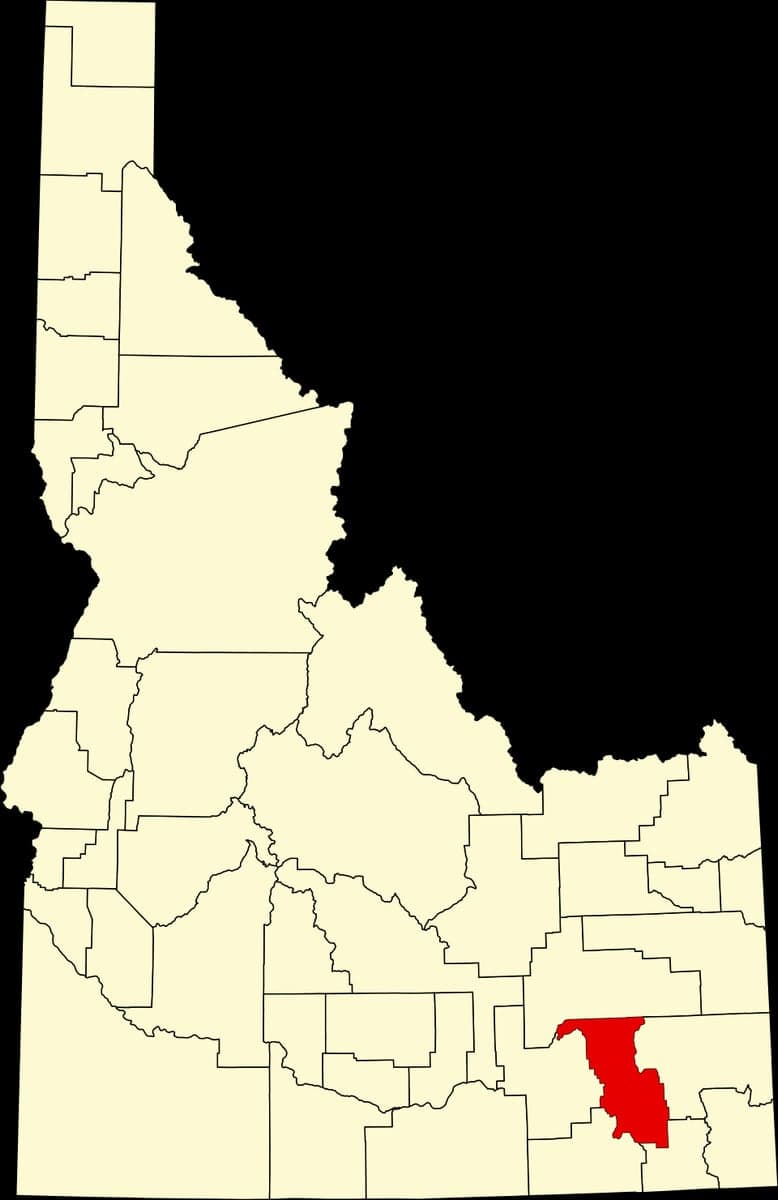
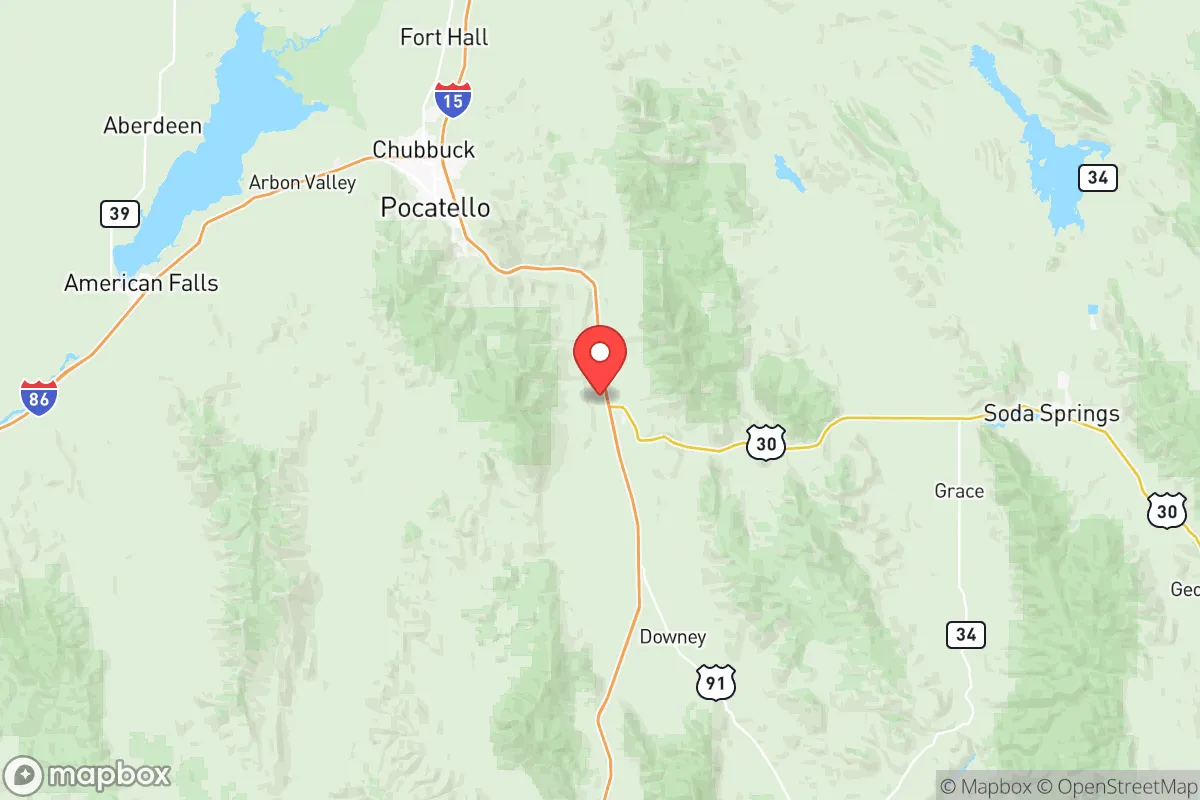
Photo: Wikipedia
Political ClimatePolitical Climate in Bannock County
Showing district-level results — no local-only data available.
Local Political AnalysisPolitical Analysis of Bannock County
Bannock County leans reliably Republican, but it’s a softer shade of red than the rest of Idaho. The county’s Cook Partisan Voting Index (PVI) of R+13 is a solid five points less conservative than the state’s overall R+18 rating. That gap isn’t just a statistical quirk—it reflects a real political split within the county, driven largely by the city of Pocatello, which acts as a blue-leaning anchor in an otherwise deeply conservative region. While the county hasn’t voted for a Democratic presidential candidate since 1964, the margins in Pocatello have been tightening, and local races often see competitive Democratic showings, especially in city council and school board contests.
How it compares
The political geography of Bannock County is a tale of two landscapes. Pocatello, home to Idaho State University and a sizable healthcare and tech workforce, consistently votes more moderately or even leans Democratic in local and national elections. In the 2024 presidential race, Pocatello precincts like those around the university campus and the historic Old Town area broke for the Democratic candidate by margins of 10 to 15 points. Drive just 15 minutes south to Chubbuck, and the political complexion shifts sharply—Chubbuck precincts routinely vote 65-70% Republican. Head further out to rural communities like Downey or Lava Hot Springs, and Republican margins can exceed 80%. The swing precincts are almost entirely within Pocatello’s city limits, where voter turnout among younger residents and ISU affiliates can tip the balance in close local races. This urban-rural divide is more pronounced in Bannock County than in Idaho’s more uniformly conservative counties like Madison or Bonneville, where the blue pockets are smaller and less organized.
What this means for residents
For conservative residents, Bannock County offers a comfortable political home with a strong Republican majority in county commission and most statewide races. Tax policy remains conservative—Idaho has a flat income tax of 5.8% and no estate tax, and Bannock County’s property tax rates are among the lowest in the state. Gun rights are broadly supported, with no county-level restrictions beyond state law. For liberal residents, the picture is more nuanced. While you won’t find a progressive majority, Pocatello provides a genuine counterweight: the city has a non-discrimination ordinance protecting LGBTQ+ residents, a rarity in southeastern Idaho, and local Democratic clubs are active and visible. State-level policies, like the near-total abortion ban passed in 2023 and the lack of expanded Medicaid under the state’s original plan, are felt more acutely by liberal residents, but the county’s moderate streak means these issues are debated more openly here than in neighboring counties like Power or Caribou.
Culturally, Bannock County stands apart from the rest of Idaho in a few key ways. The presence of Idaho State University gives Pocatello a younger, more transient population that softens the region’s otherwise strong Mormon cultural influence—the LDS church is still dominant in rural areas, but less so in town. Local politics often center on practical issues like economic development and infrastructure, rather than the culture-war battles that dominate state-level discourse. You’ll see more yard signs for local school board candidates than for national figures, and the county’s two state representatives—both Republicans—occasionally break with party leadership on education funding and land-use issues. Looking ahead, the county’s political trajectory is likely to stay moderate-Republican, with Pocatello’s growth slowly nudging the county leftward, but not enough to flip it blue anytime soon. For anyone moving here, the takeaway is simple: you’ll find your people, whether you’re a conservative in Chubbuck or a liberal in Pocatello, but the state-level politics will lean heavily red no matter where you settle.

State Political ClimatePolitical Climate in Idaho
State Political AnalysisPolitical Environment in the State
Idaho is one of the most reliably Republican states in the country, with a Cook Partisan Voting Index of R+18, meaning it votes about 18 points more Republican than the national average. The dominant coalition is a mix of rural conservatives, Mormon cultural conservatives in the southeast, and a growing wave of out-of-state transplants—many from California and the Pacific Northwest—who are often fiscally conservative but socially moderate to libertarian. Over the last 10-20 years, the state has shifted from a sleepy, low-key conservative stronghold to a more aggressively right-leaning policy laboratory, driven by a supermajority in the legislature and a governor who has signed some of the nation’s most restrictive abortion laws, broadest gun rights expansions, and largest tax cuts.
Urban vs. rural divide
The political map of Idaho is starkly divided between its fast-growing urban corridors and its vast rural expanse. The Boise metro area—Ada County (Boise, Meridian, Eagle) and Canyon County (Nampa, Caldwell)—is the state’s population center and the engine of its growth. Ada County, once a swing county, has trended rightward in recent cycles, voting +12 R in 2024, driven by transplants who moved for lower taxes and conservative governance. Canyon County is even redder, voting +24 R. The liberal strongholds are limited to a few small islands: the college town of Moscow (Latah County, home to the University of Idaho) and the resort town of Ketchum/Sun Valley (Blaine County). These two counties are the only ones that consistently vote Democratic, and even they are surrounded by deep-red rural territory. The rest of the state—from the Idaho Panhandle (Coeur d’Alene, Sandpoint) to the Magic Valley (Twin Falls) to the southeastern Mormon belt (Rexburg, Idaho Falls, Pocatello)—votes Republican by margins of 30 to 60 points. The rural-urban divide here isn’t about cities vs. suburbs; it’s about the Boise metro vs. everything else, with the metro itself being solidly conservative but with a small, vocal liberal minority in downtown Boise.
Policy environment
Idaho’s policy environment is defined by low taxes, minimal regulation, and a strong tilt toward individual liberty in certain areas. The state has a flat income tax rate of 5.8% (recently cut from 6%), and property taxes are relatively low, though they vary by county. There is no estate tax, and sales tax is 6% statewide. The regulatory posture is business-friendly, with no state-level minimum wage above the federal $7.25, and right-to-work laws in place. Education policy is a flashpoint: the state has a robust school choice movement, with a new education savings account (ESA) program passed in 2023 that allows parents to use public funds for private school tuition, homeschooling, or other educational expenses. However, teacher pay remains below the national average, and the state ranks near the bottom in per-pupil spending. Healthcare policy is limited; Idaho did not expand Medicaid until 2020 (via a ballot initiative), and the state has some of the most restrictive abortion laws in the nation, with a near-total ban (the Defense of Life Act) that has no exceptions for rape or incest, only for the life of the mother. Election laws are moderately restrictive: voter ID is required, same-day registration is not available, and mail-in voting is limited to those with an approved excuse. The state also has a closed primary system, meaning only registered Republicans can vote in GOP primaries, which effectively decides most general elections.
Recent policy direction
The last five years have seen Idaho accelerate its conservative policy agenda. On gun rights, the state passed constitutional carry (permitless carry) in 2016 and has since added preemption laws that prevent local governments from enacting their own gun restrictions. In 2023, the legislature passed a bill prohibiting any state or local enforcement of federal gun laws that conflict with Idaho’s Second Amendment protections. On parental and education rights, the 2023 ESA program was paired with a “Parents’ Bill of Rights” that requires schools to notify parents of any curriculum involving sexuality or gender identity and prohibits school employees from keeping a student’s gender identity or sexual orientation confidential from parents. On speech and privacy, Idaho passed a law in 2024 requiring age verification for adult websites and restricting minors’ access to social media algorithms. Medical and bodily autonomy is sharply limited: the near-total abortion ban has no exceptions for rape or incest, and the state has also banned gender-affirming care for minors. Property rights are strongly protected, with no statewide zoning mandates and a “private property rights” law that requires compensation for any regulation that reduces property value by more than 20%. Taxation has been cut repeatedly: the flat income tax rate dropped from 6.5% to 5.8% in 2023, and the corporate tax rate fell to 5.8% as well. Voting and ballot access remain stable but restrictive; the state has not expanded early voting or mail-in voting, and a 2024 law tightened rules for ballot initiatives, making it harder to bypass the legislature.
Civil unrest & political movements
Idaho has a history of far-right activism, but it’s important to distinguish between the mainstream conservative majority and the more fringe elements. The state has been a hub for anti-government and militia movements since the 1990s, with groups like the Idaho Liberty Watch and the People’s Rights network (founded by Ammon Bundy) maintaining a presence. In 2022, there were protests at the Idaho Statehouse over COVID-19 mandates and vaccine requirements, with some demonstrators carrying firearms. More recently, the “constitutional sheriff” movement has gained traction in rural counties, with sheriffs in places like Bonner County and Boundary County publicly stating they will not enforce certain state or federal laws they deem unconstitutional. Immigration politics are less heated than in border states, but Idaho has seen a rise in anti-immigrant rhetoric, particularly around the growing Latino population in the Magic Valley (Twin Falls, Jerome), which is driven by dairy and agricultural labor. There are no sanctuary cities in Idaho; in fact, the state passed a law in 2023 requiring local law enforcement to cooperate with federal immigration authorities. Election integrity controversies have been minimal compared to states like Arizona or Georgia, but a 2022 audit of the 2020 election in Ada County found no evidence of widespread fraud, despite some local activists claiming otherwise. Overall, the political climate is stable but polarized, with the most visible flashpoints being the annual “Idaho Day” rallies at the Statehouse and occasional standoffs between county sheriffs and state officials over gun laws or land use.
Projection
Over the next 5-10 years, Idaho will likely become even more conservative, but with a growing libertarian streak that could create internal tensions. The in-migration wave—Idaho was the fastest-growing state in the nation for several years running—is bringing in people who are fiscally conservative but socially moderate, particularly in the Boise suburbs. This could push the state toward a more “live and let live” posture on issues like marijuana legalization (currently illegal, with no medical program) and alcohol sales (the state still runs its own liquor stores). However, the rural and Mormon-dominated legislature is unlikely to budge on abortion, gun rights, or education policy. The biggest wildcard is the growing Hispanic population in the Magic Valley and the influx of younger, more secular transplants to Boise; these groups could gradually shift the state’s politics toward a more pragmatic, less ideologically rigid conservatism. But don’t expect a blue wave—Idaho will remain R+15 or higher for the foreseeable future. A new resident moving in now should expect to find a state that is deeply conservative, with a government that actively promotes low taxes, school choice, and gun rights, but also one where the culture is becoming more diverse and less insular, especially in the Boise area.
For a new resident, the bottom line is this: if you’re conservative, you’ll find Idaho a comfortable fit, with a government that shares your values and a growing economy that rewards hard work. If you’re liberal, you’ll be in a small minority, but you’ll find like-minded communities in Moscow, Ketchum, and parts of Boise—just don’t expect your views to shape state policy anytime soon. The practical takeaway is that Idaho offers a high degree of personal freedom in areas like gun ownership, property rights, and tax burden, but with significant restrictions on abortion and medical autonomy. It’s a state where your vote matters far more in local and county elections than in state or federal ones, and where the political culture is polite but firm in its conservatism. If you’re moving here, come ready to engage with a community that values self-reliance, low taxes, and a slower pace of life—and be prepared for the winters.
* Values derived from national, state, county, city and local statistics and may differ in a specific area. Last updated: 2026-06-16T02:12:18.000Z
Narrative content on this page is AI-generated and may contain mistakes. Verify any details that matter before acting on them.
ReloMaps may earn a commission from affiliate links at no extra cost to you.

