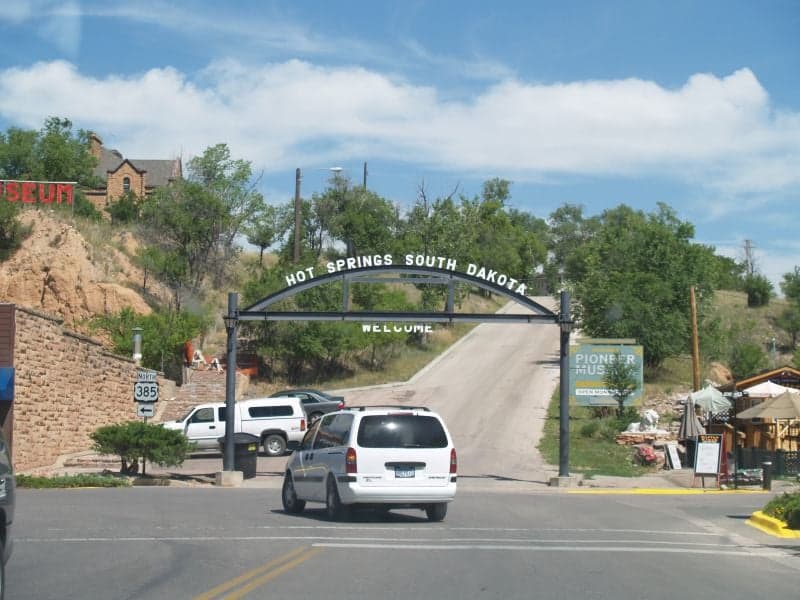
Photo: Wikipedia
Political ClimatePolitical Climate in Hot Springs, SD
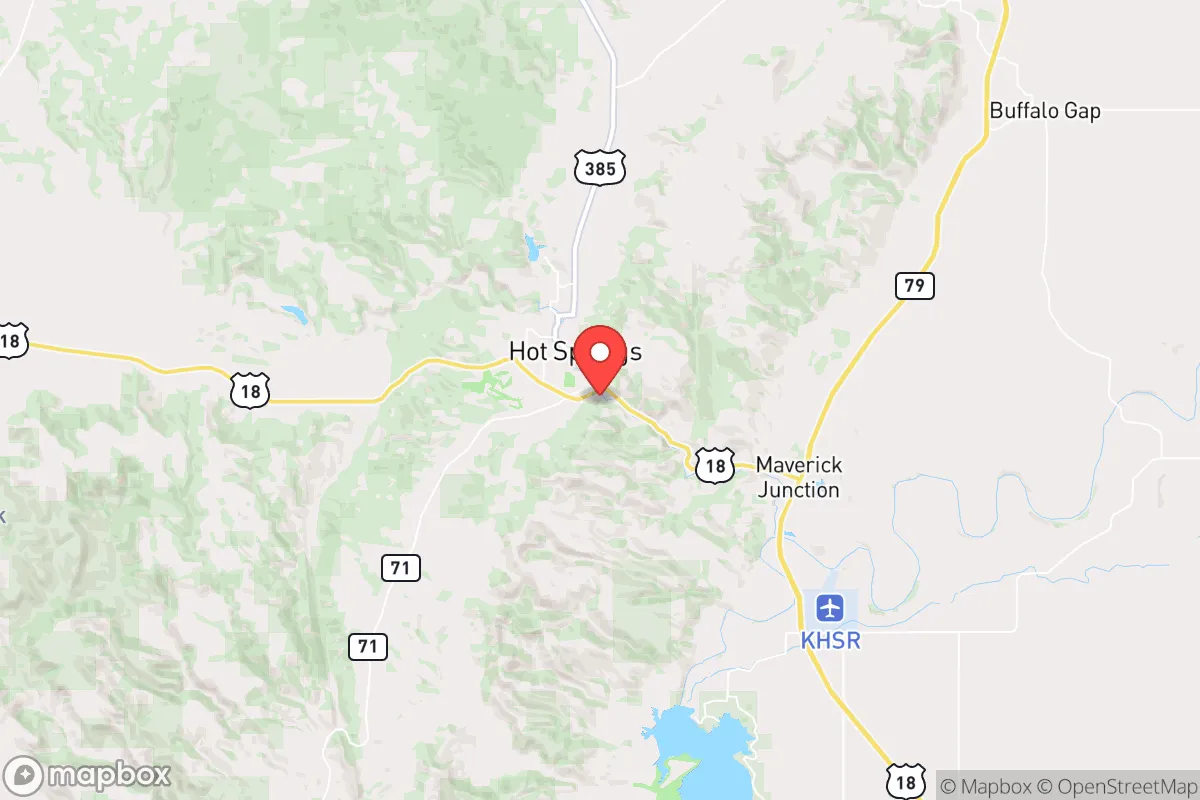
District shown is the primary district for this city’s centroid. Cities may span multiple districts.
Inherited from parent state — no local data available.
Local Political AnalysisPolitical Analysis of Hot Springs, SD
Hot Springs, South Dakota, sits in a deeply conservative corner of the state, and that’s not changing anytime soon. The Cook PVI of R+15 tells you the math—this area votes Republican by a solid, reliable margin, and it’s been that way for as long as most folks can remember. If you look at the 2024 presidential results, Fall River County, where Hot Springs is the county seat, went about 73% for Trump, which is right in line with that R+15 lean. The political trajectory here isn’t toward the middle; it’s a steady, grounded conservatism that values local control and personal freedom over government mandates.
How it compares
Drive an hour north to Rapid City, and you’ll find a different political animal. Rapid City is still conservative overall, but it’s got a more mixed bag—more transplants, more tourism money, and a younger crowd that’s brought some purple streaks into Pennington County. Hot Springs, by contrast, feels like a time capsule of traditional values. The surrounding towns—places like Edgemont, Oelrichs, and even tiny Oral—are even more rural and red, often voting 80%+ Republican. The real contrast, though, is with the Black Hills National Forest land and the state parks nearby. Those federal lands bring in a lot of visitors and some seasonal workers who lean left, but they don’t vote here. The permanent residents? They’re the ones who remember when the VA hospital was the town’s economic engine, and they’re not interested in progressive experiments that sound like they came from Denver or Portland.
What this means for residents
For someone living here, the political climate means you can generally trust that local government isn’t going to overreach into your daily life. The county commission and city council tend to focus on practical stuff—roads, water, and keeping taxes low—rather than social engineering. There’s a healthy skepticism of state-level mandates, especially when they come from Pierre, which can feel like a distant bureaucracy. The biggest concern among locals is the slow creep of federal regulations on land use and water rights, which hits close to home in a ranching and outdoor recreation area. If you value the Second Amendment, you’re in good company; concealed carry is common, and there’s no appetite for red flag laws or magazine bans. The school board here is conservative too, so you won’t see the kind of curriculum battles that plague bigger districts.
That said, there are some cultural distinctions worth noting. Hot Springs has a unique history as a health resort town, and that’s left a legacy of independent-minded folks who don’t like being told what to do. The local economy leans on tourism—the Mammoth Site, the hot springs pools, and the historic downtown—so there’s a pragmatic streak that keeps things open for business without selling out the town’s character. You won’t find a lot of political activism here, but you will find a strong sense of community that looks out for its own. The long-term outlook is stable: as long as the state keeps its hands off local property rights and the federal government doesn’t impose new land-use restrictions, Hot Springs will stay the kind of place where you can live your life without a lot of interference. That’s the real draw for people who move here—not the politics itself, but the freedom that comes with it.

State Political ClimatePolitical Climate in South Dakota
State Political AnalysisPolitical Environment in the State
South Dakota is a deeply conservative state, with a Republican lean that has only intensified over the past two decades. The state hasn’t voted for a Democratic presidential candidate since 1964, and in 2024, Donald Trump carried it by over 30 points. The dominant coalition is a mix of rural agricultural interests, small-government libertarians, and a growing number of conservative transplants fleeing blue states. The trajectory has been steadily rightward since the early 2000s, driven by a combination of low taxes, minimal regulation, and a cultural backlash against progressive policies in neighboring states like Minnesota and Colorado.
Urban vs. rural divide
The political map is starkly divided between a few small urban centers and the vast rural expanse. Sioux Falls, the largest city, is the state’s most moderate area—it still leans Republican, but with a softer edge. In 2024, Minnehaha County (Sioux Falls) voted for Trump by about 15 points, down from 20 in 2020, as younger professionals and healthcare workers have moved in. Rapid City and Pennington County are more reliably red, voting Trump by 25 points, driven by a strong military and tourism economy. The real engine of the state’s conservatism is the rural counties. Harding County in the northwest voted Trump by over 80 points, and Tripp County in the south-central region was similarly lopsided. The Black Hills region around Deadwood and Lead is a bit more libertarian-leaning, with a live-and-let-live attitude that sometimes bucks party lines on land-use issues. The only notable blue dot is Brookings, home to South Dakota State University, where the college population pushes the county to a near-even split—but that’s more of a temporary student effect than a permanent shift.
Policy environment
South Dakota’s policy environment is a conservative dream. There is no state income tax, and the sales tax is a modest 4.5% (with local add-ons pushing it to around 6.5% in Sioux Falls). Property taxes are low by national standards, and the state has a right-to-work law, meaning no one can be forced to join a union as a condition of employment. The regulatory posture is aggressively pro-business—permitting for new construction or business licenses is typically a matter of weeks, not months. On education, the state has a robust school choice program, including a tax credit scholarship for private schools, and homeschooling is virtually unregulated. Healthcare is a mixed bag: the state did expand Medicaid in 2023 after a ballot initiative, but the legislature has kept it tightly controlled. Election laws are among the most secure in the nation—voter ID is required, same-day registration is not allowed, and absentee ballots require a notarized signature or witness. There is no early voting in the traditional sense, though mail-in ballots are available for those with a valid excuse. The state also passed a law in 2024 banning ranked-choice voting, a preemptive strike against a trend seen in other states.
Trajectory & freedom
South Dakota is becoming more free in many respects, but with some concerning caveats. On the positive side, the state passed a constitutional carry law in 2019, allowing anyone legally able to own a firearm to carry it without a permit. In 2023, the legislature passed a parental rights bill that requires schools to notify parents of any curriculum involving sexuality or gender identity, and it allows parents to opt their children out of such lessons. The state also enacted a medical freedom law in 2022 that prohibits employers and government entities from mandating COVID-19 vaccines, and it bars discrimination based on vaccination status. Property rights are strong—there is no statewide zoning, and counties have limited ability to restrict land use. However, there are red flags. In 2024, the governor signed a data privacy bill that, while well-intentioned, gives the state broad authority to regulate online platforms, which could be used to suppress conservative speech in the future. The state also passed a transgender sports ban in 2022, which is popular with conservatives but has drawn federal lawsuits. The biggest concern for freedom-minded residents is the state’s growing reliance on federal funds—over 40% of the state budget comes from Washington, which creates a long-term vulnerability if the federal government ever decides to attach strings.
Civil unrest & political movements
South Dakota has seen remarkably little civil unrest compared to other states. The 2020 protests that rocked other cities barely touched Sioux Falls—a small, peaceful BLM march of a few hundred people was the extent of it. The most significant political movement in recent years has been the anti-lockdown sentiment during COVID-19. Governor Kristi Noem refused to issue a statewide mask mandate or shutdown order, which made the state a haven for people fleeing restrictions in places like California and New York. This led to a surge of in-migration, particularly to the Black Hills and the Lake Oahe region. There is a growing secessionist undercurrent in the western part of the state, where some ranchers and activists have floated the idea of joining Wyoming or forming a separate state called “West Dakota,” driven by frustration with federal land management and what they see as Sioux Falls’ outsized influence. Immigration politics are relatively quiet—the state has a small immigrant population, mostly in Sioux Falls, and the legislature passed a law in 2024 requiring all state agencies to verify immigration status for benefits. The Keystone XL pipeline controversy was a flashpoint in the 2010s, with protests near the Pine Ridge Reservation, but that has largely faded since the project was canceled. Election integrity is not a major controversy here—the state’s paper ballot system and strict voter ID laws have kept things clean, and there were no significant disputes in 2020 or 2024.
Projection
Over the next 5-10 years, South Dakota will likely become even more conservative, but with a growing tension between the old-school rural libertarians and a new wave of more activist conservatives. The in-migration from blue states—especially from California, Colorado, and Minnesota—is accelerating. These newcomers are often more culturally conservative than the native population, but they also bring higher expectations for services like broadband and healthcare, which could push the state toward more government spending. The Sioux Falls metro will continue to grow, becoming a moderate Republican stronghold, while the rural areas will remain deeply red. The biggest wild card is the state’s budget—if federal funding ever gets cut, the state will face a crisis, as it has no income tax to fall back on. That could force a debate about either cutting services or introducing a new tax, which would be a major political battle. The Black Hills will likely see the most cultural change, as wealthy out-of-state buyers snap up ranch land and drive up prices, creating a new class of conservative landowners who may clash with longtime residents over development and conservation. The state’s parental rights and medical freedom laws will likely be tested in court, but the legislature will continue to push the envelope. Expect more laws targeting transgender issues, vaccine mandates, and federal overreach.
For a new resident, the bottom line is this: South Dakota offers a high degree of personal freedom—low taxes, minimal government interference, and a culture that values self-reliance. You won’t find the political drama of a swing state or the chaos of a blue city. But you should be aware that the state’s freedom is partly subsidized by federal money, and the growing population will eventually force hard choices about infrastructure and taxes. If you’re looking for a place where you can live your life without the government breathing down your neck, and you don’t mind cold winters and long drives to the nearest airport, South Dakota is a solid bet. Just keep an eye on the statehouse—the same people who passed the good laws could easily pass bad ones if the political winds shift.
* Values derived from national, state, county, city and local statistics and may differ in a specific area. Last updated: 2026-04-23T10:33:01.000Z
Narrative content on this page is AI-generated and may contain mistakes. Verify any details that matter before acting on them.
ReloMaps may earn a commission from affiliate links at no extra cost to you.

