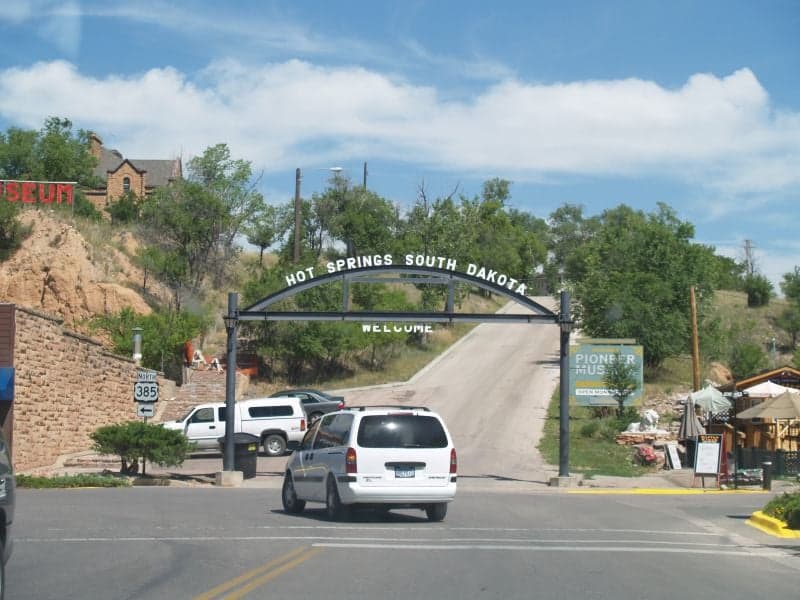
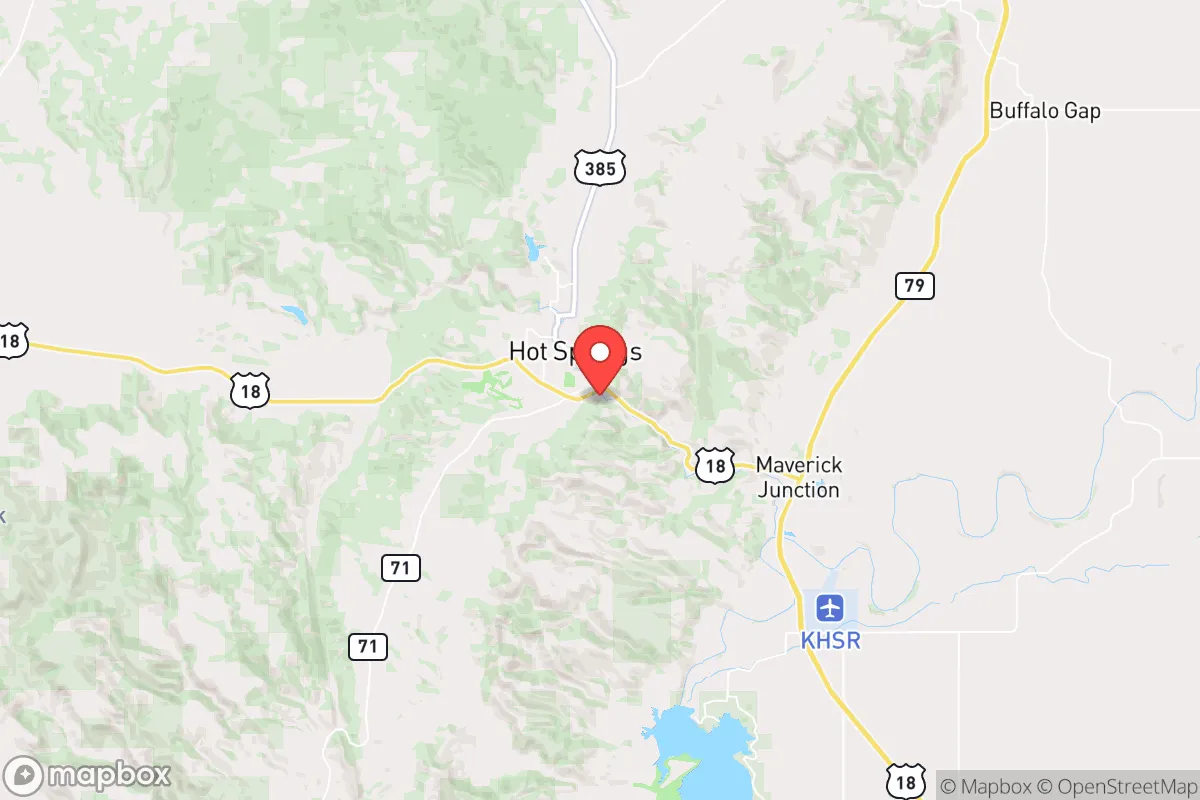
Photo: Wikipedia
Personal Sovereignty in Hot Springs, SD
Viable for self-reliance. Generally workable, though some barriers may limit total independence.
What does Personal Sovereignty tell us?
Personal Sovereignty measures your capacity for self-reliance and independence with minimal government friction. Higher scores mean fewer barriers between you and the way you want to live... but it assumes you have the space you need and good neighbors.
What does this tell us?
Personal Sovereignty measures your capacity for self-reliance and independence with minimal government friction. Higher scores mean fewer barriers between you and the way you want to live... but it assumes you have the space you need and good neighbors.
State Policy
Energy independence: Importer (35% of energy produced in-state)
Personal Liberty
Homesteading

Personal Liberty Analysis
Hot Springs, South Dakota, offers a level of personal sovereignty that is increasingly rare in the modern United States, making it a serious consideration for those prioritizing autonomy over convenience. Nestled in the southern Black Hills, this small city of roughly 3,500 people operates within a state framework that consistently ranks among the most freedom-oriented in the nation, with low taxation, minimal regulatory interference, and a legal culture that presumes individual competence over government oversight. For the survivalist or prepper mindset, Hot Springs presents a tangible alternative to the creeping administrative control found in coastal and urban centers, though it is not without its own local dynamics and trade-offs. The following analysis breaks down the specific pillars of personal sovereignty that matter most to those evaluating a strategic relocation.
Tax burden and regulatory posture: How South Dakota protects your income and property
The most immediate advantage for anyone moving to Hot Springs is the complete absence of a state income tax, a cornerstone of South Dakota’s appeal. This means every dollar earned from remote work, a local job, or a side business stays in your pocket, with no state-level withholding or annual filing. Property taxes in Fall River County, where Hot Springs sits, are moderate—typically around 1.1% to 1.3% of assessed value—which is reasonable compared to the national average and far below states like Texas or Illinois. The regulatory environment is equally lean: there is no state-level business licensing requirement for most sole proprietorships, no inventory tax, and no onerous environmental permitting for small-scale land use. Zoning in Hot Springs itself is relatively light, with the city focusing on basic health and safety codes rather than dictating what you can build or how you can use your property. For the prepper, this translates to fewer bureaucratic hurdles when constructing a workshop, a root cellar, or a secure storage facility. The state’s overall fiscal discipline—South Dakota has no state debt and a constitutional balanced budget requirement—means you are not subsidizing distant government programs through hidden taxes or inflation-driven levies.
Self-defense and gun law specifics: Constitutional carry and castle doctrine in the Black Hills
South Dakota is a constitutional carry state, meaning no permit is required to carry a concealed firearm for anyone legally allowed to possess one. This applies fully in Hot Springs, with no additional city-level restrictions beyond state law. The state also has a strong castle doctrine and a stand-your-ground statute, eliminating any duty to retreat before using deadly force in self-defense within your home, vehicle, or place of business. For the survivalist, this legal framework provides a clear, unambiguous right to defend life and property without fear of prosecution for exercising that right. Firearm purchases are straightforward: no waiting periods, no universal background checks beyond the federal NICS system, and no restrictions on magazine capacity or firearm types. Hot Springs is also within a short drive of federal land in the Black Hills National Forest and Buffalo Gap National Grassland, where legal target shooting is permitted on most public land (with basic safety precautions). The local sheriff’s office in Fall River County is generally supportive of gun rights, and there is no history of local ordinances attempting to circumvent state preemption laws. For those building a defensive capability, this is as close to a free environment as you will find in the lower 48.
Self-reliance and homesteading viability: Lot sizes, zoning, and off-grid feasibility
Hot Springs and its surrounding rural areas offer genuine opportunities for self-reliant living, though the specifics depend heavily on whether you buy inside city limits or on unincorporated county land. Within the city, standard residential lots range from one-quarter to one-half acre, and the zoning code allows for small-scale livestock like chickens and rabbits, as well as vegetable gardens and fruit trees. However, larger animals such as goats or pigs require a special permit, and the city does enforce basic building codes for new construction. The real opportunity lies in the county: Fall River County has minimal zoning outside municipal boundaries, and parcels of 5 to 40 acres are common and affordable, often selling for $2,000 to $5,000 per acre depending on proximity to water and utilities. Off-grid living is entirely feasible here. There are no state laws prohibiting rainwater collection, composting toilets, or solar panel installation. The county does not require building permits for agricultural structures or sheds under a certain size, and many residents rely on well water and septic systems. The climate is semi-arid, with about 18 inches of precipitation annually, so a reliable water source—either a deep well or a seasonal creek—is critical for any serious homesteading plan. For the prepper, this means you can secure a parcel, build a cabin or a shipping container home, and live with minimal government interaction, provided you meet basic health and safety standards for your own dwelling.
Personal liberties: Parental rights, medical autonomy, speech, and property
South Dakota has been a battleground for parental rights in education, and the current legal environment strongly favors family authority over state mandates. There is no state-level mask or vaccine mandate for children attending public schools, and parents have the legal right to opt their children out of any curriculum or activity they find objectionable. The state also has a robust school choice program, including open enrollment across district lines and a growing number of charter and private options. Medical autonomy is more nuanced: South Dakota does not have a state-level vaccine passport or mandatory reporting system for alternative treatments, but it does have a conservative medical board that generally defers to standard protocols. For the survivalist, the key advantage is the lack of a state income tax and the absence of a state-level emergency powers law that could be used to freeze bank accounts or restrict travel—a concern in states like New York or California. Free speech is protected under both the U.S. Constitution and the South Dakota Constitution, which explicitly states that "every person may freely speak, write and publish on all subjects, being responsible for the abuse of that right." Property rights are similarly strong: the state has a right-to-farm law that protects agricultural operations from nuisance lawsuits, and eminent domain is rarely used for private development. For the individualist, Hot Springs offers a legal environment where you are presumed free to live as you see fit, unless you cause demonstrable harm to others.
In the broader context of American personal sovereignty, Hot Springs, South Dakota, ranks among the top-tier locations for those seeking to minimize government overreach and maximize self-determination. The combination of no income tax, constitutional carry, minimal zoning, strong parental rights, and a culture of self-reliance creates a foundation that is difficult to replicate in most other regions. Compared to the Pacific Northwest or the Northeast, where regulatory density and tax burdens are high, Hot Springs feels like a different country entirely. It is not a libertarian utopia—there are still local ordinances, property taxes, and federal oversight—but for the survivalist or prepper who values practical autonomy over theoretical ideals, this small Black Hills town offers a rare and workable balance. The trade-offs are real: limited job diversity, harsh winters, and a remote location. But for those who prioritize sovereignty above all else, those are not drawbacks—they are the price of freedom.

* Values derived from national, state, county, city and local statistics and may differ in a specific area. Last updated: 2026-04-23T10:33:01.000Z
Narrative content on this page is AI-generated and may contain mistakes. Verify any details that matter before acting on them.
ReloMaps may earn a commission from affiliate links at no extra cost to you.

