 Popular
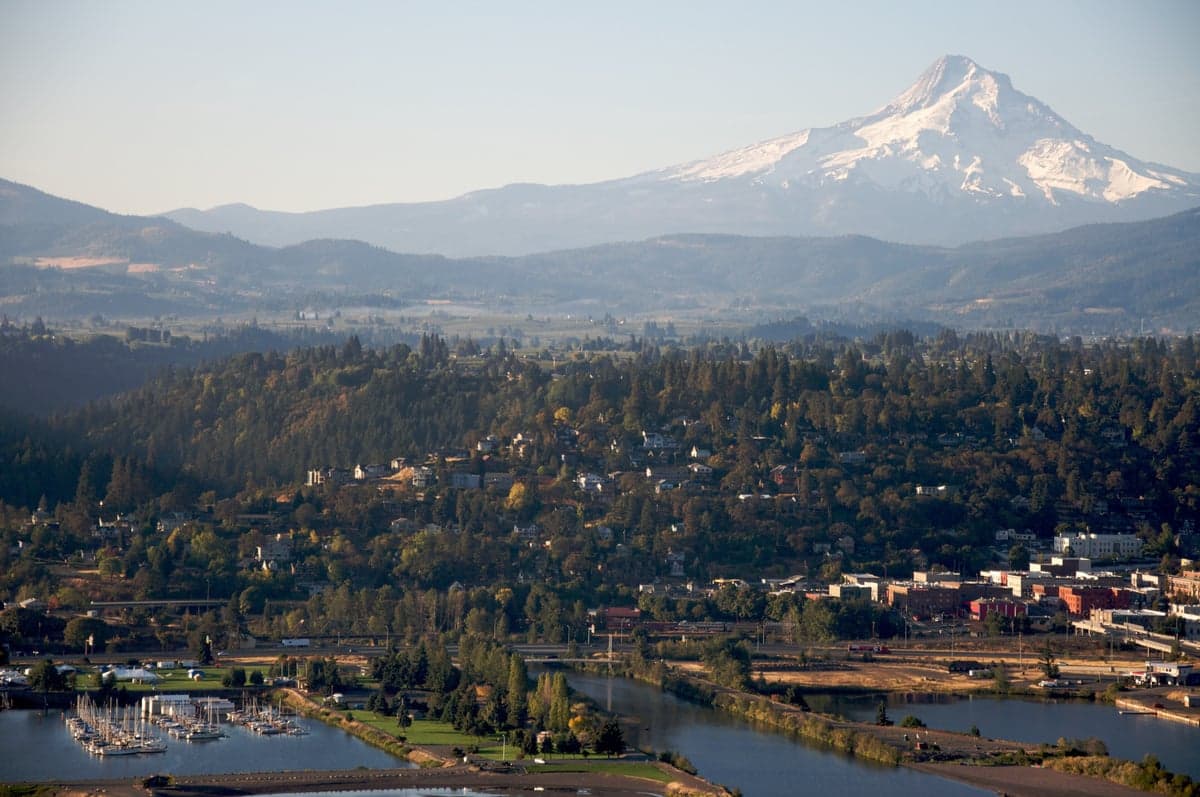
Photo: Wikipedia
Personal Sovereignty in Hood River, OR
Viable for self-reliance. Generally workable, though some barriers may limit total independence.
What does Personal Sovereignty tell us?
Personal Sovereignty measures your capacity for self-reliance and independence with minimal government friction. Higher scores mean fewer barriers between you and the way you want to live... but it assumes you have the space you need and good neighbors.
What does this tell us?
Personal Sovereignty measures your capacity for self-reliance and independence with minimal government friction. Higher scores mean fewer barriers between you and the way you want to live... but it assumes you have the space you need and good neighbors.
State Policy
Energy independence: Importer (35% of energy produced in-state)
Personal Liberty
Homesteading

Personal Liberty Analysis
Hood River, Oregon, presents a complex personal sovereignty landscape where the area’s natural beauty and outdoor lifestyle intersect with a regulatory environment that is notably more restrictive than many conservative-leaning relocation targets. While the Columbia River Gorge offers a stunning backdrop for self-reliant living, the city and state impose significant constraints on tax burden, self-defense rights, and property use that a freedom-minded individual must weigh carefully. The overall autonomy environment here is best described as "managed independence"—ample opportunity for outdoor self-sufficiency, but with a heavy hand from state and local governments on core liberties.
Tax burden and regulatory posture in Hood River and Oregon
Oregon’s tax structure is a major consideration for anyone prioritizing financial sovereignty. The state has no sales tax, which can be a meaningful advantage for large purchases and daily spending, but it compensates with the fifth-highest state income tax in the nation, with a top marginal rate of 9.9% on income over $125,000 for single filers. Property taxes in Hood River County are moderate by Oregon standards, averaging around 0.85% of assessed value, but the state’s property tax system is complex, with Measure 5 and Measure 50 caps limiting annual increases to 3% for existing homeowners—a benefit for long-term residents but a potential shock for new buyers whose assessed values reset at purchase price. The regulatory posture in Hood River is distinctly heavy-touch. The city enforces strict land-use planning under Oregon’s statewide Urban Growth Boundary (UGB) system, which tightly controls development and limits rural sprawl. Building permits, zoning changes, and even minor home renovations can require lengthy review processes. For a reader accustomed to minimal government interference, the permitting culture here will feel bureaucratic and slow. Business regulations are similarly dense, with Oregon’s Bureau of Labor and Industries enforcing robust employee protections, paid leave mandates, and a minimum wage that is among the highest in the country ($14.20/hour in 2026 for non-Portland metro areas). This regulatory density is not inherently good or bad, but it is a concrete constraint on personal economic freedom that a sovereignty-minded individual must plan around.
Self-defense and gun law specifics in Hood River and Oregon
Oregon’s gun laws have become significantly more restrictive in recent years, and Hood River residents operate under these state-level constraints. The state requires a permit to purchase a handgun (Measure 114, though its implementation has been partially blocked by court challenges as of early 2026), and all firearm sales from licensed dealers require a background check through the Oregon State Police. Open carry of loaded firearms in public is generally legal in unincorporated areas of Hood River County, but the city of Hood River itself prohibits open carry within city limits unless the individual has a valid concealed handgun license. Concealed carry permits are issued by the county sheriff on a shall-issue basis—meaning if you meet the statutory requirements (age 21+, no disqualifying criminal history, completion of a safety course), the sheriff must issue the permit. However, the process can take 30-45 days, and the permit is valid for four years. Magazine capacity is restricted to 10 rounds under Measure 114, though this provision is also under legal challenge. For self-defense in the home, Oregon law recognizes the castle doctrine but does not have a broad "stand your ground" statute; a duty to retreat exists in public spaces if it can be done safely. The practical effect for a Hood River resident is that self-defense planning requires careful compliance with state and local laws, and the legal landscape is in flux. Compared to states with constitutional carry or minimal firearm regulation, Oregon imposes a moderate-to-high burden on the right to keep and bear arms.
Self-reliance and homesteading viability in Hood River County
Hood River County offers genuine potential for self-reliant living, but it is constrained by Oregon’s land-use framework. The county is known for its fertile agricultural soil and a strong local food culture, with numerous orchards, vineyards, and small farms. For homesteading, the key factor is zoning. Land outside the Urban Growth Boundary is typically zoned Exclusive Farm Use (EFU) or Forestland, which permits dwellings only if the property meets minimum acreage requirements (often 20-80 acres for EFU) and the owner demonstrates a bona fide farm or forest operation. This makes it difficult to buy a small parcel for a hobby homestead. Inside the UGB, residential lots in Hood River city are typically 5,000 to 10,000 square feet, which limits space for gardens, livestock, or workshops. Off-grid feasibility is low within city limits, where the city requires connection to municipal water and sewer. In unincorporated areas, off-grid systems (solar, well, septic) are permitted but must meet Oregon’s strict building codes and environmental regulations, including water rights permitting for wells. The county’s Right to Farm ordinance protects agricultural operations from nuisance complaints, which is a plus for those who want to keep chickens, goats, or bees. However, the overall regulatory environment favors established agricultural operations over small-scale, independent homesteaders. For a family seeking to build a fully self-sufficient property with minimal government oversight, Hood River County is a challenging but not impossible location—expect significant paperwork, permitting fees, and potential neighbor or county pushback on non-standard living arrangements.
Personal liberties in Hood River: parental rights, medical autonomy, speech, and property
Personal liberties in Hood River reflect Oregon’s generally progressive state policies, which can be a double-edged sword for a conservative-leaning reader. Parental rights are a notable area of tension. Oregon has some of the strongest student privacy laws in the nation, with policies that allow schools to withhold information about a student’s gender identity or sexual orientation from parents if the student requests it. This has been a flashpoint in Hood River County School District, where some parents have voiced concerns about transparency. On the other hand, Oregon law does not require parental consent for a minor to access reproductive health services, including contraception and abortion, without parental notification. Medical autonomy is robust in some areas—Oregon was the first state to legalize physician-assisted suicide (Death with Dignity Act) and has legalized recreational marijuana, with dispensaries in Hood River. However, vaccine mandates for school attendance are strict, with no personal belief exemption allowed for required childhood immunizations. Free speech is protected under the Oregon Constitution, which provides even broader protections than the First Amendment in some contexts, including a strong prohibition on prior restraint. Property rights are significantly curtailed by Oregon’s land-use system; the state’s Measure 37 (2004) and Measure 49 (2007) attempted to balance property rights with planning goals, but the net effect is that landowners have limited ability to develop or use their property in ways inconsistent with the local comprehensive plan. For a reader who values maximum personal autonomy, Hood River’s regulatory environment will feel intrusive, particularly on parental rights and property use. The trade-off is a community that values environmental stewardship and social cohesion, but that comes at the cost of individual discretion.
In the broader Pacific Northwest context, Hood River offers a moderate level of personal sovereignty—significantly more constrained than rural Idaho or Eastern Washington, but less restrictive than Portland or Seattle. The area rewards those who are willing to navigate bureaucracy and comply with state mandates, while offering genuine opportunities for outdoor self-reliance and a strong local community. For a conservative-leaning individual or family who prioritizes low taxes, minimal regulation, and maximum personal liberty, Hood River will likely feel like a compromise. However, for those who value the natural environment and are willing to work within the system, it provides a viable, if managed, autonomy environment.

* Values derived from national, state, county, city and local statistics and may differ in a specific area. Last updated: 2026-08-15T00:43:48.000Z
Narrative content on this page is AI-generated and may contain mistakes. Verify any details that matter before acting on them.
ReloMaps may earn a commission from affiliate links at no extra cost to you.

