Photo: Wikipedia
Political ClimatePolitical Climate in Harpers Ferry, IA
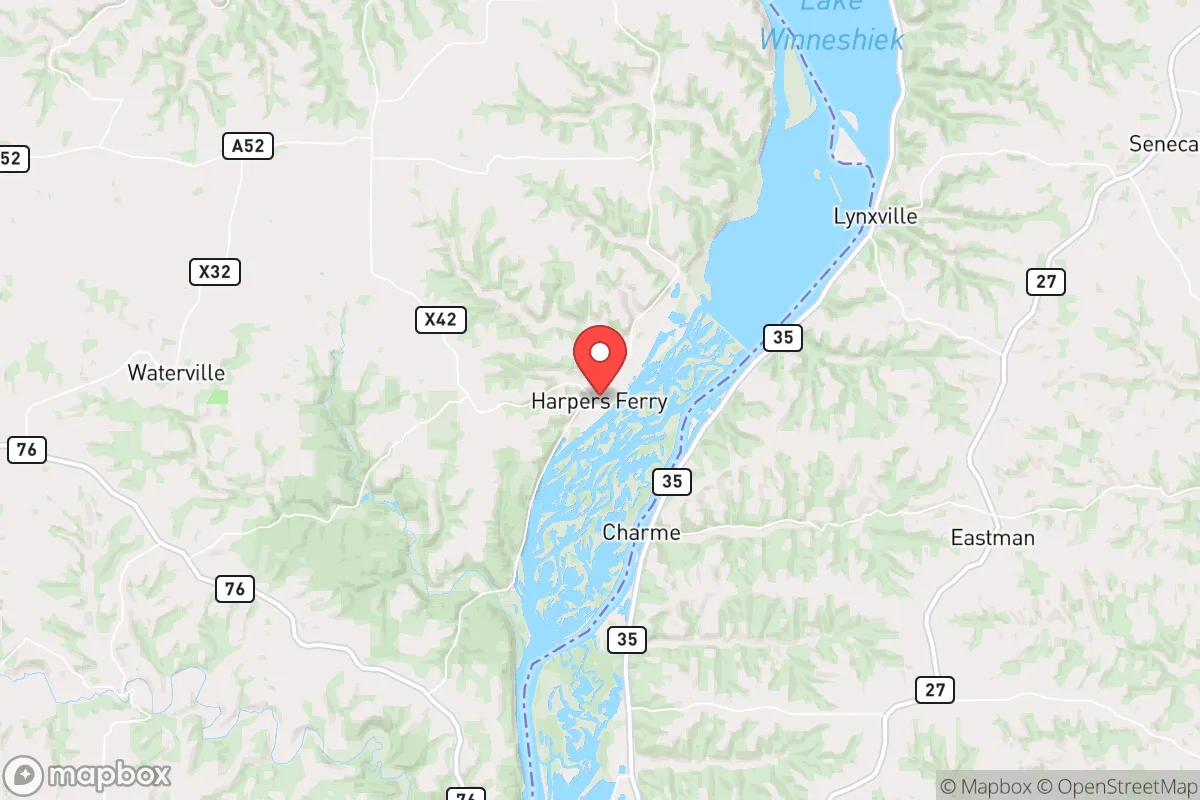
District shown is the primary district for this city’s centroid. Cities may span multiple districts.
Local Political AnalysisPolitical Analysis of Harpers Ferry, IA
Harpers Ferry, Iowa, leans reliably Republican, but it’s not as deep red as the surrounding state of Iowa as a whole. The area carries a Cook PVI of R+4, meaning it votes about four points more Republican than the national average, while Iowa statewide sits at R+6. That two-point gap might sound small, but locals will tell you it reflects a real difference in tone and turnout. Harpers Ferry has a more moderate, pragmatic streak than the hardline rural counties to the west and south, partly because of its position along the Mississippi River and its mix of retirees, tourism workers, and small-scale farmers. The political trajectory here has been slowly shifting rightward over the past decade, but not as sharply as in places like Decorah (about 20 miles southwest) or Waukon (15 miles west), where evangelical and agricultural interests dominate. In Harpers Ferry, you’ll still find a fair number of split-ticket voters—people who back Republicans for president but vote for local Democrats who support conservation and river access.
How it compares
Compared to Iowa as a whole, Harpers Ferry is a bit more independent and less tribal. Statewide, the R+6 PVI reflects a broad rural-urban divide: Des Moines and Iowa City lean blue, while most of the rest of the state votes solidly red. Harpers Ferry sits in Allamakee County, which voted for Trump by about 18 points in 2020—close to the state average of +8 for Trump, but with a notable Libertarian vote that sometimes hits 3-4%. The nearby town of Lansing (just north) is even more conservative, while Prairie du Chien, Wisconsin, just across the river, leans slightly more Democratic due to its union and manufacturing base. The contrast is most visible in local elections: Harpers Ferry’s city council often includes a mix of Republicans and independents, whereas countywide races in Allamakee rarely see a Democrat on the ballot. The river itself acts as a moderating force—tourism and second-home owners from Minnesota and Wisconsin bring in different perspectives than the corn-and-soybean interior.
What this means for residents
For conservative residents, Harpers Ferry offers a comfortable environment where Republican candidates are the default, and local policies on taxes, gun rights, and land use align with their values. You won’t see many yard signs for Democrats, and the county GOP is active but not aggressive. For liberal residents, the picture is more nuanced: they’re a clear minority, but not isolated. The river community tends to be live-and-let-live, and progressive voices are heard on issues like river conservation, public access to the Mississippi, and small-business support. There’s no real political hostility day-to-day—most folks just avoid the topic at the bar or the bait shop. The practical impact is that property taxes are moderate (around 1.2% of assessed value), zoning is minimal, and the school board leans conservative but not ideological. The biggest political fights in recent years have been over a proposed wind farm and a countywide mask mandate during COVID—both split along predictable lines, but neither turned into a culture-war battleground like in more polarized parts of Iowa.
Culturally, Harpers Ferry stands apart from the rest of Iowa in a few ways. The town’s identity is tied to the river and the Driftless Area’s bluffs, not to row crops or CAFOs, which gives local politics a conservationist bent that you don’t see in, say, Grundy County. There’s a stronger sense of place and a slower pace of change. Policy-wise, the county has resisted some of the more aggressive state-level pushes on school vouchers and renewable energy mandates, preferring local control. For a newcomer, the political climate here feels less like a red-state stereotype and more like a quiet, pragmatic corner of the Midwest where people vote their interests rather than their cable news feed. It’s not a swing district by any stretch, but it’s not a monolith either—and that’s exactly what makes it feel like home for a lot of folks who don’t fit neatly into either party’s box.

State Political ClimatePolitical Climate in Iowa
State Political AnalysisPolitical Environment in the State
Iowa has been a reliably Republican state in presidential elections for over a decade, carrying a Cook Partisan Voting Index of R+6, but its political identity is more nuanced than that number suggests. The state swung hard for Donald Trump in 2016 and 2020 after voting for Barack Obama in 2008 and 2012, and the GOP now holds all four U.S. House seats, both U.S. Senate seats, and supermajorities in the state legislature. That said, Iowa remains a place where ticket-splitting still happens—Governor Kim Reynolds won re-election in 2022 by nearly 19 points while some down-ballot Democrats held on in local races, and the state’s rural-to-urban divide creates a political map that looks like a checkerboard of deep red and competitive blue.
Urban vs. rural divide
The political geography of Iowa is straightforward: the state’s few population centers lean Democratic, while the vast rural and small-town expanse is deeply Republican. The Des Moines metro area, including Polk County (Des Moines proper) and Dallas County (suburbs like Waukee and West Des Moines), is the state’s blue anchor—Polk County went for Biden by about 17 points in 2020, while Dallas County, once reliably red, has shifted to a lean-Republican or toss-up status as young professionals move in. Johnson County, home to Iowa City and the University of Iowa, is the state’s most reliably Democratic county, voting for Biden by over 40 points. On the flip side, counties like Sioux County in the northwest (home to conservative Christian colleges and a large Dutch Reformed population) routinely vote 80%+ Republican, and rural counties like Kossuth, Emmet, and Palo Alto in north-central Iowa have become even redder as population declines and the remaining voters trend older and more conservative. The Mississippi River counties, including Dubuque and Scott (Davenport), are more competitive—Dubuque County went for Trump by just 2 points in 2020, while Scott County flipped to Biden by a narrow margin. The key takeaway: if you live in Des Moines, Iowa City, or the Quad Cities, you’ll see a mix of political signs and bumper stickers; drive 20 minutes outside any of those cities, and you’re in solid Trump country.
Policy environment
Iowa’s policy environment is defined by a low-tax, limited-government posture that has accelerated under unified Republican control. The state has a flat individual income tax rate of 3.8% as of 2025, down from a top rate of 8.98% in 2021, and the corporate income tax is being phased down to a flat 5.5%. Property taxes are relatively low compared to neighboring states like Illinois and Minnesota, though local levies for schools and services vary. The state is a right-to-work state, meaning union membership is voluntary and union power is limited. On education, Iowa has a robust school choice program: the Education Savings Account (ESA) program, signed in 2023, gives every K-12 student state funding to attend private or religious schools, with no income cap. Public school funding has been a point of contention, with per-pupil spending below the national average. Healthcare policy is conservative: Iowa did not expand Medicaid under the ACA in the traditional way, instead using a waiver program (Iowa Health and Wellness Plan) that covers adults up to 138% of the federal poverty level but with premiums and copays. The state also has a six-week abortion ban (the “fetal heartbeat” law) that took effect in 2023 after a court ruling, with no exceptions for rape or incest. Election laws have tightened: voter ID is required, absentee ballot drop boxes are limited to one per county, and early voting windows have been shortened. For a conservative relocator, this is a state that delivers on tax cuts, school choice, and Second Amendment rights (permitless carry was signed in 2021). For a liberal relocator, the policy environment feels increasingly restrictive, especially on reproductive rights and voting access.
Recent policy direction
The last five years have seen Iowa move decisively in a conservative direction across nearly every policy area. On gun rights, the state passed permitless carry (HF 756) in 2021, allowing any legal adult to carry a concealed firearm without a permit, and also enacted “stand your ground” language in self-defense law. On education, the ESA program (HF 68) passed in 2023 is one of the most expansive school choice laws in the country, and a 2022 law (SF 496) prohibits instruction on sexual orientation and gender identity in K-6 classrooms and restricts it in older grades. On medical and bodily autonomy, the 2023 six-week abortion ban (SF 359) is among the strictest in the nation, and the state has also restricted gender-affirming care for minors (HF 68, same bill as the ESA). On property rights, Iowa has a strong “private property rights” framework, including a 2022 law (SF 542) that limits the ability of counties to regulate agricultural land use and restricts eminent domain for carbon pipelines—a flashpoint issue where landowners have clashed with developers. On voting and ballot access, the 2021 law (SF 413) shortened early voting from 29 days to 20, required polls to close at 8 p.m., and banned the use of private grants for election administration. On privacy and surveillance, Iowa has no comprehensive data privacy law, though a 2023 bill (HF 593) created a consumer data protection framework that is weaker than California’s or Virginia’s. For a relocator weighing liberties, the trade-off is clear: Iowa maximizes gun rights, school choice, and tax freedom, while restricting abortion access, LGBTQ+ protections, and voting convenience.
Civil unrest & political movements
Iowa is not a state known for large-scale civil unrest, but it has seen organized political movements on both sides. The most visible flashpoint in recent years has been the carbon pipeline controversy: proposed CO2 pipelines by Summit Carbon Solutions and Navigator CO2 have sparked massive grassroots opposition from landowners and environmental groups, with protests at county board meetings and statehouse hearings. This has created an unusual coalition of conservative property-rights advocates and liberal environmentalists. On the right, the Iowa Firearms Coalition and The FAMiLY Leader (a Christian conservative group) are active in lobbying and voter mobilization. On the left, Indivisible Iowa and the Iowa Abortion Access Fund organize protests and canvassing, particularly around the statehouse during legislative sessions. Immigration politics are less heated than in border states, but a 2024 law (SF 2340) makes it a state crime to be in Iowa without legal status, mirroring Texas-style enforcement—this has drawn protests from immigrant advocacy groups. Election integrity controversies have been relatively muted compared to other swing states, though Trump’s 2020 loss in the state (by 8 points) was accepted by most Republican officials, and the 2022 midterms saw no major disputes. A new resident would notice occasional protests on the statehouse lawn in Des Moines, especially during the legislative session (January to May), but daily life is generally calm and politically engaged rather than confrontational.
Projection
Over the next 5-10 years, Iowa is likely to become more Republican, not less, driven by demographic trends and in-migration patterns. The state’s population is aging and slowly declining in rural areas, while the Des Moines metro and Iowa City continue to grow—but those urban gains are not enough to offset rural losses. In-migration is primarily from other Midwestern states (Illinois, Minnesota, Wisconsin) and tends to be slightly more conservative than the national average, as people move for lower taxes and housing costs. The Republican supermajority in the legislature is unlikely to be broken, and further tax cuts, school choice expansion, and restrictions on abortion and transgender rights are probable. The wild card is the carbon pipeline issue, which could fracture the GOP coalition between business interests and property-rights populists. For a liberal relocator, the political environment will feel increasingly hostile, with fewer competitive races and less representation. For a conservative relocator, the state will continue to deliver on its policy promises, though the dominance of one party can lead to internal factionalism and occasional policy overreach. The bottom line: if you’re moving to Iowa, you’re moving to a state that is solidifying its conservative identity, with a political climate that rewards engagement on the right and requires resilience on the left.
For a new resident, the practical takeaway is that Iowa’s political climate is stable, predictable, and increasingly conservative. If you align with the dominant party, you’ll find a state that is actively implementing your priorities—lower taxes, school choice, gun rights, and restrictions on abortion and gender-related policies. If you don’t, you’ll find a state where your vote matters less in statewide races but where local politics (city councils, school boards) still offer meaningful influence. The state’s small size and engaged citizenry mean that individual voices can still be heard, whether at a county board meeting on a pipeline or a school board hearing on curriculum. Just know that the direction of travel is clear, and it’s not likely to reverse anytime soon.
* Values derived from national, state, county, city and local statistics and may differ in a specific area. Last updated: 2026-10-17T20:11:48.000Z
Narrative content on this page is AI-generated and may contain mistakes. Verify any details that matter before acting on them.
ReloMaps may earn a commission from affiliate links at no extra cost to you.

