Photo: Wikipedia
Demographics of Hanover, PA
Affluence Level in Hanover, PA
A middle-class area roughly in line with national averages across income, home values, education, and employment.
People of Hanover, PA
The people of Hanover, Pennsylvania, today form a predominantly white, working-class community of 16,483 residents, characterized by a strong German heritage and a notably low foreign-born population of just 2.0%. The city’s identity is rooted in its manufacturing and agricultural history, with a population that is 81.6% white, 10.4% Hispanic, 2.7% Black, and 1.4% East/Southeast Asian. With only 16.4% of adults holding a college degree, Hanover remains a place where blue-collar values and local industry, such as the Utz snack food empire and nearby warehouses, shape daily life.
How the city was settled and grew
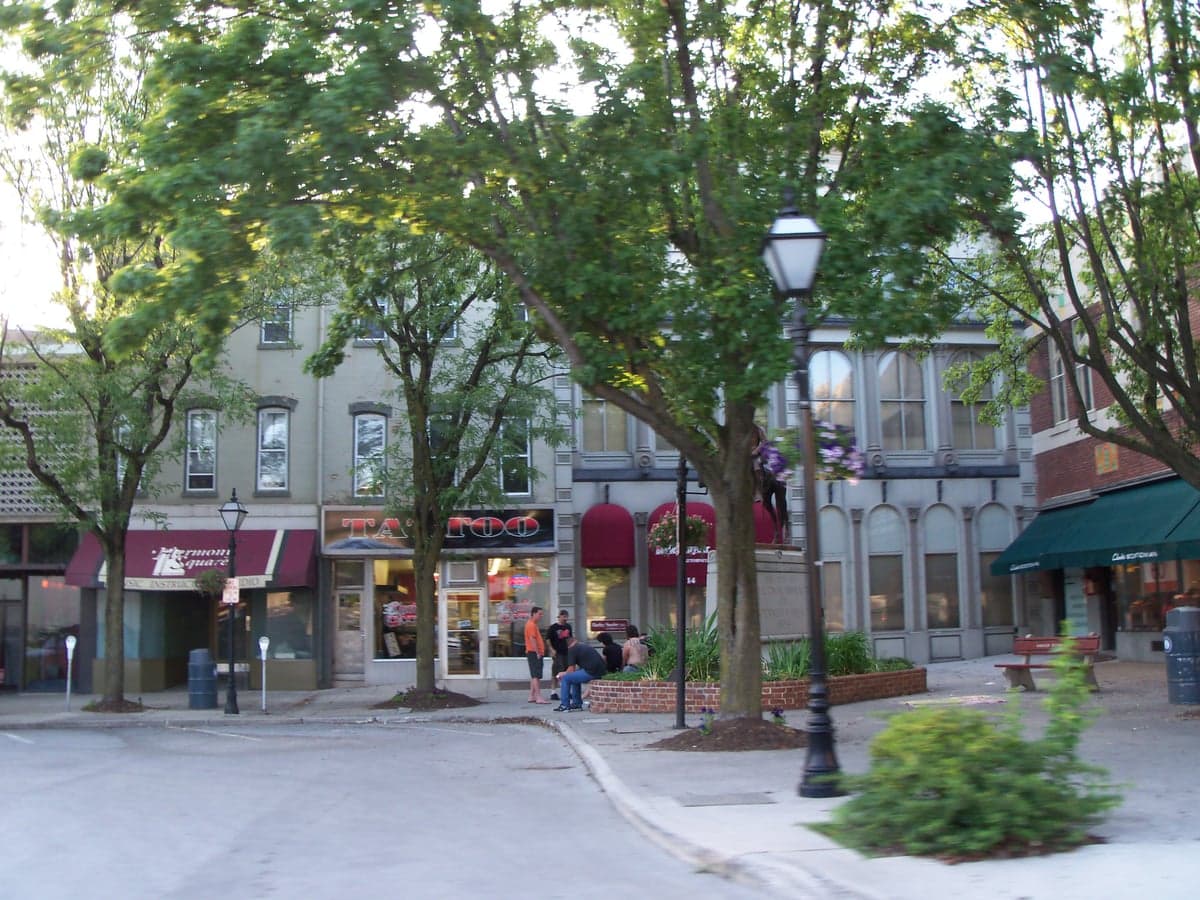
Hanover’s population story begins with German-speaking immigrants, primarily from the Palatinate region, who arrived in the mid-18th century. These settlers were drawn by William Penn’s promise of religious tolerance and fertile farmland in the Codorus Creek valley. The original town, laid out in 1763 by Colonel Richard McAllister, quickly became a market and trade hub. The first wave of German settlers built the Center Square district, with its iconic 1891 town clock, and established the York Street corridor as the commercial spine. A second wave of German and Swiss immigrants arrived in the 1830s and 1840s, settling in the West End neighborhood, where they built the brick row homes and churches that still define the area. The arrival of the railroad in the 1850s and the rise of local industries—shoe factories, cigar rolling, and later the Hanover Shoe Company—drew a small number of Irish and Italian laborers, who concentrated in the East Side near the rail yards. By 1900, the population had reached roughly 5,000, and the city’s German character was firmly cemented.
Modern era (post-1965)
The post-1965 period brought modest demographic change to Hanover. The 1965 Hart-Celler Act did not trigger a large influx of foreign-born residents; the foreign-born share today remains just 2.0%, far below the national average. Instead, the most significant shift has been domestic: the growth of the Hispanic population, now at 10.4%. This community began forming in the 1990s and 2000s, driven by employment in local food processing plants (notably Utz and Snyder’s-Lance) and warehouse logistics. Hispanic residents have concentrated in the South Side neighborhood, south of the railroad tracks, and in the Penn Street area, where a small cluster of Mexican and Central American restaurants and bodegas has emerged. The Black population, at 2.7%, is largely concentrated in the East Side and a few blocks near the Carlisle Street corridor, reflecting historic housing patterns. The East/Southeast Asian population (1.4%) is small and dispersed, with no single ethnic enclave. White flight to surrounding townships—such as Penn Township and Conewago Township—has been a steady trend since the 1970s, leaving the city itself with a slightly more diverse but still overwhelmingly white core.
The future
Hanover’s population is likely to remain stable or decline slightly over the next 10–20 years, as the city’s aging white population (median age ~40) is not being replaced by younger families at a high rate. The Hispanic share is expected to continue growing slowly, potentially reaching 15–18% by 2040, driven by ongoing demand for warehouse and food-processing labor. However, the city is not tribalizing into distinct ethnic enclaves; rather, the Hispanic population is gradually assimilating into the broader working-class fabric, with second-generation residents increasingly moving to the West End and North Side neighborhoods. The East/Southeast Asian and Black populations are likely to remain small and stable. The biggest demographic wildcard is the potential for new housing developments on the city’s fringe—such as the Grandview area—which could attract younger white families from the surrounding townships back into the city limits.
For someone moving in now, Hanover is a stable, culturally conservative community where German heritage still shapes local festivals, church life, and social norms. The city is not becoming a diverse melting pot but rather a slowly graying, modestly Hispanic-influenced working-class town. New residents will find a place where neighborly familiarity and a strong sense of local identity remain the dominant social forces.

* Values derived from national, state, county, city and local statistics and may differ in a specific area. Last updated: 2026-04-19T10:23:21.000Z
Narrative content on this page is AI-generated and may contain mistakes. Verify any details that matter before acting on them.
ReloMaps may earn a commission from affiliate links at no extra cost to you.

