
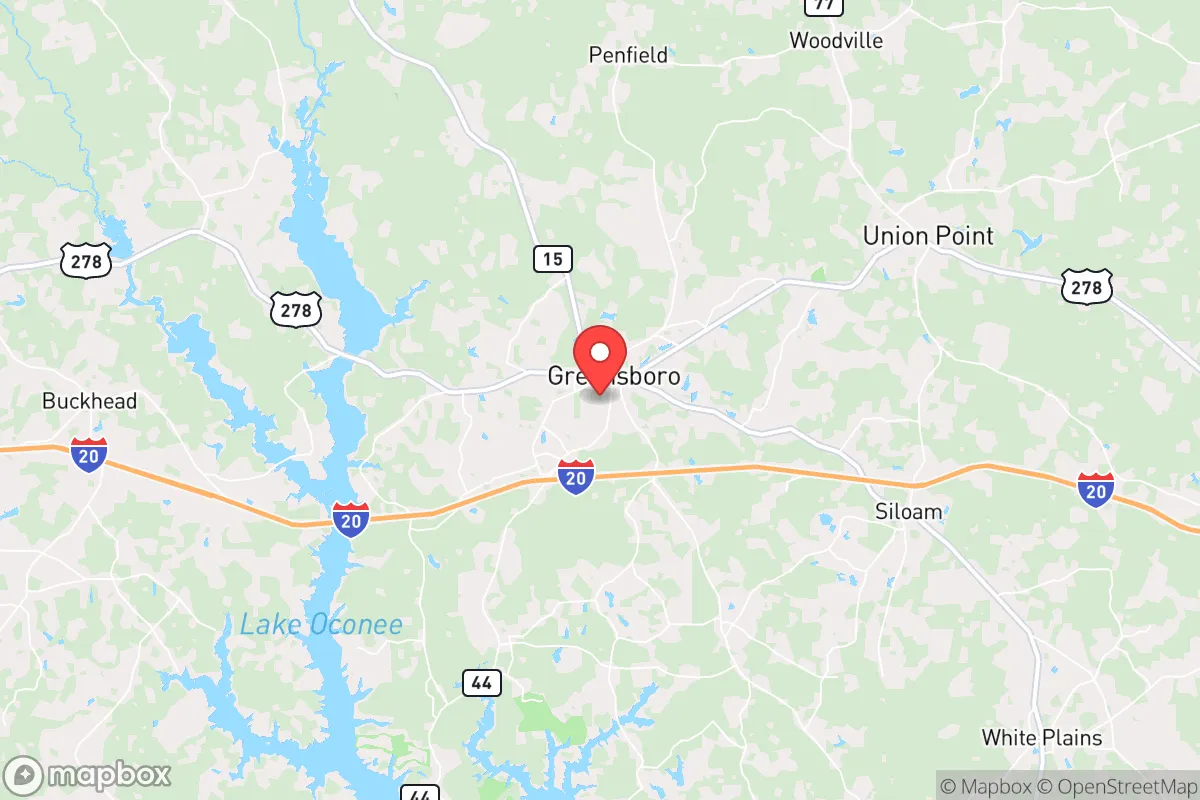
Photo: Wikipedia
Personal Sovereignty in Greensboro, GA
Viable for self-reliance. Generally workable, though some barriers may limit total independence.
What does Personal Sovereignty tell us?
Personal Sovereignty measures your capacity for self-reliance and independence with minimal government friction. Higher scores mean fewer barriers between you and the way you want to live... but it assumes you have the space you need and good neighbors.
What does this tell us?
Personal Sovereignty measures your capacity for self-reliance and independence with minimal government friction. Higher scores mean fewer barriers between you and the way you want to live... but it assumes you have the space you need and good neighbors.
State Policy
Energy independence: Importer (12% of energy produced in-state)
Personal Liberty
Homesteading

Personal Liberty Analysis
Greensboro, Georgia, offers a notably high degree of personal sovereignty, grounded in Georgia’s broader legal framework that favors limited government, strong property rights, and individual self-defense. For a relocation audience prioritizing autonomy, this Greene County seat presents a regulatory environment that is light-touch by national standards, though not entirely unregulated. The combination of a low state and local tax burden, permissive gun laws, and a rural zoning landscape creates a setting where self-reliance is both legally protected and practically feasible, making it a compelling option for those seeking to maximize personal freedom within a conservative-leaning state.
Tax burden and regulatory posture: How light is the government footprint?
Georgia’s state-level tax structure is designed to minimize the government’s claim on personal income and property. The state levies a flat income tax rate of 5.49%, which is scheduled to decline to 4.99% by 2029, and there is no state-level estate or inheritance tax. For a single individual or family in Greensboro, the effective tax burden is further reduced by a relatively low property tax rate. Greene County’s millage rate for unincorporated areas and the city of Greensboro is around 12.5 to 13.5 mills, which translates to roughly $1,250 to $1,350 per $100,000 of assessed value. This is significantly lower than many metro Atlanta counties, where rates can exceed 30 mills. Sales tax in Greensboro is 7%, composed of the 4% state rate plus local option taxes, which is moderate for Georgia. The regulatory posture at the county level is generally permissive. Greene County does not impose a county-wide building code for single-family homes in unincorporated areas, though the city of Greensboro does enforce the International Residential Code (IRC). This means that outside city limits, a property owner has substantial latitude in construction methods, provided they meet basic state health and safety requirements for septic systems and wells. Business licensing is straightforward, with no county-level occupational tax for most home-based enterprises, though a state business license is required for certain regulated professions. Overall, the government footprint here is light, with a clear preference for low taxes and minimal bureaucratic hurdles.
Self-defense and gun law specifics: What are the legal protections?
Georgia is a strong Second Amendment state with a legal framework that heavily favors the individual’s right to self-defense. The state has permitless carry, meaning any legal resident 21 or older can carry a concealed or open firearm without a license. For those who still want a Georgia Weapons Carry License (WCL) for reciprocity with other states, Greene County’s probate court issues them with a typical turnaround of 30-60 days. The state’s “Stand Your Ground” law is unambiguous: there is no duty to retreat in any place where a person is lawfully present, and the use of deadly force is justified if a person reasonably believes it is necessary to prevent imminent death or great bodily harm to themselves or others. Castle Doctrine protections extend to vehicles and places of work, not just the home. There are no state-level restrictions on magazine capacity, no assault weapon bans, and no firearm registration requirements. Private firearm sales between individuals do not require a background check. For a resident of Greensboro, this means the legal environment for self-defense is among the most permissive in the country. The only notable restriction is that carrying a firearm into a place of worship is prohibited unless the church authorizes it, and carrying on school property is generally prohibited except in a vehicle parked on the lot. For a reader prioritizing self-defense autonomy, Greensboro offers a legal framework that places few barriers between the individual and their right to protect themselves.
Self-reliance and homesteading viability: Lot sizes, zoning, and off-grid feasibility
Greensboro’s rural character makes it highly viable for homesteading and self-reliant living. In unincorporated Greene County, there is no minimum lot size for single-family residential use, though the health department requires at least one acre for a conventional septic system and well. Many properties in the county are available in 2- to 10-acre parcels, which are ideal for gardens, small livestock, and woodlots. Zoning is minimal: the county has no agricultural zoning district, meaning that keeping chickens, goats, or even a few cattle is generally permitted on residential property as long as it does not constitute a commercial operation that would require a business license. The city of Greensboro does have zoning, but its agricultural and residential zones allow for small-scale animal husbandry. Off-grid feasibility is high. Georgia law does not require a connection to a municipal water or sewer system, and many rural properties rely on private wells and septic. Solar panels are legal and unregulated at the county level, though the city requires a building permit for roof-mounted systems. Rainwater collection is explicitly legal under state law (O.C.G.A. § 12-5-121), and there are no restrictions on composting toilets or greywater systems, provided they meet basic health codes. The main constraint is the Georgia Department of Natural Resources’ Environmental Protection Division, which regulates well drilling and septic system installation, but these are one-time permitting processes, not ongoing restrictions. For a family seeking to reduce dependence on utilities and grocery stores, Greensboro’s regulatory environment is highly accommodating.
Personal liberties: Parental rights, medical autonomy, speech, and property
Georgia law provides strong protections for personal liberties that resonate with a conservative-leaning audience. Parental rights are explicitly recognized in state statute (O.C.G.A. § 20-2-780), which affirms that parents have the fundamental right to direct the upbringing, education, and health care of their children. This includes the ability to opt out of school curricula or activities that conflict with their religious or moral beliefs, though the process requires a written request to the local school board. Greene County Schools, which serves Greensboro, has a conservative school board that generally defers to parental authority. Medical autonomy is similarly protected. Georgia does not have a state-level vaccine mandate for adults, and while certain vaccines are required for school attendance, medical and religious exemptions are available. The state’s “Right to Try” law allows terminally ill patients to access experimental treatments, and there are no state-level restrictions on the purchase of dietary supplements or herbal remedies. Free speech is protected under the Georgia Constitution, which contains its own free speech clause that has been interpreted by state courts as at least as protective as the First Amendment. There are no local ordinances restricting political signs, though the city of Greensboro has a 30-day limit on temporary signs. Property rights are robust: Georgia is a “Dillon’s Rule” state, meaning local governments only have powers expressly granted by the state, which limits the ability of county or city officials to impose restrictive land-use regulations. Eminent domain is strictly limited to public uses like roads and utilities, and the state constitution prohibits the taking of private property for economic development purposes. For a reader who values these specific liberties, Greensboro’s legal environment is supportive and predictable.
Compared to other areas in the Southeast, Greensboro offers a notably high degree of personal sovereignty, particularly in the areas of self-defense, property rights, and low taxation. The regulatory environment is light but not absent, with the main constraints being state-level health and safety codes rather than local overreach. For a single individual or family who prioritizes autonomy and self-reliance, this Greene County community provides a legal and practical foundation that is difficult to match in more urbanized or heavily regulated states. The combination of permissive gun laws, homesteading feasibility, and strong parental rights makes Greensboro a strategic choice for those seeking to maximize personal freedom within a stable, conservative legal framework.

* Values derived from national, state, county, city and local statistics and may differ in a specific area. Last updated: 2026-08-17T20:13:03.000Z
Narrative content on this page is AI-generated and may contain mistakes. Verify any details that matter before acting on them.
ReloMaps may earn a commission from affiliate links at no extra cost to you.

