Photo: Wikipedia
Demographics of Greenbelt, MD
Affluence Level in Greenbelt, MD
A middle-class area roughly in line with national averages across income, home values, education, and employment.
People of Greenbelt, MD
Greenbelt, Maryland, is a city of 24,572 residents that stands out as one of the most racially and ethnically diverse communities in Prince George’s County, with a population that is 45.4% Black, 20.7% White, 17.1% Hispanic, 6.3% East/Southeast Asian, and 2.7% Indian. It is a densely settled, majority-renter city (over 60% of housing units are rentals) with a highly educated workforce—46.1% of adults hold a bachelor’s degree or higher. Originally a New Deal planned community, Greenbelt today is a majority-minority city where government employment, proximity to Washington D.C., and a strong sense of civic identity define daily life.
How the city was settled and grew
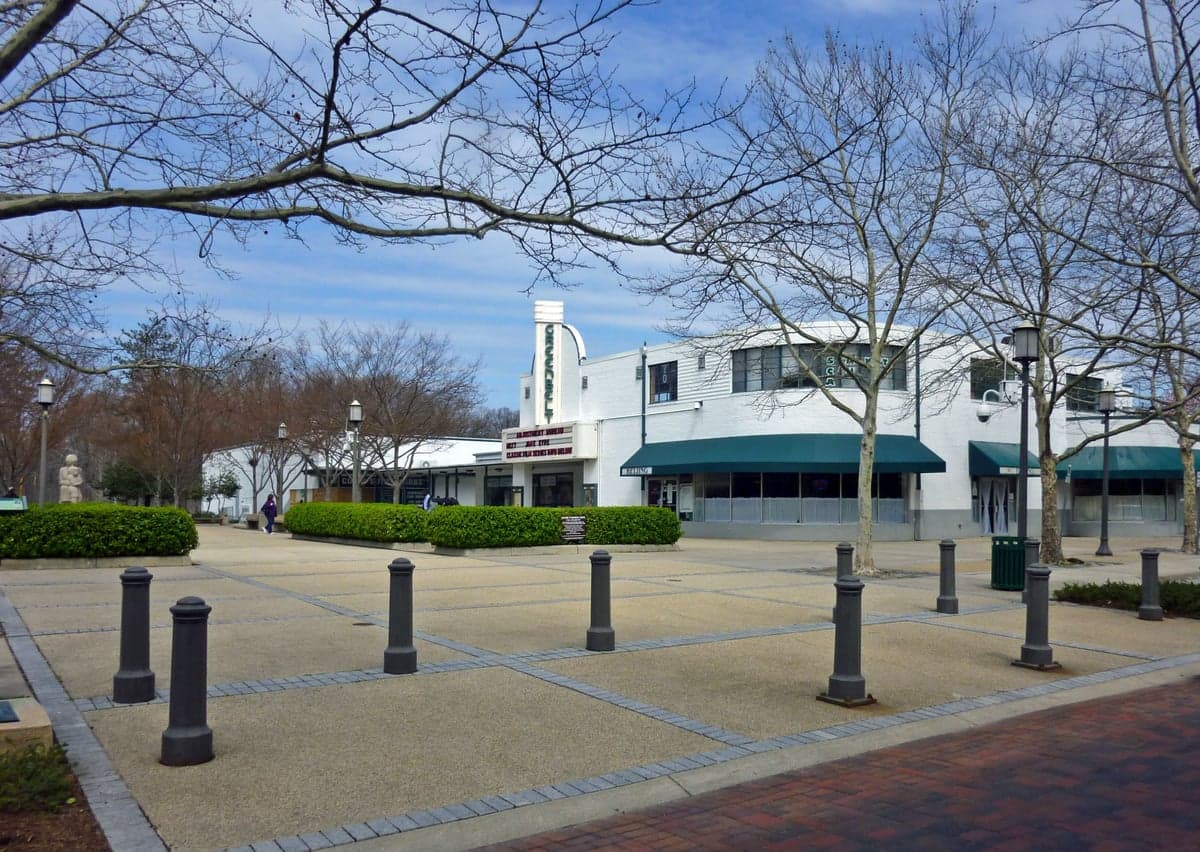
Greenbelt was not a gradual settlement but a deliberate federal experiment. In 1935, the U.S. government under President Franklin Roosevelt acquired 3,200 acres of farmland in Prince George’s County to build one of three “greenbelt towns”—planned suburbs designed to provide affordable housing for low- and moderate-income workers during the Great Depression. The first residents, who moved in between 1937 and 1938, were overwhelmingly White, native-born, and employed in federal government agencies such as the Department of Agriculture and the Navy. They settled in the Old Greenbelt historic district, a compact core of Art Deco and International Style rowhouses and apartments arranged around a central shopping center and green spaces. This original population was carefully screened for income and employment stability, creating a homogenous community of government clerks, engineers, and professionals. During World War II, the city expanded with temporary housing for defense workers, and by the 1950s, the Greenbelt West neighborhood (also called West Greenbelt) was developed with single-family homes to accommodate the postwar baby boom, still predominantly White and middle-class.
Modern era (post-1965)
The 1965 Immigration and Nationality Act, combined with the Civil Rights movement and the expansion of the D.C. federal workforce, fundamentally reshaped Greenbelt’s population. Starting in the late 1960s, Black families began moving into Greenbelt East and the Springhill Lake apartment complex, a large garden-apartment development built in the 1960s that became a gateway for middle-class African American families seeking suburban schools and jobs. By 1980, the city was roughly 40% Black, and White flight to outer suburbs accelerated through the 1990s. The 1990s and 2000s saw a surge of Hispanic and East/Southeast Asian immigration, primarily into the Greenbelt Station area (near the Metro station) and the Lakeland neighborhood, a historically Black enclave that became more diverse. Today, the Indian subcontinent community (2.7% of the population) is concentrated in newer condo developments near the Greenbelt Metro station and along Cherrywood Lane, drawn by tech and government jobs. The East/Southeast Asian population (6.3%) includes Vietnamese, Korean, and Filipino families, many of whom settled in the Greenbelt East and Springhill Lake areas. The foreign-born share of 17.2% is higher than the Maryland state average (15.5%), reflecting the city’s role as an affordable, transit-connected entry point for immigrants.
The future
Greenbelt’s population is trending toward greater diversity but also toward economic bifurcation. The city’s Black population share has stabilized around 45%, while the White share has continued to decline slowly (from 25% in 2010 to 20.7% today). The Hispanic share is growing steadily, driven by both domestic migration and immigration from Central America, and is projected to reach 20-22% by 2035. The East/Southeast Asian and Indian communities are growing more slowly, primarily through in-migration from other parts of the D.C. region rather than direct immigration. The city is not homogenizing; instead, distinct enclaves are persisting: Old Greenbelt remains majority White and older, Springhill Lake is majority Black and Hispanic, and the Greenbelt Station area is the most ethnically mixed, with a growing Asian and Indian presence. The major demographic wildcard is the planned redevelopment of the Greenbelt Metro station area, which will add 1,500+ new housing units—likely attracting younger, higher-income professionals, many of whom will be White or Asian, potentially shifting the racial balance slightly. The city’s population is expected to grow to roughly 27,000 by 2040, with the foreign-born share remaining stable or increasing modestly.
For someone moving in now, Greenbelt is a city that has fully transitioned from a planned White government-worker enclave to a majority-minority, immigrant-rich suburb. It is not a gentrifying frontier or a declining inner ring—it is a stable, diverse, middle-class community where government employment, rental housing, and transit access anchor the economy. The population is becoming slightly more Hispanic and slightly less White, but the core identity as a Black-majority, highly educated, and politically progressive city is unlikely to change in the next decade. New residents should expect a dense, walkable core in Old Greenbelt, a sprawling apartment landscape in Springhill Lake, and a transit-oriented future around the Metro station.

* Values derived from national, state, county, city and local statistics and may differ in a specific area. Last updated: 2026-04-22T01:16:10.000Z
Narrative content on this page is AI-generated and may contain mistakes. Verify any details that matter before acting on them.
ReloMaps may earn a commission from affiliate links at no extra cost to you.

