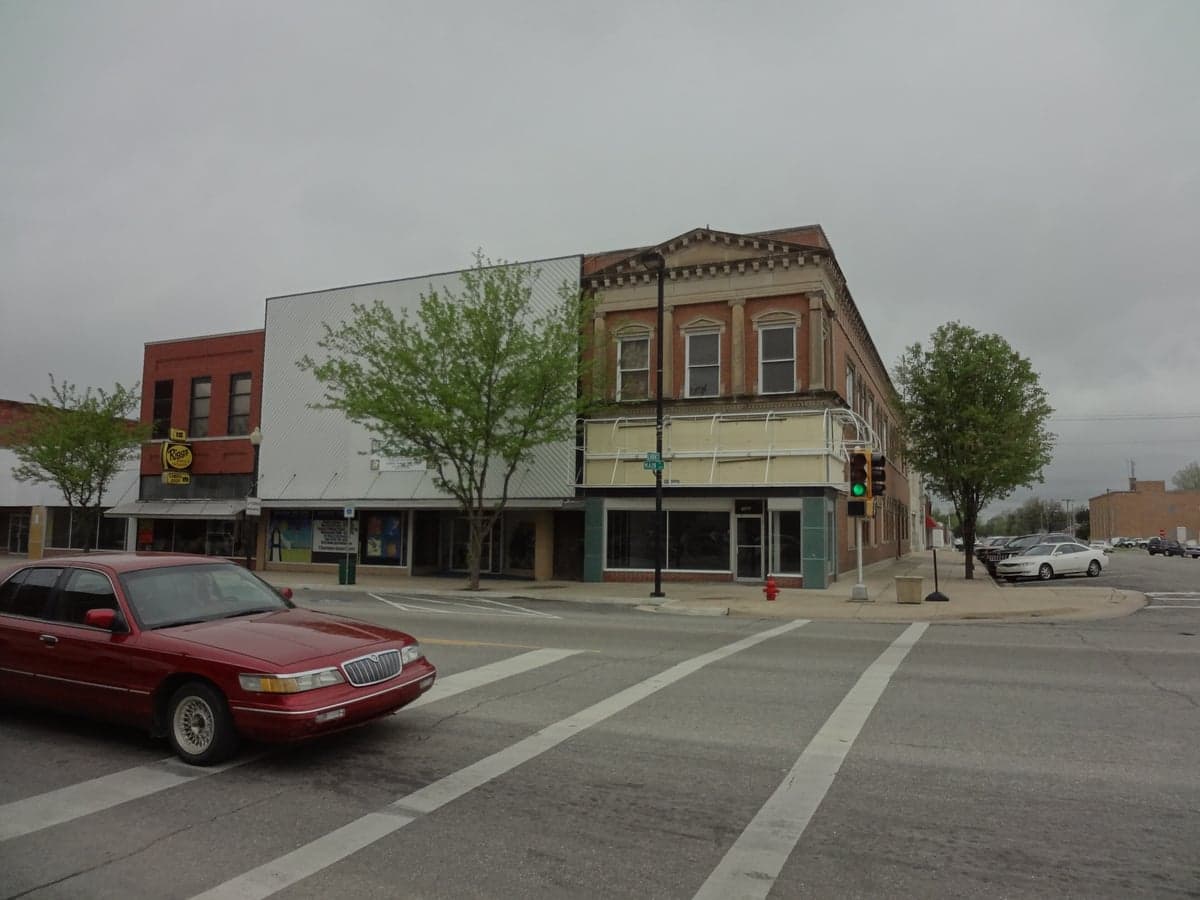
Photo: Wikipedia
Political ClimatePolitical Climate in Great Bend, KS
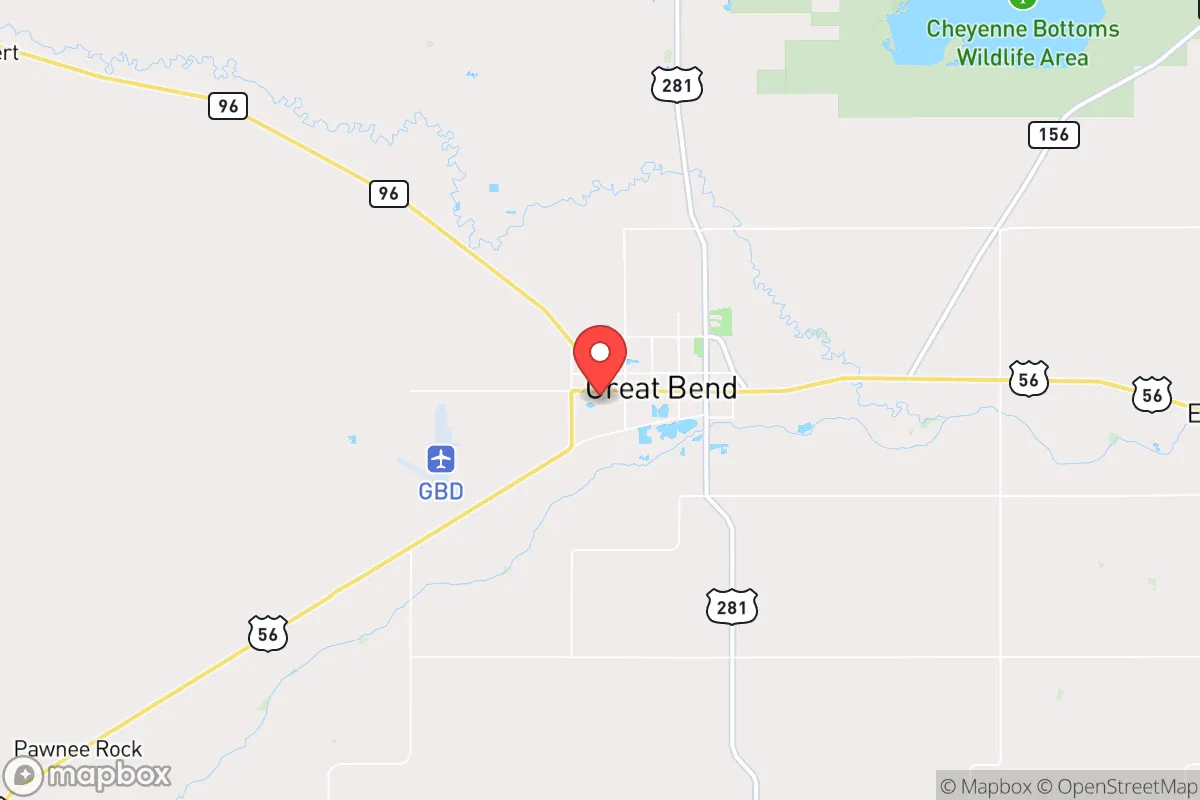
District shown is the primary district for this city’s centroid. Cities may span multiple districts.
Local Political AnalysisPolitical Analysis of Great Bend, KS
Great Bend, Kansas, sits solidly in the red, with a Cook PVI of R+16 that reflects a deeply ingrained conservative tradition. This isn't a recent shift; the area has long prioritized personal responsibility, limited government, and a way of life that resists the progressive trends seen in places like Lawrence or Kansas City. While the national winds have blown leftward in recent cycles, Great Bend has held its ground, and if anything, the local sentiment has hardened against what many see as government overreach into personal freedoms and rights.
How it compares
To understand Great Bend's political climate, you have to look at the surrounding region. Barton County itself is a Republican stronghold, but the real contrast comes when you drive an hour east to Salina or two hours south to Wichita. Salina, while still conservative, has seen a noticeable uptick in progressive activism, especially around local school board races and city council decisions. Wichita, as the state's largest city, has pockets of deep blue influence, particularly in its core. Great Bend, by contrast, feels like a time capsule of older Kansas values. The nearby towns of Hoisington and Ellinwood lean even more conservative, but Great Bend is the anchor. The difference isn't subtle—it's in the way people talk about taxes, property rights, and the role of government in daily life. There's a palpable distrust of any policy that feels like it's coming from Topeka or Washington, D.C., and that sentiment has only grown stronger since the pandemic-era mandates.
What this means for residents
For someone moving here, the political climate means a few concrete things. First, you can expect low taxes and a local government that generally stays out of your business. The city council and county commission are dominated by fiscal conservatives who view government expansion as a threat to personal liberty. Second, you'll find a community that values self-reliance—neighbors help neighbors, but there's little appetite for large-scale social programs. Third, and this is the part that worries some longtime residents, there's a creeping concern that outside influences are testing the local culture. You see it in debates over library content, school curriculum, and zoning laws. The fear is that a few vocal activists, often backed by national money, could push Great Bend toward the kind of progressive policies that have eroded freedoms in places like Johnson County. So far, the community has held the line, but it requires constant vigilance. The local elections matter more here than in most places because the stakes are about preserving a way of life.
Culturally, Great Bend stands apart from the state's urban centers in its emphasis on faith, family, and firearms. The Second Amendment isn't just a talking point here; it's a lived reality, with most households owning guns for hunting, sport, and protection. The local churches—predominantly Catholic and mainline Protestant—are community anchors, not just Sunday destinations. There's also a strong agricultural backbone that shapes the political worldview: when your livelihood depends on weather, markets, and hard work, you tend to view government intervention as a hindrance, not a help. The long-term trajectory depends on whether the next generation stays or leaves for the coasts. If they stay, Great Bend will likely remain a conservative bulwark. If they leave, and new arrivals bring different values, the political character could shift. For now, it's a place where personal freedom still means something, and where the default answer to "should the government do that?" is a firm "no."

State Political ClimatePolitical Climate in Kansas
State Political AnalysisPolitical Environment in the State
Kansas has long been a reliably Republican state at the presidential level, voting for the GOP candidate in every election since 1968 except for 1992 and 2008, but the state’s political climate is far more nuanced than a simple red-state label suggests. Over the past 10-20 years, the dominant coalition has been a mix of traditional fiscal conservatives, rural social conservatives, and a growing suburban moderate wing, creating a persistent tension between the state’s deeply red rural areas and its increasingly purple urban centers. The 2022 gubernatorial race, where Democrat Laura Kelly won re-election while Republicans swept every other statewide office, perfectly captures this split—the state is not trending uniformly blue, but the old-school conservative dominance is being challenged by a more pragmatic, business-friendly conservatism in the suburbs.
Urban vs. rural divide
The political map of Kansas is a textbook study in geographic polarization. The eastern third of the state, anchored by Kansas City (Wyandotte County) and Lawrence (Douglas County), is the Democratic stronghold—Wyandotte County gave Biden 63% of the vote in 2020, while Douglas County hit 68%. These are the only two counties that consistently vote blue, driven by union households, university faculty, and a growing minority population. In contrast, the vast rural expanse—places like Garden City in Finney County, Dodge City in Ford County, and Colby in Thomas County—votes Republican by margins of 70-80%, fueled by agriculture, energy, and a strong social conservative base. The real battleground is the suburban ring around Kansas City, particularly Johnson County (Overland Park, Lenexa, Olathe). Johnson County, once a GOP lock, has shifted from +22 R in 2012 to +4 R in 2020, making it the epicenter of suburban moderation. Wichita (Sedgwick County) is a microcosm of the state: the city itself leans slightly Democratic, but the surrounding suburbs and rural areas keep the county red by about 10 points. Topeka (Shawnee County) is a toss-up, with the state capital’s government workforce and union presence balancing out the rural precincts.
Policy environment
Kansas’s policy environment is a mixed bag for conservatives. The state has a flat income tax rate of 5.7% (down from 6.45% in 2022), and the sales tax is 6.5% statewide, but local add-ons can push it over 10% in cities like Overland Park. The property tax burden is moderate, but there’s no homestead exemption for primary residences, which frustrates homeowners. On the regulatory front, Kansas is generally business-friendly, with a right-to-work law and no state-level minimum wage above the federal $7.25. Education policy is a flashpoint: the state has school choice through charter schools and a tax-credit scholarship program for private school tuition, but the Kansas Supreme Court has repeatedly forced the legislature to increase K-12 funding, leading to a $5 billion budget surplus that some conservatives see as overtaxation. Healthcare is a sore spot—Kansas has not expanded Medicaid under the Affordable Care Act, a win for fiscal conservatives, but the state’s rural hospitals are struggling, and the uninsured rate sits at 9.5%. Election laws are solid: voter ID is required, there’s no same-day registration, and the state purges inactive voters regularly. The 2021 law banning ballot drop boxes except in county election offices was a clear win for election integrity advocates.
Trajectory & freedom
On the freedom front, Kansas has been a mixed bag over the last five years, with some clear wins and some concerning backslides. The biggest win for personal liberty was the 2022 passage of the Second Amendment Protection Act (HB 2579), which prohibits state and local enforcement of any federal gun laws that infringe on the right to keep and bear arms—a direct challenge to federal overreach. The state also passed a parental rights bill (SB 496) in 2023, requiring schools to notify parents of any changes to a student’s health or well-being, including gender identity discussions. On the medical autonomy front, Kansas voters overwhelmingly rejected a constitutional amendment in 2022 that would have removed the right to abortion, preserving the state Supreme Court’s 2019 ruling that protects abortion access under the state constitution—a loss for pro-life advocates. Taxation freedom took a hit when the 2012-2017 “Kansas Experiment” of zero income tax for pass-through businesses was repealed after budget crises, but the flat tax rate is still a win for simplicity. Property rights are generally strong, with no statewide rent control and a relatively straightforward eminent domain process. The concerning trend is the growing influence of the state’s regulatory bureaucracy, particularly in environmental permitting and occupational licensing, which can feel like a slow creep of government control.
Civil unrest & political movements
Kansas has seen its share of political flashpoints, but nothing approaching the scale of coastal states. The most visible movement in recent years has been the anti-vaccine mandate protests in 2021-2022, particularly in Wichita and Topeka, where thousands gathered at the state capitol to oppose COVID-19 mandates and school closures. These protests were largely peaceful but energized the libertarian and conservative grassroots. On the left, the Kansas Abortion Access Fund and groups like Planned Parenthood Great Plains have been highly active, organizing bus trips to Colorado for out-of-state patients and holding regular rallies in Lawrence and Kansas City. Immigration politics are relatively quiet compared to border states, but Garden City and Dodge City have seen tensions over meatpacking plant labor, with some local officials pushing for stricter enforcement. There’s no sanctuary city movement of note—Kansas law prohibits sanctuary policies, and local sheriffs generally cooperate with ICE. Election integrity controversies flared after 2020, with the Kansas GOP launching a “forensic audit” of the 2020 election in Johnson County, which found no evidence of widespread fraud but did highlight administrative errors. The state’s Kansas State Rifle Association is a powerful force, regularly organizing at the capitol and holding training events in Salina and Hays.
Projection
Looking ahead 5-10 years, Kansas is likely to become more politically competitive, but not necessarily more liberal. The key demographic shift is the continued growth of Johnson County, which is adding 10,000-15,000 new residents annually, many from blue states like California and Illinois. These newcomers tend to be fiscally conservative but socially moderate, which could push the state toward a more pragmatic, less ideological conservatism. The rural population is shrinking, with counties like Cheyenne and Rawlins losing 5-10% of their population per decade, which will gradually reduce the rural conservative vote share. However, the state’s in-migration is still overwhelmingly from other red states, and the Kansas GOP is likely to maintain control of the legislature through 2030 due to gerrymandered maps. The wild card is the state Supreme Court—if the court continues to strike down conservative legislation on education funding and abortion, expect a push for judicial retention reform or even a constitutional amendment to limit the court’s power. A new resident moving in now should expect a state that remains solidly red on most issues, but with a growing suburban moderate wing that could make primary elections more interesting and general elections more competitive.
For a conservative-leaning individual or family considering a move to Kansas, the bottom line is this: you’ll find a state that generally respects your right to live your life without heavy-handed government interference, especially on guns, taxes, and parental rights. The urban-rural divide means you can choose your preferred political environment—deep red in the small towns, purple in the suburbs, or blue in the cities. The biggest practical takeaway is to pay attention to local school board and county commission races, as those are where the real battles over curriculum, property taxes, and land use are fought. Kansas isn’t Texas or Florida in terms of aggressive conservative policy, but it’s a solid, stable place where your freedoms are largely protected and your vote actually counts in a state that’s still competitive enough to keep politicians honest.
* Values derived from national, state, county, city and local statistics and may differ in a specific area. Last updated: 2026-04-29T18:44:47.000Z
Narrative content on this page is AI-generated and may contain mistakes. Verify any details that matter before acting on them.
ReloMaps may earn a commission from affiliate links at no extra cost to you.

