Photo: Wikipedia
Demographics of Great Bend, KS
Affluence Level in Great Bend, KS
A below-average socioeconomic profile. Incomes, home values, and educational attainment trail the U.S., with higher poverty and unemployment.
People of Great Bend, KS
The people of Great Bend, Kansas, today number 14,596, forming a community that is predominantly white (70.1%) with a substantial and growing Hispanic minority (25.0%). The city’s identity is rooted in its agricultural and railroad heritage, reflected in a lower-than-average college attainment rate of 20.9% and a small foreign-born population of 3.6%. This is a stable, family-oriented community where a strong sense of local history and a conservative, self-reliant ethos remain central to daily life.
How the city was settled and grew
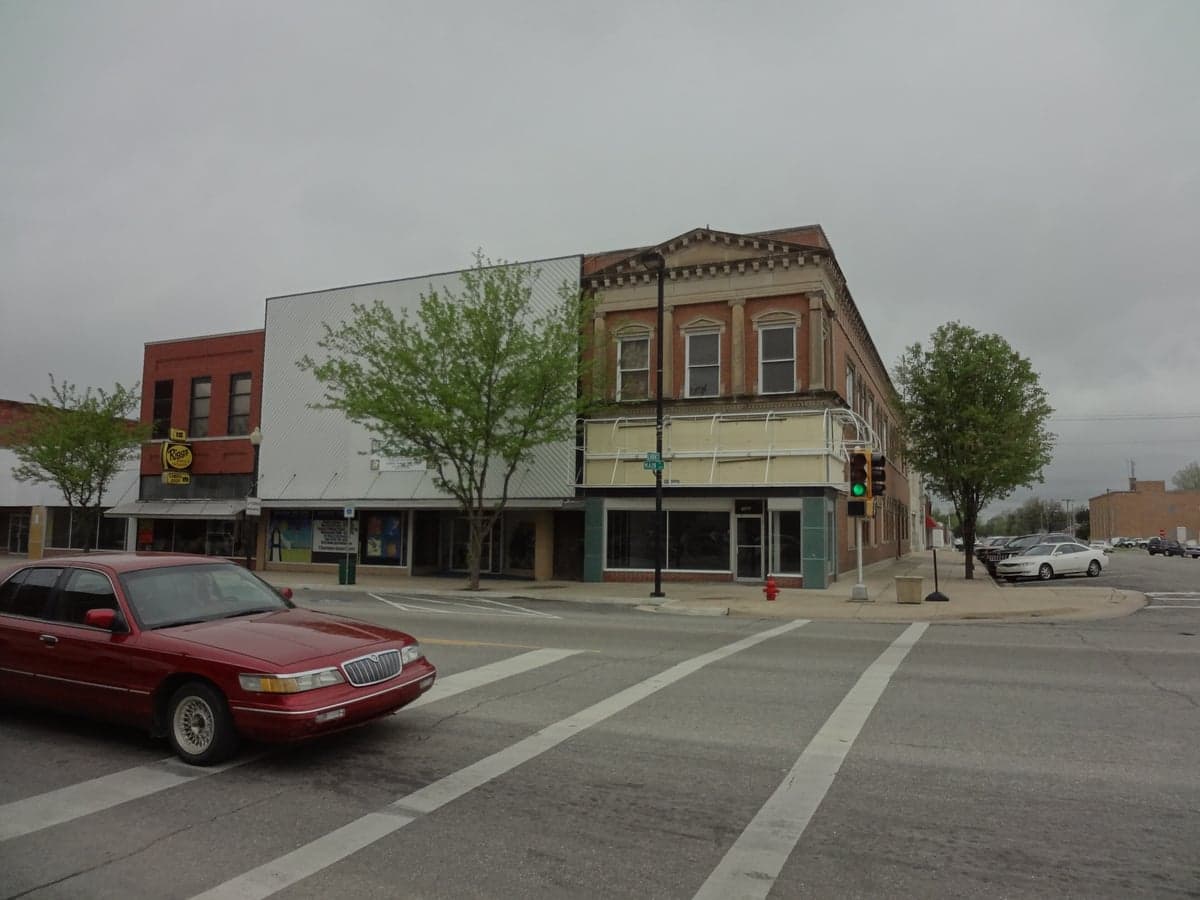
Great Bend’s human history begins with the Santa Fe Trail, which passed through the area in the 1820s, but permanent settlement did not take hold until the arrival of the railroad. The city was officially founded in 1871 as a stop on the Atchison, Topeka and Santa Fe Railway, which drew a wave of Anglo-American homesteaders and merchants. These early settlers, largely of German, Irish, and English stock, built the original downtown core around what is now Lakin Avenue and the adjacent Railroad District, where grain elevators and stockyards anchored the economy. A second wave arrived in the 1880s and 1890s, composed of German-Russian Mennonite families fleeing religious persecution in the Russian Empire. These skilled wheat farmers established the Mennonite Settlement area on the city’s south and east sides, bringing with them the hard red winter wheat varieties that would transform Kansas agriculture. By 1900, Great Bend was a thriving agricultural service center, with a population of roughly 2,500, almost entirely white and native-born.
Modern era (post-1965)
The post-1965 period brought the most significant demographic shift in Great Bend’s history: the arrival of Hispanic families, primarily of Mexican and Central American origin. This migration was driven by labor demand in the region’s meatpacking plants and agricultural fields, particularly at the Iowa Beef Processors (IBP) plant (now Tyson Fresh Meats) that opened in the 1970s. Hispanic workers and their families settled predominantly in the West Side neighborhoods near the plant and along 10th Street, creating a distinct enclave that today accounts for the city’s 25.0% Hispanic share. Unlike many Midwestern towns that saw white flight, Great Bend experienced a more gradual integration, with many Anglo families remaining in the North Side and East Side neighborhoods established in the early 20th century. The city’s Black population remains minimal at 0.7%, and East/Southeast Asian communities (0.4%) and Indian subcontinent residents (0.1%) are present only in very small numbers, largely tied to professional roles at the local hospital or university. The foreign-born share of 3.6% is modest, indicating that most Hispanic residents are now U.S.-born second or third generation.
The future
Great Bend’s population is slowly aging and slightly declining, mirroring rural Kansas trends. The Hispanic share is expected to continue its gradual increase, driven by higher birth rates and continued, if slower, immigration for agricultural and meatpacking work. However, the community is not tribalizing into rigid enclaves; intermarriage and shared civic institutions—particularly the schools and churches—are fostering assimilation. The West Side Hispanic neighborhoods are becoming more mixed as younger Anglo families move into newer housing developments on the city’s fringe. The white population is projected to shrink modestly as older residents pass away and younger adults leave for larger cities, but the overall character of Great Bend—conservative, family-focused, and rooted in agriculture—is likely to persist. The college attainment rate of 20.9% may rise slowly as the local economy diversifies into healthcare and education, but the city will remain a blue-collar and agricultural hub.
For someone moving in now, Great Bend offers a stable, low-crime environment where traditional values and community ties remain strong. The city is becoming slightly more diverse but is not experiencing the rapid demographic change seen in larger Kansas cities. It is a place where a newcomer can expect to be welcomed into a tight-knit, predominantly white and Hispanic community that values hard work, faith, and neighborliness.

* Values derived from national, state, county, city and local statistics and may differ in a specific area. Last updated: 2026-04-29T18:44:47.000Z
Narrative content on this page is AI-generated and may contain mistakes. Verify any details that matter before acting on them.
ReloMaps may earn a commission from affiliate links at no extra cost to you.

