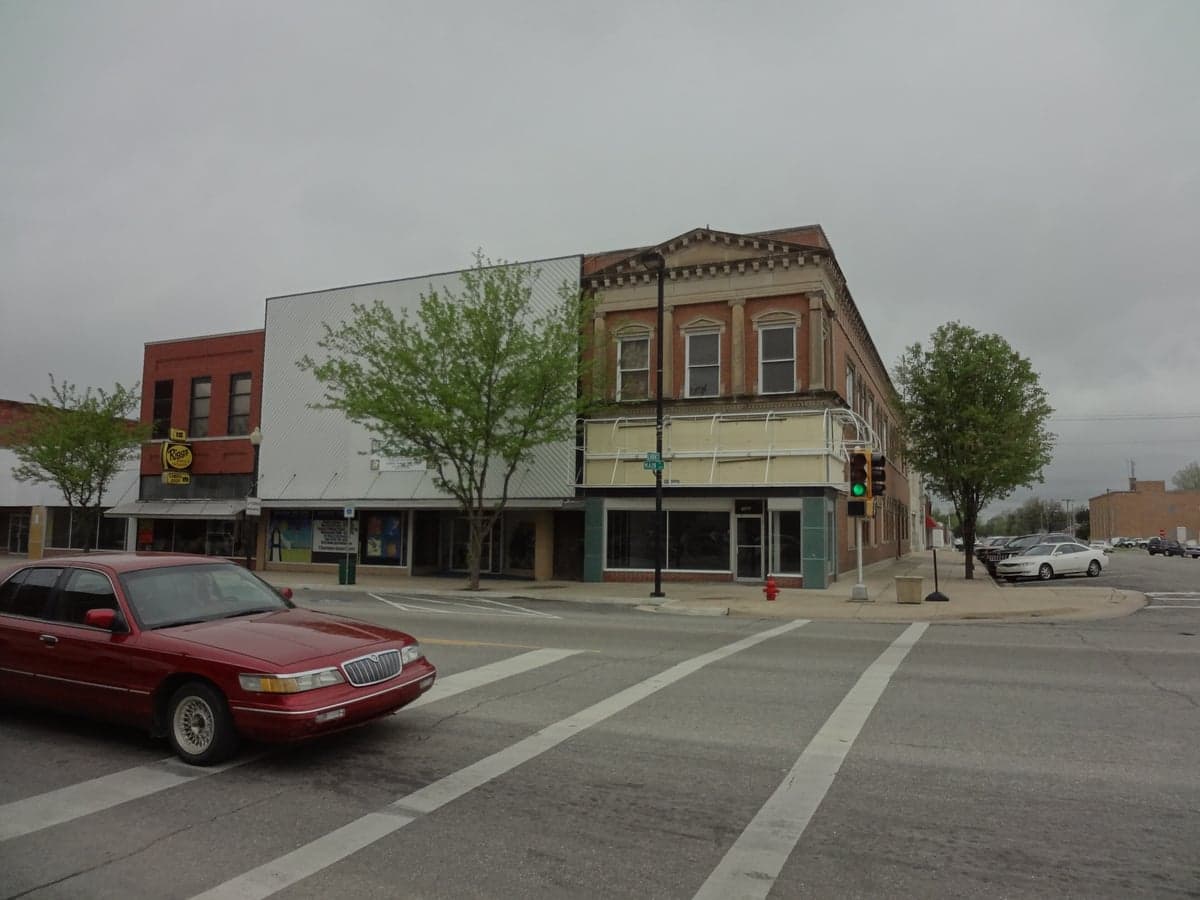
Photo: Wikipedia
Personal Sovereignty in Great Bend, KS
Viable for self-reliance. Generally workable, though some barriers may limit total independence.
What does Personal Sovereignty tell us?
Personal Sovereignty measures your capacity for self-reliance and independence with minimal government friction. Higher scores mean fewer barriers between you and the way you want to live... but it assumes you have the space you need and good neighbors.
What does this tell us?
Personal Sovereignty measures your capacity for self-reliance and independence with minimal government friction. Higher scores mean fewer barriers between you and the way you want to live... but it assumes you have the space you need and good neighbors.
State Policy
Energy independence: Self-sufficient (80% of energy produced in-state)
Personal Liberty
Homesteading

Personal Liberty Analysis
Great Bend, Kansas, offers a notably high degree of personal sovereignty compared to much of the United States, largely due to Kansas’s constitutional protections and a local culture that prizes self-reliance over government intervention. For the strategic relocator—whether a single individual or a parent—this translates into a living environment where the default posture of local government is non-interference, not regulation. The state’s legal framework, combined with the rural ethos of Barton County, creates a zone where personal autonomy in self-defense, property use, and family decisions is the baseline, not the exception. This is not a place where the state is your partner; it is a place where the state is largely absent from your daily life.
Tax burden and regulatory posture: How Kansas compares to high-tax states
Kansas’s tax structure is a significant draw for those seeking to minimize government extraction from their income and property. The state levies a flat personal income tax rate of 5.7% as of 2026, with no progressive brackets that penalize higher earners. Property taxes in Barton County are moderate, with the effective rate on residential property hovering around 1.2% of assessed value—well below the national average and far less than states like Illinois or New York. Sales tax in Great Bend totals 8.5% (state + local), but groceries and prescription drugs are exempt. More importantly, Kansas has no estate tax or inheritance tax, meaning wealth transfers to the next generation remain intact. On the regulatory front, Kansas is a right-to-work state, which limits union power and keeps labor costs predictable for small businesses. Occupational licensing requirements are less burdensome than in coastal states, and the state has actively rolled back environmental regulations on agriculture and small manufacturing. For the prepper or survivalist, this means fewer permits, fewer inspections, and fewer opportunities for the state to assert control over your economic activities. The overall regulatory posture is one of tolerance: unless you are causing a clear public nuisance, local authorities are unlikely to intervene.
Self-defense and gun law specifics: Constitutional carry and castle doctrine in practice
Kansas is one of the strongest states in the nation for self-defense rights, and Great Bend residents enjoy the full spectrum of those protections. The state has permitless constitutional carry for both open and concealed carry for anyone 21 or older who can legally possess a firearm. No permit, training, or background check beyond the federal NICS check at purchase is required for carry. For those who want reciprocity with other states, a Kansas concealed carry license is available and recognized in over 35 states. The castle doctrine is codified in Kansas law, with no duty to retreat in any place where a person is lawfully present—including your vehicle. This means that if an intruder enters your home or occupied vehicle, you are legally presumed to have acted in self-defense if you use deadly force. Stand Your Ground protections extend to public spaces as well. Local law enforcement in Barton County is generally supportive of gun rights; there are no local ordinances that restrict magazine capacity, firearm types, or storage requirements. For the parent, this means you can teach your children firearm safety and marksmanship without fear of legal overreach. The nearest gun ranges and outdoor shooting areas are within a 15-minute drive of downtown Great Bend.
Self-reliance and homesteading viability: Lot sizes, zoning, and off-grid feasibility
Great Bend’s zoning and land-use policies are remarkably permissive for a town of its size, making it a viable location for those pursuing a self-reliant or semi-homesteading lifestyle. Within the city limits, standard residential lots range from one-quarter to one-half acre, and the city code explicitly allows for the keeping of chickens, rabbits, and bees with minimal permitting. Larger livestock such as goats or horses require a property of at least one acre, which is easily found in the unincorporated areas of Barton County just outside town. Zoning for accessory structures—sheds, workshops, greenhouses—is lenient, with no HOA-style restrictions in most neighborhoods. Off-grid feasibility is high: the area receives ample sunlight for solar panels, and well water is accessible on most rural parcels at depths of 100-200 feet. While the city requires connection to municipal water and sewer for in-town properties, rural parcels have no such mandate, allowing for septic systems and rainwater catchment. The county’s building code is based on the International Residential Code but enforcement is light, especially for agricultural outbuildings. For the serious prepper, the surrounding farmland offers parcels of 5 to 40 acres at prices under $5,000 per acre, with no subdivision or minimum dwelling size requirements that would prevent a modest cabin or earth-sheltered home.
Personal liberties: Parental rights, medical autonomy, speech, and property
Kansas has been at the forefront of protecting parental rights in education and healthcare. The state’s Parental Bill of Rights, enacted in 2023, gives parents explicit authority over their children’s medical decisions, educational curriculum access, and the right to opt out of any school activity without penalty. School boards in Barton County are locally elected and responsive to conservative values; there is no state-level mandate for controversial sex education or critical race theory in K-12 classrooms. Medical autonomy is strong: Kansas does not have a state vaccine mandate for adults or children, and there is no statewide mask mandate or business closure authority that can be invoked without legislative approval. The state has also passed laws protecting healthcare workers who decline to participate in procedures they find morally objectionable. On speech and assembly, Kansas is a low-restriction environment. There are no hate speech laws that criminalize political or religious expression, and the state has preempted local governments from enacting their own gun, zoning, or labor ordinances that exceed state law—meaning Great Bend cannot unilaterally impose restrictions that would infringe on property rights or self-defense. Property rights are further protected by Kansas’s strong eminent domain laws, which require a public use finding and full market compensation, with no allowance for economic development takings.
In the broader landscape of American personal sovereignty, Great Bend ranks among the top tier of small towns for those who prioritize freedom from government overreach. Compared to the Pacific Northwest or the Northeast, where regulatory density and cultural pressure toward conformity are high, Great Bend offers a breathing room that is increasingly rare. The trade-off is limited economic diversity and a slower pace of life, but for the survivalist or conservative parent seeking a location where the state is a distant presence rather than a daily manager, this central Kansas community delivers a sovereignty profile that is both legally robust and culturally reinforced. It is not a libertarian utopia—taxes still exist, and the federal government still has reach—but it is a place where a determined individual can live largely on their own terms, with minimal interference from the local or state apparatus.

* Values derived from national, state, county, city and local statistics and may differ in a specific area. Last updated: 2026-04-29T18:44:47.000Z
Narrative content on this page is AI-generated and may contain mistakes. Verify any details that matter before acting on them.
ReloMaps may earn a commission from affiliate links at no extra cost to you.

