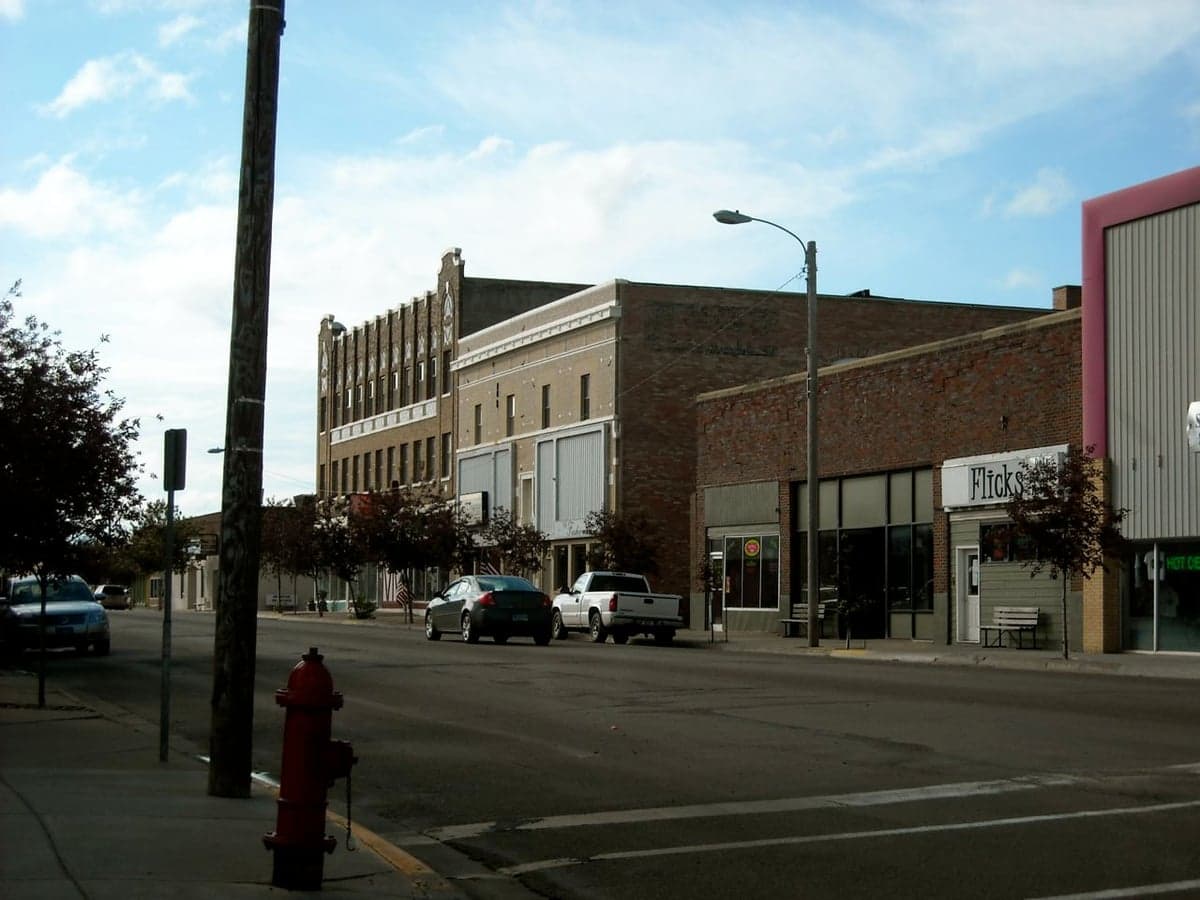
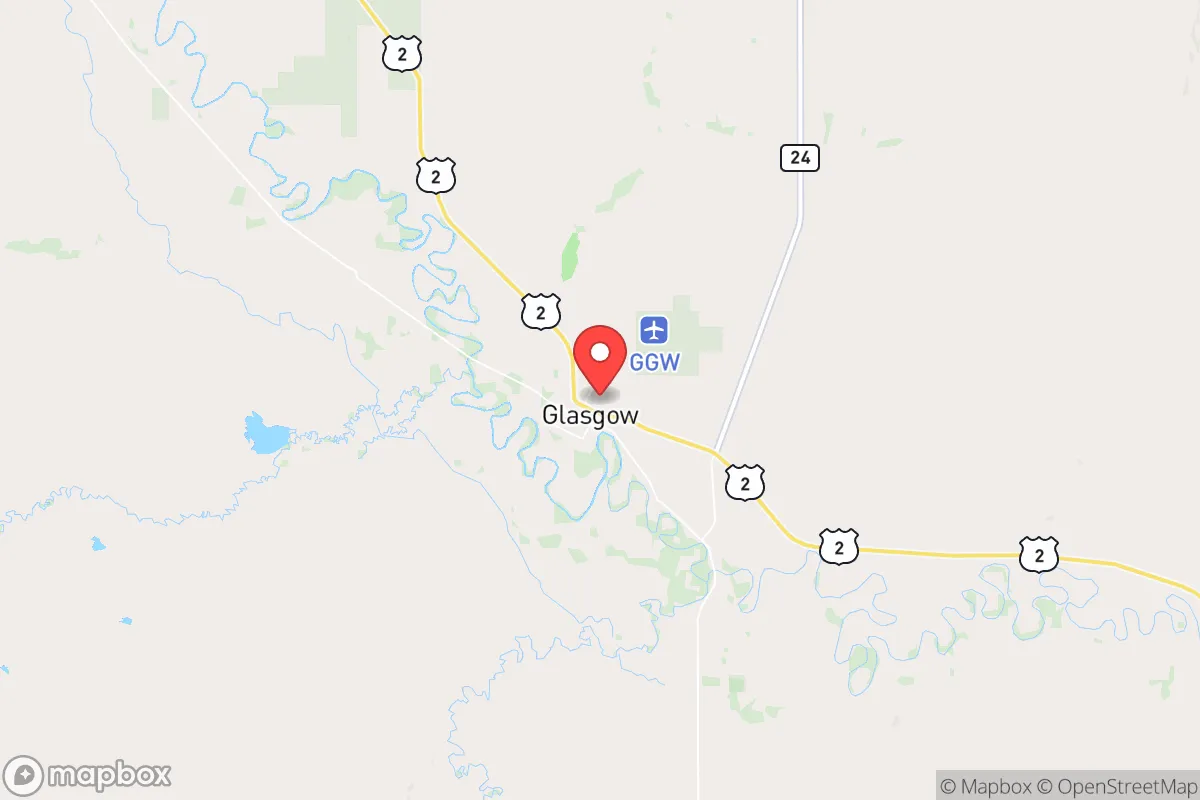
Photo: Wikipedia
Political ClimatePolitical Climate in Glasgow, MT
District shown is the primary district for this city’s centroid. Cities may span multiple districts.
Local Political AnalysisPolitical Analysis of Glasgow, MT
Glasgow, Montana, sits smack in the middle of a deep-red region, with a Cook PVI of R+15 that tells you all you need to know about the local political leanings. This isn't a place that's drifted left over the years; it's a community that has held the line, and for the most part, folks here still believe in personal responsibility, limited government, and the right to live your life without a bunch of bureaucratic nonsense getting in the way. You'll find a solid, no-nonsense conservative majority that votes its conscience, and that's been the case for as long as anyone can remember.
How it compares
Drive an hour or so west to Malta, and you'll find a similar vibe—another small town that votes red and keeps its nose clean. But head south to Billings, and you start to see a different picture. Billings is the big city, and like most big cities, it's got a lot more progressive noise, with folks pushing for higher taxes, more regulations, and the kind of social engineering that makes you shake your head. Glasgow is the opposite. It's a place where the local government still remembers that its job is to keep the streets safe and the water running, not to tell you how to run your life. The contrast is stark: Glasgow is a bastion of common sense in a state that's seeing some troubling shifts toward the left in its urban centers.
What this means for residents
For the people who live here, this political climate means a lot of freedom, plain and simple. You're not constantly looking over your shoulder for some new ordinance or mandate that tells you what you can and can't do with your property, your business, or your family. The tax burden is light compared to what you'd find in a place like Missoula or Bozeman, and the local school board isn't trying to push a radical agenda on your kids. You can own a gun without being treated like a criminal, and you can speak your mind without fear of being canceled. That's the kind of life that's getting harder to find, and it's why a lot of folks are starting to look at places like Glasgow as a refuge from the chaos in the rest of the country.
That said, you can't be complacent. There's a creeping influence from the state level, with Helena trying to impose more and more regulations on everything from land use to energy production. The fight to keep Glasgow's way of life intact is an ongoing one, and it requires staying informed and staying involved. The good news is that the community is tight-knit and willing to push back. The bad news is that the political winds are shifting, and if you're not careful, you could wake up one day and find that the freedoms you took for granted are gone. For now, though, Glasgow remains a place where conservative values aren't just tolerated—they're the norm. And that's something worth holding onto.

State Political ClimatePolitical Climate in Montana
State Political AnalysisPolitical Environment in the State
Montana has long been a reliably Republican state at the presidential level, voting for the GOP candidate in every election since 1992, but its political climate is far from monolithic. The state is currently defined by a deep urban-rural split, with a libertarian-leaning, pro-freedom streak that has recently clashed with a wave of progressive activism in its fastest-growing cities. Over the last 10-20 years, the state has shifted from a sleepy, reliably red outpost to a battleground over the very definition of "freedom," with the 2020 and 2024 cycles showing a hardening of partisan lines, especially as out-of-state transplants reshape the political landscape in places like Bozeman and Missoula.
Urban vs. rural divide
The political map of Montana is a study in contrasts. The western third of the state, dominated by the Rocky Mountains and the university towns of Missoula and Bozeman, is the engine of Democratic and progressive power. Missoula County, home to the University of Montana, has voted Democratic in every presidential election since 1992, often by double digits. Bozeman’s Gallatin County, once a conservative stronghold, has flipped dramatically in the last decade, voting for Joe Biden in 2020 and Kamala Harris in 2024, driven by an influx of wealthy, left-leaning tech workers and outdoor enthusiasts. In contrast, the eastern two-thirds of the state—the vast, sparsely populated plains and ranchlands—are deeply conservative. Counties like McCone, Garfield, and Petroleum routinely deliver 80-90% of their votes to Republicans. The state’s largest city, Billings (Yellowstone County), is a bellwether: it leans Republican but has a sizable moderate and business-friendly conservative base that can swing in close races. The state capital, Helena, is a political outlier—a small city with a strong government-worker and progressive activist presence that votes reliably blue, creating a constant tension with the rural, ranching-dominated legislature.
Policy environment
Montana’s policy environment is a mixed bag for conservatives. On the plus side, the state has no sales tax, a flat income tax rate of 5.9% (recently lowered from 6.9%), and a strong right-to-work law. The 2023 legislature passed a major property tax relief package, though rising home values have largely eaten those gains. The state’s regulatory posture is generally light, especially for agriculture and energy extraction, but the permitting process for new housing and businesses in growing areas like Bozeman and Missoula has become notoriously slow and expensive due to local government overreach. Education policy is a flashpoint: Montana has a robust school choice movement, with a new Education Savings Account (ESA) program passed in 2023, but it faces constant legal challenges from teachers’ unions. The state’s election laws are relatively secure—voter ID is required, and same-day registration is allowed but with proof of residency—though there have been no major controversies like in some other states. Healthcare is a concern: Montana expanded Medicaid under the Affordable Care Act, and the program is popular, but the state’s rural hospitals are struggling, and access to specialists is limited outside of Billings and Missoula.
Trajectory & freedom
The trajectory of personal freedom in Montana is a tale of two trends. On one hand, the state has been a national leader in expanding gun rights: in 2021, it passed a law allowing permitless concealed carry, and in 2023, it passed a "Second Amendment Preservation Act" that attempts to nullify federal gun laws. Property rights are generally strong, with a "right to farm" amendment in the state constitution, but local zoning battles in Bozeman and Missoula are increasingly pitting newcomers against longtime residents. On the other hand, the state has seen a concerning expansion of government overreach in the name of public health. During the COVID-19 pandemic, Governor Greg Gianforte (R) largely resisted lockdowns, but local health departments in Missoula and Gallatin counties imposed some of the most restrictive mask and vaccine mandates in the region. More recently, the 2023 legislature passed a law banning vaccine mandates by private employers, a clear win for medical freedom. Parental rights have been strengthened with a 2023 law requiring school districts to notify parents of any "sexually explicit" instructional materials, a direct response to the growing influence of progressive school boards in Bozeman and Missoula. The overall trend is positive for freedom, but the battle is being fought city by city.
Civil unrest & political movements
Montana has seen a noticeable uptick in organized political activism on both sides. The most visible flashpoint has been the debate over critical race theory and LGBTQ+ issues in schools. In 2022, a group of parents in Bozeman successfully recalled three school board members who had pushed for a radical diversity, equity, and inclusion (DEI) curriculum, a major victory for parental rights. On the left, the "Montana Women’s March" and "Indivisible" groups remain active, particularly in Missoula and Helena, organizing protests against the state’s abortion restrictions (a 2023 law bans abortion after 20 weeks). Immigration politics are relatively quiet, as Montana has a very small foreign-born population, but there have been localized tensions over the resettlement of refugees in Missoula and Billings. Election integrity has not been a major controversy, though the 2020 and 2024 results in Gallatin County were closely scrutinized due to the rapid demographic change. There is no serious secession or nullification movement, but the "Montana Freedom Caucus" in the state legislature has been a vocal force for pushing back against federal overreach, particularly on land management issues (the state is 30% federally owned).
Projection
Looking ahead 5-10 years, the political trajectory of Montana is precarious. The state is experiencing one of the fastest growth rates in the nation, driven by remote workers and retirees from California, Washington, and Oregon. These newcomers tend to be more moderate to liberal on social issues, and they are concentrated in the already-blue counties of Missoula, Gallatin, and Lewis and Clark (Helena). If this trend continues, the state could become a true swing state within a decade, with the potential for Democrats to win statewide races for governor or Senate. The 2024 election saw Republicans lose ground in the state house, and the margin in the governor’s race narrowed. For conservatives, the key battleground will be the state legislature, where rural districts still hold disproportionate power. The fight over land use, property rights, and local control will intensify, as newcomers demand more services and denser housing, while longtime residents resist. The state’s libertarian streak is strong, but it is being tested by the same cultural forces that have transformed Colorado and Oregon. Someone moving in now should expect a state that is still broadly conservative but increasingly contested, with the most significant political battles happening at the local level in the growing cities.
For a new resident, the bottom line is this: Montana offers a high degree of personal freedom on paper—low taxes, strong gun rights, and a culture of self-reliance—but the reality on the ground varies dramatically by location. If you move to a rural county like Ravalli or Carbon, you will find a deeply conservative, hands-off environment. If you settle in Bozeman or Missoula, you will encounter a rapidly progressive local government that is actively working to impose the same policies you may be trying to leave behind. The state’s political future is not yet written, but the battle lines are clear, and the outcome will depend on who shows up to vote in the next few election cycles. Choose your county carefully, and get involved in local politics—your freedom depends on it.
* Values derived from national, state, county, city and local statistics and may differ in a specific area. Last updated: 2026-04-30T01:05:10.000Z
Narrative content on this page is AI-generated and may contain mistakes. Verify any details that matter before acting on them.
ReloMaps may earn a commission from affiliate links at no extra cost to you.

