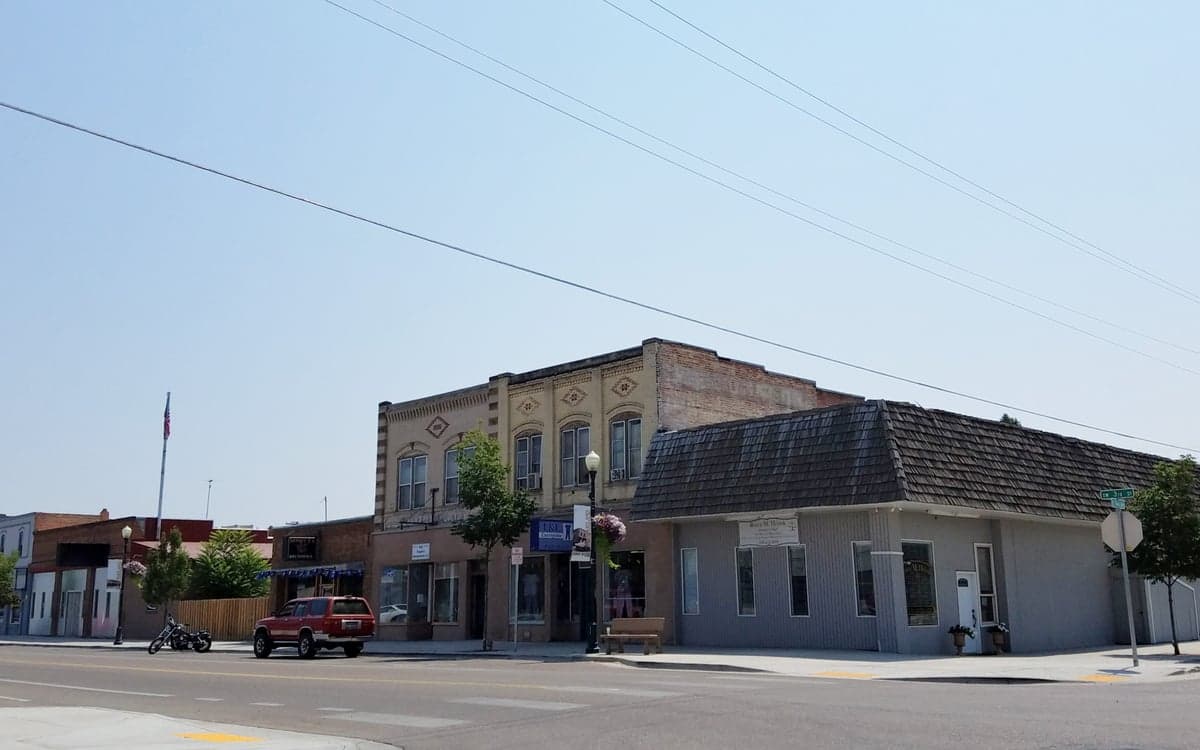
Photo: Wikipedia
Demographics of Fruitland, ID
Affluence Level in Fruitland, ID
A middle-class area roughly in line with national averages across income, home values, education, and employment.
People of Fruitland, ID
Fruitland, Idaho, is a small, predominantly white and Hispanic community of 6,405 residents, characterized by its agricultural roots and a strong sense of local identity. The city’s population is notably less diverse than the national average, with a foreign-born population of just 2.2% and a college attainment rate of 17.5%, reflecting a working-class, family-oriented character. Distinctive markers include a tight-knit, conservative social fabric and a population that has grown steadily but slowly, with most residents having deep generational ties to the area.
How the city was settled and grew
Fruitland’s human history begins with the arrival of Euro-American settlers in the late 19th century, drawn by the promise of irrigated farmland along the Snake River. The city’s name itself reflects its agricultural founding: early settlers planted orchards and vineyards, establishing a fruit-growing economy that would define the area for decades. The original population was almost entirely of Northern European descent—primarily English, German, and Scandinavian homesteaders—who built the first homes in what is now the Historic Downtown Fruitland district, centered around the original railroad depot. By the early 1900s, a second wave of settlers, including families of Irish and Italian origin, arrived to work the expanding fruit and sugar beet fields, settling in the North Fruitland neighborhood near the old sugar beet factory. The city incorporated in 1947, and through the mid-20th century, the population remained overwhelmingly white, with growth driven by agricultural expansion and the construction of the nearby Payette River irrigation projects.
Modern era (post-1965)
After the 1965 Immigration and Nationality Act, Fruitland saw minimal demographic change compared to larger Idaho cities. The foreign-born population remains very low at 2.2%, and the city did not experience the post-1965 waves of Asian or Indian immigration seen in Boise or Nampa. Instead, the most significant modern shift has been the growth of the Hispanic community, which now makes up 21.7% of the population. This growth began in the 1980s and 1990s, driven by agricultural labor demand in the surrounding orchards and packing plants. Hispanic families, primarily of Mexican descent, concentrated in the South Fruitland area, near the agricultural processing facilities, and in the Westside neighborhood, where more affordable housing stock developed. The white population, still the majority at 71.7%, remains concentrated in the older Historic Downtown and the newer Fruitland Heights subdivision, a suburban-style development built in the 2000s. The East/Southeast Asian population is very small at 1.3%, and the Indian subcontinent population is negligible at 0.2%, with no distinct ethnic enclaves. The Black population is recorded at 0.0%, reflecting the area’s historical homogeneity.
The future
Fruitland’s population is heading toward a slow but steady increase in Hispanic representation, while the white majority is likely to remain dominant for the foreseeable future. The Hispanic community is growing through natural increase and continued in-migration for agricultural work, but the city’s overall foreign-born rate (2.2%) suggests that most Hispanic residents are U.S.-born or long-term residents, not recent immigrants. The city is not tribalizing into distinct enclaves; rather, the South Fruitland and Westside neighborhoods are becoming more integrated as younger white families also move into those areas for affordable housing. The East/Southeast Asian and Indian populations are too small to project significant growth, and the Black population is expected to remain near zero. The college attainment rate of 17.5% is low, indicating that Fruitland is not attracting a knowledge-worker influx, and the population is likely to remain working-class and family-oriented. Over the next 10–20 years, the city will likely become slightly more Hispanic, but will retain its overall character as a predominantly white, agricultural community.
For someone moving in now, Fruitland offers a stable, conservative, and family-focused environment where the population is slowly diversifying along Hispanic lines, but remains overwhelmingly white and native-born. The city is not a destination for international migration or urban professionals; it is a place where agricultural roots still define daily life, and where new residents will find a community that values continuity over rapid change.

* Values derived from national, state, county, city and local statistics and may differ in a specific area. Last updated: 2026-05-03T04:44:57.000Z
Narrative content on this page is AI-generated and may contain mistakes. Verify any details that matter before acting on them.
ReloMaps may earn a commission from affiliate links at no extra cost to you.

